


Pedal-Operated Containers for Recycling Applications
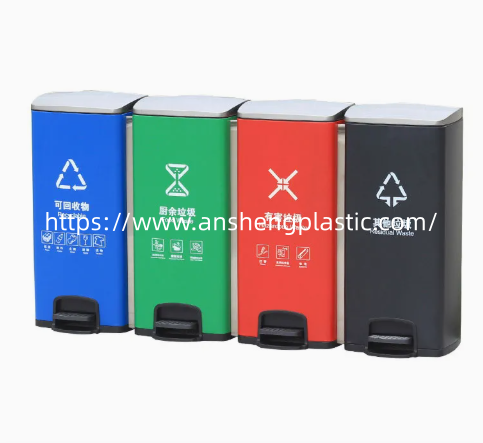
Organized waste separation is an important part of modern waste management, particularly in homes, offices, restaurants, hotels, and public facilities where different types of refuse need to be collected separately. A Recycling Pedal Bin provides a convenient solution by combining a foot-operated opening mechanism with a container designed for everyday waste collection. Its hands-free operating method can make disposal more convenient, while the covered design helps keep collected waste out of direct view. For distributors and purchasing professionals, understanding the product structure, operating mechanism, and intended application helps determine which models are suitable for different customer groups.
A pedal bin generally consists of a plastic container body, a lid, a foot pedal, and a mechanical linkage connecting the pedal to the lid. When the user presses the pedal, the mechanism lifts the lid and creates an opening for waste disposal. Releasing the pedal allows the lid to return to its closed position. Depending on the design, the mechanism may use connecting rods, pivot points, springs, or other mechanical components. The actual construction varies between models, so buyers should examine the operating structure when comparing different products.
The main advantage of pedal-operated containers is that users can open the lid without touching it directly with their hands. This feature is useful in kitchens, food preparation areas, bathrooms, offices, and other environments where convenient waste disposal is important. It can also help reduce direct contact with frequently handled lid surfaces. However, a pedal mechanism does not replace regular cleaning or appropriate hygiene practices. The container itself still requires routine maintenance according to the conditions in which it is used.
Plastic is a common material for the main body of this product category because it offers flexibility in design and relatively convenient handling. Polypropylene and polyethylene are frequently used thermoplastics in plastic container production. Their characteristics differ, and the appropriate choice depends on the required product structure, expected loading conditions, and manufacturing process. Buyers should verify the actual material specifications of each model, particularly when purchasing products intended for frequent commercial use.
The container body should provide sufficient stability during normal operation. When a user presses the pedal, the force applied to the mechanism should not cause the entire unit to move excessively or become unstable. A suitably designed base, appropriate proportions, and balanced weight distribution can contribute to more convenient operation. Buyers evaluating samples should check whether the container remains stable on a flat surface and whether the pedal can be operated without requiring excessive force.
Lid construction is another important factor. A properly fitted cover should open sufficiently for convenient disposal and return to its intended closed position after use. The opening angle, lid weight, connection points, and mechanical movement can influence the overall user experience. If the lid does not move smoothly or closes inconsistently, everyday operation may become inconvenient. For this reason, purchasing teams should inspect both the appearance and basic functionality of the mechanism before confirming larger orders.
Capacity selection depends on the volume and type of waste generated in the intended environment. Small pedal bins are often suitable for bathrooms, bedrooms, and individual workstations. Medium-sized models may be more appropriate for kitchens, offices, and shared indoor spaces. Larger containers can serve commercial areas where waste collection needs are greater. Buyers should consider not only the stated capacity but also the product's external dimensions, opening size, and available installation space.
Recycling applications introduce additional considerations. Facilities may use separate containers for paper, plastic packaging, metal cans, food waste, or general refuse. Different colors and identification labels can help users distinguish the intended waste categories. However, recycling practices vary between countries, municipalities, and individual organizations. A distributor supplying international markets should therefore avoid assuming that one color system is universally applicable. Product colors, labels, and sorting instructions should match the requirements of the destination market.
The lid configuration also affects cleaning and maintenance. Removable components may make it easier to access areas around the opening and remove collected residue. Smooth interior surfaces can simplify routine washing, while detachable lids can improve access during cleaning if the design supports safe removal and reinstallation. The pedal and linkage should also be checked periodically for loose connections, dirt accumulation, or visible wear. Any maintenance procedure should follow the product's actual construction and applicable cleaning recommendations.
For distributors, product consistency is an important factor when purchasing pedal-operated containers in volume. Buyers should confirm dimensions, colors, material specifications, lid compatibility, and packaging arrangements before production. Sample evaluation can help identify differences in pedal movement, lid alignment, surface finish, and overall stability. If the products are intended for retail sales, packaging appearance and product identification may also influence the purchasing decision of end customers.
Transportation and storage should be considered when selecting different product sizes. Large containers can occupy significant warehouse and shipping space, while compact models may be easier to organize in mixed product shipments. Where the design permits nesting, this feature may help improve storage efficiency. Buyers should confirm whether nesting affects the shape, finish, or condition of the product during extended storage and transportation.
When sourcing Recycling Pedal Bin products for different customer groups, purchasing teams should compare the complete design rather than focusing exclusively on the pedal mechanism. Capacity, material, stability, lid performance, ease of cleaning, and compatibility with local recycling practices all influence product suitability. Businesses developing their plastic waste collection ranges can explore product information and available options at https://www.anshengplastic.com/ to support further supplier evaluation and procurement planning.
- Technology for Students
- Admissions & Applications
- Online Courses
- Career and Jobs
- Campus Life
- Drinks
- Film
- Fitness
- Food
- Games
- Gardening
- Health
- Home
- Literature
- Music
- Networking For Students
- Insights
- Party
- Religion
- Shopping
- Sports
- Theater
- Wellness
- Education News
- Business & Finance For Students
- Security, Law & Crime Education
- Insurance
- Science & Technology For Students
 English
 Arabic
 French
 Spanish
 Portuguese
 Deutsch
 Turkish
 Dutch
 Italiano
 Russian
 Romaian
 Portuguese (Brazil)
 Greek