


Leveraging MCA Master Data for Corporate Due Diligence and Credit Risk Assessment
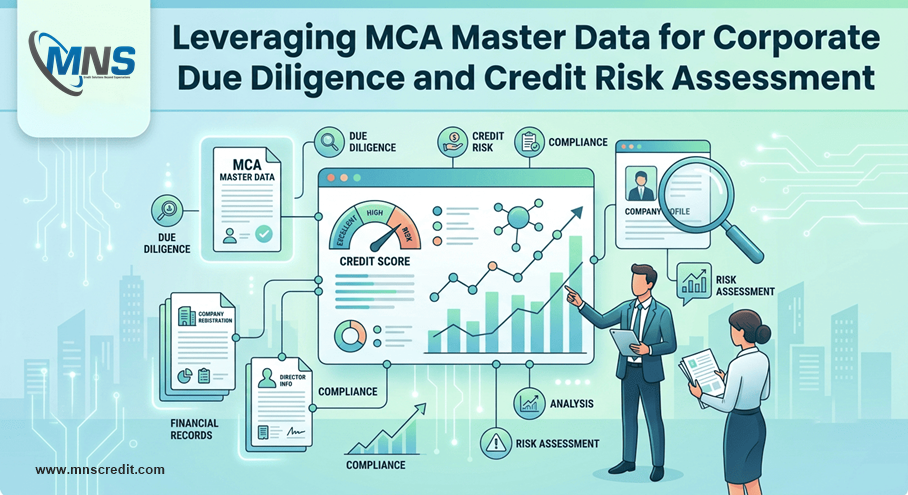
Corporate due diligence and credit risk assessment both rest on the same basic requirement: knowing, with certainty, who you are dealing with before you decide how much trust — and how much money — to extend. In India, that certainty starts with MCA Master Data, the official registry of company information maintained by the Ministry of Corporate Affairs. For credit teams, lenders, and investors, it is not simply a compliance formality. It is a data source that, read properly, tells a surprisingly detailed story about a company's stability, governance, and repayment capacity long before a credit committee ever sees a proposal.
Why MCA Master Data Belongs at the Center of Due Diligence
Unlike self-reported financials or promotional materials, MCA Master Data is filed under statutory obligation and carries legal consequences for inaccuracy. That makes it one of the few sources in a due diligence file that is genuinely independent of the counterparty's own narrative. It anchors the identity check — confirming CIN, legal name, incorporation date, and registered office — and then extends into governance signals: who the directors are, how many other companies they are linked to, whether the company has kept its statutory filings current, and what charges exist against its assets. MNS goes beyond standard MCA company search results to provide structured, verified, and risk-assessed reports that convert this raw registry information into something a credit or risk team can actually act on.
Reading MCA Data Through a Credit Lens
A credit analyst and a compliance officer look at the same MCA record but ask different questions of it. For credit risk purposes, the fields that matter most are:
● Charges and their status — Open charges reveal existing secured borrowing. A pattern of charges created and satisfied on schedule suggests a functioning, disciplined borrower. Charges that remain open long past a normal loan tenure, or a sudden spike in new charges, both warrant closer review.
● Paid-up capital versus scale of operations — A mismatch between thin paid-up capital and a company claiming large turnover figures is a classic early indicator of thin equity cushioning and higher leverage risk.
● Filing consistency — Annual returns and financial statements filed on time, year after year, indicate a management team that treats compliance seriously. Gaps or consistent late filing often precede visible financial distress by a year or more.
● Director history and network — Directors connected to companies that have gone dormant, been struck off, or faced disqualification carry reputational and governance risk that a purely financial-statement review would miss.
● Corporate structure changes — Frequent changes in registered office, director turnover, or shifts in authorized capital can indicate restructuring, distress, or, in some cases, an attempt to distance the entity from past obligations.
Integrating MCA Data Into the Due Diligence Workflow
A disciplined process typically follows this sequence: first, confirm the entity's legal identity and current status through MCA Master Data. Second, pull the director and charge history to build a governance and leverage profile. Third, cross-reference filed financial statements against the counterparty's own representations — inconsistencies here are often the first sign of aggressive or misleading self-reporting. Fourth, layer in external checks such as litigation history, banking references, and trade credit reports. Finally, translate all of this into a documented risk rating rather than a simple pass/fail decision, since most counterparties fall somewhere between clearly safe and clearly high-risk.
From Registry Data to a Credit Decision
Registry data alone does not produce a credit score, but it materially improves the quality of one. A company with an active status, timely filings, a clean director profile, and proportionate charge activity supports a stronger credit case even before financial ratios are calculated. Conversely, red flags at the MCA level — dormant status, disqualified directors, unexplained capital mismatches — should trigger enhanced scrutiny regardless of how favorable the submitted financials look, because those financials may themselves be part of the misrepresentation. This is where structured credit assessment, which evaluates financial health, repayment ability, and qualitative factors together, becomes more reliable when it is grounded in independently verified registry data rather than counterparty-supplied documents alone.
Why This Matters More for Trade Credit and SME Lending
Large, listed borrowers are typically covered by rating agencies, audited financials, and public disclosure requirements. The real gap sits with SMEs, private limited companies, and newer trade counterparties, where financial statements may be unaudited, informally prepared, or simply unavailable at the point a credit decision needs to be made. For this segment, MCA Master Data is often the single most reliable, independently sourced data point available — making it disproportionately valuable exactly where credit risk visibility is otherwise weakest.
Middle East and Cross-Border Considerations
For companies extending credit to counterparties operating between India and the Middle East, the same underlying discipline applies through CBUAE, DIFC, and ADGM commercial registries, supported by FATF and MENAFATF-aligned screening standards. Building a credit view that spans both markets means treating registry verification as step one in every jurisdiction, not an optional extra reserved for larger exposures.
Turning Registry Data Into a Repeatable Scoring Model
Ad hoc reviews of MCA data produce inconsistent decisions — one analyst may treat a two-year filing gap as disqualifying, another may wave it through if the counterparty offers a plausible explanation. A more defensible approach converts the same fields into a weighted scoring model: status, filing timeliness, charge history, director quality, and capital adequacy each contribute points toward an overall risk band, with clear thresholds for approval, conditional approval, or decline. This doesn't remove judgment entirely, but it ensures that two similar counterparties are treated similarly, and it gives a credit committee a consistent basis for comparing exposures across a portfolio rather than relying on each reviewer's individual read of the same registry facts.
Monitoring After the Credit Decision Is Made
A credit decision based on MCA data at a single point in time has a shelf life. Filing status, director composition, and charge activity can all shift materially within a year, and a borrower approved on strong registry signals can deteriorate long before that shows up in a missed payment. Periodic re-verification — particularly for larger exposures or longer credit tenures — closes this gap, allowing a lender or credit team to tighten terms, request additional security, or reduce exposure at the first sign of registry-level deterioration, rather than waiting for a payment default to confirm what the data had already begun to suggest.
Conclusion
MCA Master Data was designed as a compliance and transparency tool, but in the hands of a credit or due diligence team, it functions as an early warning system. It surfaces governance issues, leverage patterns, and compliance discipline that financial statements alone often miss or delay revealing. Lenders, investors, and credit managers who build MCA verification into the front end of their due diligence process, convert it into a consistent scoring model, and continue monitoring it after approval — rather than treating it as a one-time, box-ticking exercise — consistently catch risk earlier, price it more accurately, and avoid the counterparties that were never going to be reliable in the first place.
- Technology for Students
- Admissions & Applications
- Online Courses
- Career and Jobs
- Campus Life
- Drinks
- Film
- Fitness
- Food
- Oyunlar
- Gardening
- Health
- Home
- Literature
- Music
- Networking For Students
- Insights
- Party
- Religion
- Shopping
- Sports
- Theater
- Wellness
- Education News
- Business & Finance For Students
- Security, Law & Crime Education
- Insurance
- Science & Technology For Students
 Turkish
 English
 Arabic
 French
 Spanish
 Portuguese
 Deutsch
 Dutch
Dutch
 Italiano
 Russian
 Romaian
 Portuguese (Brazil)
 Greek
Greek