


Scrap Silver Calculator: How Much Is Your Silver Worth?
Introduction
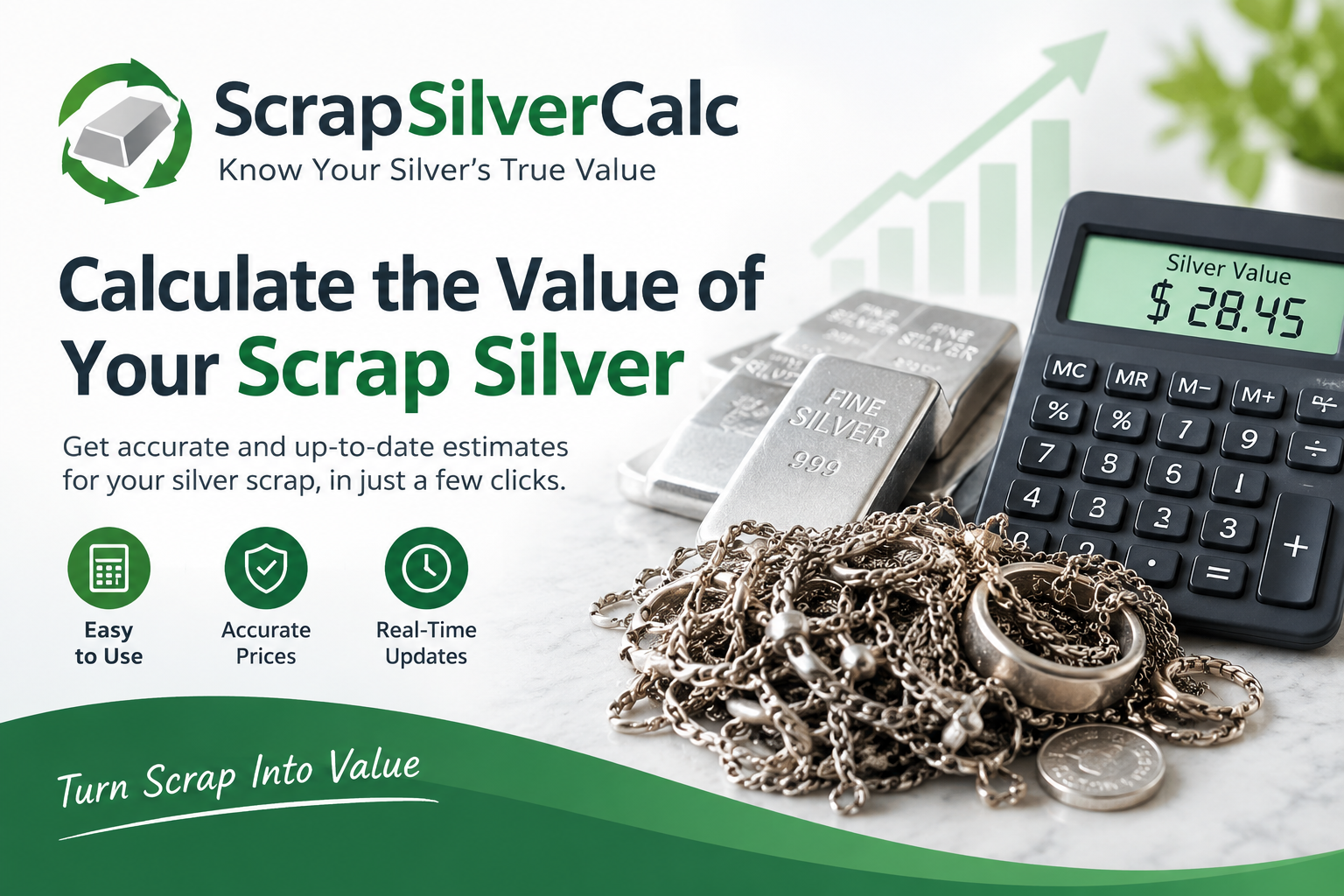
You've got a few odd pieces of silver sitting in a drawer, and you'd like to know whether they're worth a few dollars or a few hundred. A scrap silver calculator settles that quickly. You enter the weight, pick the purity, and it applies the live market price. ScrapSilverCalc offers it free, in nine currencies, with no signup. Here's how to get a number you can trust, and how to read it once you have it.
The Short Answer: Weight, Purity, Price
Every silver valuation comes down to three inputs, and you control two of them. The weight comes from your scale. The purity comes from the stamp on your piece. The third, the price, moves all day on global markets, which is why the calculator pulls the live silver spot price, quoted per troy ounce in US dollars. Get those three right and the rest is arithmetic.
The tool keeps the process light. Type your weight and choose a unit from ten options, including grams, troy ounces, pennyweights, and tola. Pick a purity from the dropdown, or enter a custom percentage for anything unusual. Set your currency and hit Calculate. You'll see a melt figure and a realistic payout, and it updates as you change any field. There are also quick presets for coins like Morgan dollars and Silver Eagles that fill in the details for you.
A Worked Example With Real Numbers
Abstract formulas only help so much, so let's put actual figures through it. Imagine you've collected 100 grams of broken sterling jewelry and old spoons, and you want to know what it's worth before calling a buyer. The example below uses a $75 per ounce spot price. That's only an illustration, since your live number will differ, but the method is identical every time.
Start by converting grams to troy ounces: 100 divided by 31.1035. Multiply by the sterling purity of 0.925, then by $75. That gives you $223.05 of melt value. Now suppose your refiner charges 10 percent. Subtract $22.31 and you're left with roughly $200.75 in your pocket. Notice how the buyer's cut matters almost as much as the metal itself, which is why it's smart to know the number before the conversation starts. If you swap in coin silver at .900, the same 100 grams comes to $217.03 melt.
Melt Value or Scrap Value: Which Number Do You Need?
These two terms get used interchangeably, and that's where the confusion starts. They answer different questions, and picking the wrong one leads to unrealistic expectations. One tells you what your metal is theoretically worth. The other tells you what a buyer will realistically hand over. Which one matters depends entirely on whether you're tracking silver or selling it.
Silver melt value is the worth of the pure silver in your item at spot, the maximum before any fees. Scrap value is that figure minus the refiner's fee, typically 5 to 15 percent. Collectors and stackers who just want to track their holdings should watch melt. Sellers should watch scrap, because it's what actually lands in your hand.
The calculator lets you flip between the two modes and adjust the fee to match your dealer. Remember that collector premiums, taxes, and shipping aren't included, and real offers can land 5 to 15 percent away from any estimate.
Reading Your Silver's Purity
Purity is the single biggest factor you control, and it's printed right on most pieces. Because pure silver is soft, nearly everything is an alloy, mixed with copper or another metal for strength. The percentage of actual silver in that mix is called fineness. A small difference in the stamp makes a visible difference in the payout, so it's worth reading carefully rather than guessing.
Sterling silver is .925, found in most jewelry, flatware, and holloware, often stamped 925 or STER. Fine silver at .999 appears on bullion bars and American Silver Eagles. Coin silver at .900 covers US dimes, quarters, halves, and dollars made before the Coinage Act of 1965.
Those pre-1965 coins are often called junk silver, which only means worn and without collector premium. European pieces turn up at .835 or .800, and the dropdown also handles .9999, .958 Britannia, and gold-filled items.
Weights, Units, and the Troy Ounce Trap
If a valuation looks off, the unit is usually the culprit. Silver is priced per troy ounce worldwide, but weighed in grams for jewelry, pounds for bulk lots, pennyweights by refiners, and tola across South Asia. Mix them up and your expected value can swing by as much as 21 percent. The calculator converts everything automatically, yet it still helps to understand the one mistake that catches almost everyone.
A regular ounce is 28.35 grams, while a troy ounce is 31.1035 grams. They aren't interchangeable, and silver always uses troy. Pounds split the same way. An everyday pound holds about 14.58 troy ounces, around $1,093 of fine silver at a $75 spot. A troy pound holds exactly 12, closer to $900. Most people mean the regular one, so ask your buyer which they're quoting. For reference, a tola is 11.664 grams.
Confirm It's Real Before You Count on It
A calculator can only be as honest as its inputs. If the piece isn't solid silver, the result is fiction, however carefully you weigh it. Before you spend time on numbers, spend a minute on identification. It's boring work, but it prevents the worst moment in selling silver, which is discovering at the counter that your "silver" was plated.
Look for hallmarks first. Sterling is stamped 925, STER, or STERLING. Fine silver shows .999 or FINE, and European pieces may carry 800, 835, or 958 with national marks. Be wary of EPNS, A1, or Silver Plate, which mean base metal under a hair-thin coating with almost no melt value. Then try a strong magnet. Real silver isn't magnetic, so if it sticks, it isn't pure silver. In the US, the FTC's rule on silver content draws the line between genuine alloys and plating.
Selling Without Leaving Money Behind
Knowing your number is half the job. The other half is choosing the right buyer, because nobody pays full melt. Every buyer keeps a margin, and the margins differ a lot. The trade is always payout against speed and convenience, so the best choice depends on how much silver you have and how patient you're willing to be.
Refiners typically pay 85 to 95 percent of melt, ideal for lots of five troy ounces or more, though you'll need to ship. Coin and bullion dealers pay 92 to 98 percent for recognized items like Silver Eagles, bars, and junk silver. Local jewelers offer 60 to 85 percent, depending on the relationship.
Pawn shops pay 50 to 75 percent but give you instant cash. Online marketplaces can beat melt for collectibles, though eBay fees run near 13 percent and shipping is yours. Get at least two quotes, and bring your calculated number with you.
Frequently Asked Questions
How do I calculate the value of scrap silver?
Multiply the weight in troy ounces by the purity as a decimal, then by the spot price. For scrap value, subtract the refiner fee. The calculator handles all of it automatically.
Why does the silver price change so often?
Silver trades around the clock on global markets, including COMEX in New York, London, Tokyo, and Shanghai. Daily moves of 1 to 3 percent are normal. Industrial demand, investment flows, inflation news, and dollar strength all play a part, so refresh before finalizing a sale.
How much is one troy ounce of silver worth?
Pure .999 silver is worth the full spot price. Sterling is worth 92.5 percent of it, and .900 coin silver is worth 90 percent.
Does silver-plated jewelry have any value?
Almost none. The silver layer is too thin to recover economically, and marks like EPNS or Triple Plate mean it isn't solid silver.
Can I use this for coins and bullion?
Yes. The presets cover Morgan dollars, Walking Liberty halves, Silver Eagles, Maple Leafs, and one-ounce bars. Collectible coins may sell above melt, so the result shows the metal-value floor.
How accurate is it?
The formula is exact. Your accuracy depends on your inputs, so use a jeweler's scale that reads to 0.01 gram, since kitchen scales aren't precise enough, and verify your hallmarks first.
Conclusion
So, how much is your silver worth? Whatever the weight, the purity, and the live price multiply out to, minus whatever your buyer keeps. That's the whole story.
Weigh carefully, read the stamp, keep troy and regular ounces straight, and decide whether you want the melt number or the scrap number. Then compare a couple of offers against your own figure. Silver stops feeling mysterious the moment you've done the math yourself.
- Technology for Students
- Admissions & Applications
- Online Courses
- Career and Jobs
- Campus Life
- Drinks
- Film
- Fitness
- Food
- Игры
- Gardening
- Health
- Главная
- Literature
- Music
- Networking For Students
- Insights
- Party
- Religion
- Shopping
- Sports
- Theater
- Wellness
- Education News
- Business & Finance For Students
- Security, Law & Crime Education
- Insurance
- Science & Technology For Students
 Russian
 English
 Arabic
 French
 Spanish
 Portuguese
 Deutsch
 Turkish
 Dutch
 Italiano
 Romaian
 Portuguese (Brazil)
 Greek