


10 Essential Cutting Tools Every CNC Machine Shop Should Have
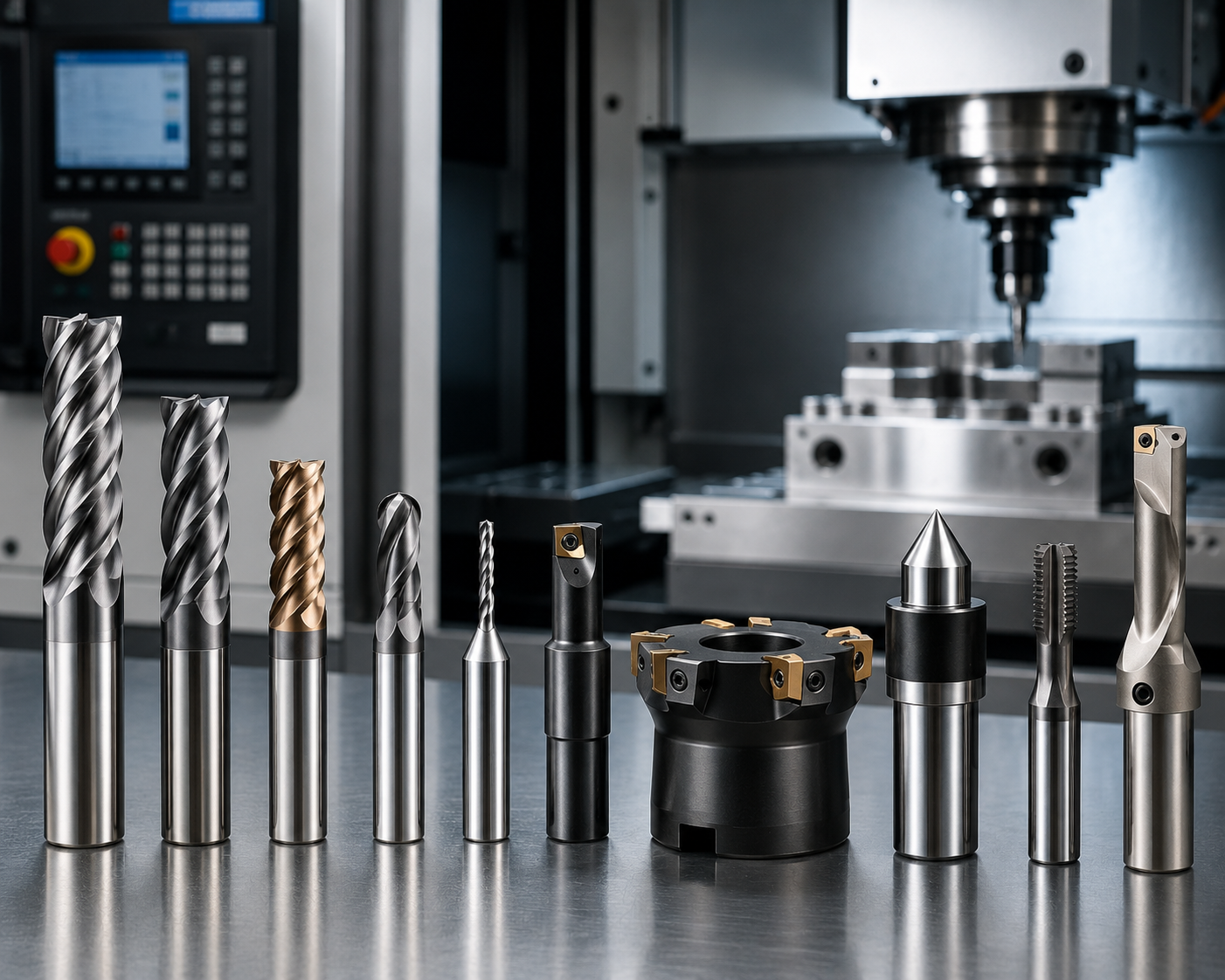
A successful CNC machine shop depends on having the right tools for every stage of the machining process. From removing large amounts of material to creating precise holes, threads, slots, and finished surfaces, cutting tools play a critical role in productivity and part quality.
The right tooling can help machinists achieve consistent dimensions, improve surface finishes, reduce tool changes, and maintain efficient production. While every shop has different requirements, there are several essential tools that form the foundation of a well-equipped CNC machining operation.
1. Carbide End Mills
Carbide end mills are among the most versatile tools used in CNC milling. They can perform operations such as slotting, pocketing, profiling, contouring, and finishing.
End mills are available in different diameters, flute counts, geometries, and coatings. Two and three flute designs can provide efficient chip evacuation for certain materials, while four flute and higher flute configurations can offer additional cutting edges for appropriate applications.
Selecting the correct end mill based on the workpiece material and machining operation can improve tool life and cutting performance.
2. CNC Drills
Drills are essential for producing holes in machined components. CNC machine shops may use different drill types depending on the material, hole diameter, depth, and required accuracy.
Carbide drills can provide excellent wear resistance and are suitable for demanding applications when used with appropriate cutting parameters. Choosing the right drill geometry and maintaining proper spindle speed and feed rate can help produce clean, consistent holes.
3. Carbide Inserts
Carbide inserts are widely used for machining operations where replaceable cutting edges provide practical and economical performance. Inserts can be used in turning, milling, and other applications depending on their design.
Different insert shapes, grades, coatings, and geometries are available for specific materials and operations. Roughing applications may require a different insert configuration than finishing operations.
Using the correct insert can help control cutting forces, improve surface quality, and extend tool life.
4. Taps
Taps are designed to create internal threads in drilled holes. They are essential when machined components require threaded holes for fasteners or assembly.
Different tap configurations are designed for different materials, thread specifications, and machining conditions. Proper hole diameter, lubrication, cutting speed, and tap selection all contribute to thread quality.
For CNC applications, machinists should also consider the specific requirements of the machine and threading process before selecting a tap.
5. Reamers
Reamers are precision tools designed to improve the dimensional accuracy and surface finish of existing holes. Unlike drills, which are primarily used to create holes, reamers remove a smaller amount of material to refine an already prepared opening.
They are particularly useful when a component requires a more controlled hole diameter or improved internal surface finish.
Proper hole preparation and cutting parameters are essential for achieving consistent reaming results.
6. Thread Mills
Thread mills produce threads using a milling process rather than traditional tapping. They can be useful for CNC machining applications that require flexibility and controlled thread production.
Thread milling can be particularly useful for larger thread sizes, specialized materials, and applications where CNC control over the threading process is beneficial.
Because the process is controlled through programmed tool movement, machinists can carefully manage cutting conditions and thread geometry.
7. Face Mills
Face mills are designed to machine broad, relatively flat surfaces efficiently. Their multiple cutting edges allow material to be removed across a larger area compared with smaller milling tools.
Face milling is commonly used during initial material removal and surface preparation. The appropriate face mill depends on factors such as machine horsepower, spindle capability, workpiece material, depth of cut, and required surface finish.
Indexable face mills can also provide practical advantages because individual cutting edges can be replaced when they become worn.
8. Ball Nose End Mills
Ball nose end mills feature a rounded cutting tip and are commonly used for three-dimensional machining. They are particularly useful for curved surfaces, contours, molds, dies, and components with complex geometries.
The rounded cutting profile allows the tool to follow curved surfaces while maintaining controlled contact with the workpiece.
Tool diameter, flute configuration, machining parameters, and material should all be considered when selecting a ball nose end mill.
9. Chamfer Mills
Chamfer mills are used to create angled edges and remove sharp corners from machined components. Chamfering can improve the appearance of a finished part while making edges safer to handle.
These tools can also be used to prepare components for assembly or create specific design features.
Selecting the correct chamfer angle and tool diameter helps ensure that the required edge profile can be produced consistently.
10. Slotting Cutters
Slotting cutters are designed specifically for creating slots, grooves, and other narrow features. Depending on the design, they can be used for keyways and specialized machining applications.
The correct slotting cutter should be selected based on the required slot width, depth, material, and machine capabilities. Proper chip evacuation is especially important when machining deep or narrow slots.
Choosing the Right Precision Cutting Tools
Having a selection of cutting tools is important, but choosing the right tool for each application is even more important. Material type, tool diameter, flute count, cutting speed, feed rate, depth of cut, machine rigidity, and coolant conditions can all influence performance.
Using suitable precision cutting tools can help manufacturers maintain dimensional accuracy and achieve repeatable machining results. However, even high-quality tooling needs to be matched with appropriate machining parameters and a stable setup.
Tool condition should also be monitored throughout production. Excessive wear, unusual cutting sounds, poor surface finish, or dimensional changes can indicate that a tool needs adjustment or replacement.
The Importance of Precision Measurement
Cutting tools produce the finished component, but measuring equipment confirms whether the component meets its specifications. CNC machine shops commonly use micrometers, indicators, bore gauges, and calipers as part of their inspection processes.
For general dimensional checks, starret calipers can be used alongside more specialized precision measuring instruments. Matching the measuring instrument to the required tolerance helps ensure that inspection results are reliable and repeatable.
Keeping cutting and measurement processes closely connected allows machinists to identify potential problems earlier and maintain consistent production quality.
Building an Effective Tool Inventory
A CNC machine shop does not necessarily need every available tool configuration. Instead, the tooling inventory should reflect the materials, components, and machining operations performed most frequently.
Maintaining commonly used end mills, drills, inserts, taps, reamers, face mills, and specialty cutters can reduce production interruptions and minimize unnecessary setup delays. As machining requirements expand, specialized tools can be added to the inventory.
At Cutting Tool Solutions, selecting the appropriate tooling starts with understanding the machining application. A well-planned tool inventory can make it easier for machinists to respond to different production requirements while maintaining efficient workflows.
Final Thoughts
The right cutting tools form the foundation of an efficient CNC machine shop. End mills, drills, inserts, taps, reamers, thread mills, face mills, ball nose end mills, chamfer mills, and slotting cutters each serve specific purposes across modern machining operations.
The goal is not simply to maintain a large inventory. It is to have dependable tools that match the materials, machines, tolerances, and operations your shop handles regularly.
At Cutting Tool Solutions, the focus is on helping machining professionals find tooling suited to their specific requirements. By combining appropriate precision cutting tools with proper machining parameters, reliable measurement practices, and regular tool maintenance, CNC machine shops can improve productivity, extend tool life, and achieve consistent finished-part quality.
- Technology for Students
- Admissions & Applications
- Online Courses
- Career and Jobs
- Campus Life
- Drinks
- Film
- Fitness
- Food
- Oyunlar
- Gardening
- Health
- Home
- Literature
- Music
- Networking For Students
- Insights
- Party
- Religion
- Shopping
- Sports
- Theater
- Wellness
- Education News
- Business & Finance For Students
- Security, Law & Crime Education
- Insurance
- Science & Technology For Students
 Turkish
 English
 Arabic
 French
 Spanish
 Portuguese
 Deutsch
 Dutch
Dutch
 Italiano
 Russian
 Romaian
 Portuguese (Brazil)
 Greek
Greek