


CNC Prototyping: How It Helps Turn Product Ideas Into Reality
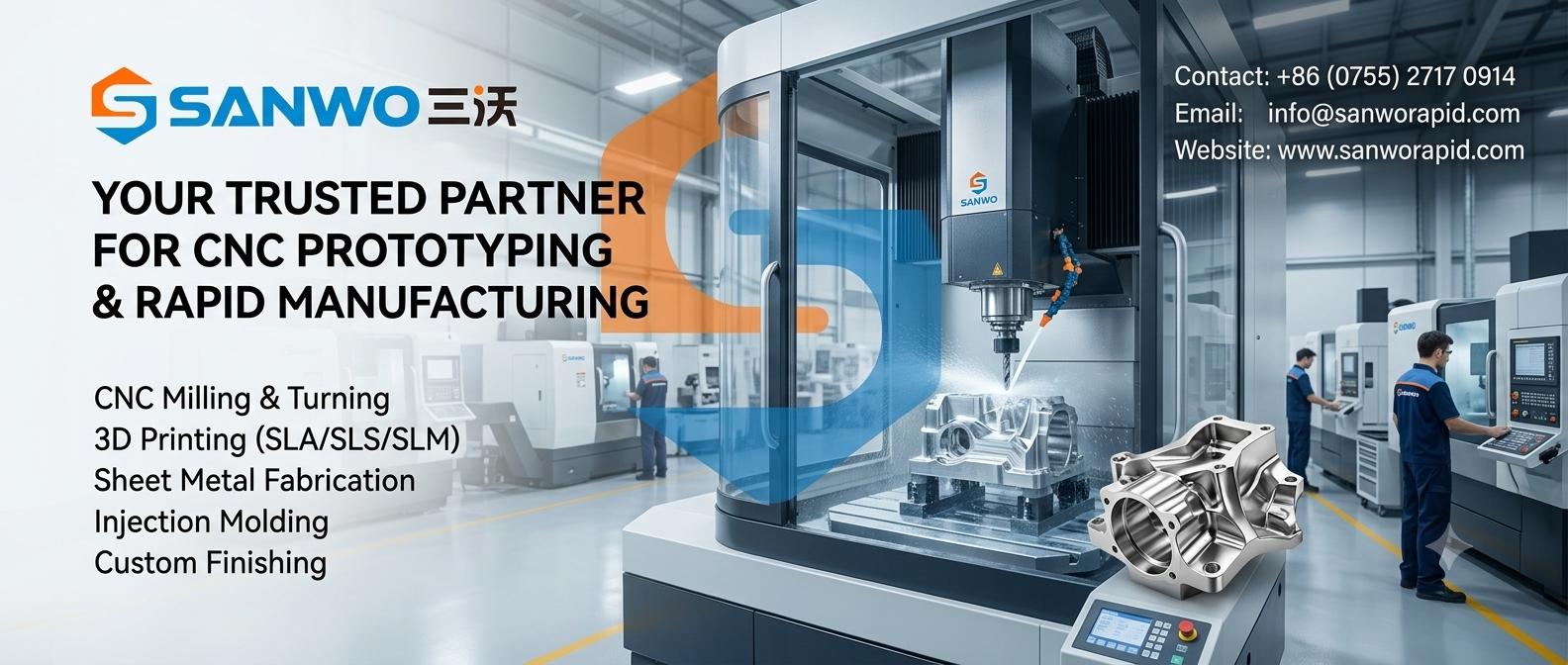
Bringing a new product to market involves much more than creating a great idea. Before a product reaches mass production, designers and engineers need to test its shape, fit, performance, strength, and functionality. This is where CNC prototyping plays an important role.
CNC machining allows manufacturers to transform a digital CAD design into a physical prototype with high accuracy and consistency. From aluminum housings and automotive components to medical devices and robotics parts, CNC prototypes help companies identify design problems early and make better decisions before investing in expensive production tooling.
For businesses looking for reliable prototype manufacturing, SanwoRapid provides CNC machining and rapid manufacturing solutions designed to support projects from initial concept through production.
What Is CNC Prototyping?
CNC prototyping is a manufacturing process in which computer-controlled machines produce physical parts directly from digital CAD designs. Depending on the component, manufacturers can use CNC milling, CNC turning, drilling, or multi-axis machining to create the required geometry.
Unlike some rapid prototyping methods that primarily focus on appearance, CNC machining can produce prototypes using production-grade materials. This makes the resulting parts suitable for functional testing, assembly checks, dimensional inspection, and real-world evaluation.
For example, imagine an engineer designing an aluminum enclosure for an electronic device. Instead of moving directly from a CAD model to mass production, the company can manufacture several CNC prototypes first. These prototypes can be assembled with internal components, tested for fit, evaluated for heat management, and modified if necessary.
That extra testing can prevent expensive mistakes later.
Why Is CNC Prototyping Important?
Product development rarely happens perfectly on the first attempt. A design that looks correct on a computer screen may reveal unexpected problems when it becomes a physical part.
A prototype gives engineers something tangible to evaluate.
With CNC prototyping, teams can discover issues such as incorrect dimensions, poor component fit, insufficient wall thickness, difficult assembly, or inadequate mechanical performance before entering full-scale production.
Some of the main benefits include:
-
High dimensional accuracy
-
Consistent and repeatable production
-
Functional prototypes made from real materials
-
Faster design validation
-
Wide material selection
-
Suitable for complex components
-
Useful for low-volume manufacturing
-
Compatibility with various surface finishes
This makes CNC machining particularly valuable for products where performance matters as much as appearance.
CNC Prototyping Materials: What Can You Machine?
One of the biggest advantages of CNC machining is the variety of materials available.
Aluminum
Aluminum is widely used for prototypes because it is lightweight, strong, corrosion-resistant, and relatively easy to machine. It is commonly found in automotive, aerospace, electronics, robotics, and industrial applications.
Stainless Steel
When a prototype requires greater strength, durability, or corrosion resistance, stainless steel can be a suitable option. It is commonly used for mechanical components and industrial applications.
Brass and Copper
Brass is known for its machinability and attractive appearance, while copper is particularly useful for applications requiring excellent electrical or thermal conductivity.
Engineering Plastics
CNC machining is not limited to metals. Materials such as ABS, nylon, POM, polycarbonate, and PTFE can also be machined into functional prototype components.
Choosing the right material depends on the intended application, mechanical requirements, operating environment, appearance, and budget.
How Does the CNC Prototyping Process Work?
Although CNC machining may seem highly automated, producing a quality prototype requires careful planning.
The process generally follows these steps:
1. Create the CAD Model
The product begins as a digital 3D model. The CAD file defines the shape and dimensions of the component.
2. Review the Design
Engineers evaluate the model for manufacturability. Features such as wall thickness, internal corners, holes, pockets, and tolerances are reviewed.
3. Select the Material
The appropriate metal or plastic is selected according to the prototype's intended function.
4. Create the Toolpaths
CAM software converts the CAD geometry into machining instructions that control cutting tools and machine movements.
5. Machine the Prototype
The CNC machine removes material from the workpiece until the required component is produced.
6. Inspect the Part
Critical dimensions are checked against the engineering drawings and specifications.
7. Apply Finishing
Depending on the project, additional processes such as anodizing, polishing, bead blasting, painting, or powder coating may be applied.
8. Test the Prototype
The finished component can then be assembled and tested under real or simulated conditions.
This structured process helps manufacturers maintain consistency while reducing the risk of errors.
CNC Prototyping vs. 3D Printing
Both CNC machining and 3D printing are popular rapid prototyping technologies, but they serve different purposes.
|
Feature |
CNC Prototyping |
3D Printing |
|
Materials |
Metals and plastics |
Mainly polymers, with some metal processes |
|
Accuracy |
High |
Depends on technology |
|
Surface quality |
Generally excellent |
Depends on printing method |
|
Functional testing |
Excellent for many applications |
Depends on material |
|
Material properties |
Often close to production materials |
Can differ from production materials |
|
Complex internal geometry |
Limited by tool access |
Often easier |
|
Low-volume production |
Suitable |
Suitable for selected applications |
If your prototype needs high-strength aluminum, stainless steel, or another production-like material, CNC machining may be the better choice.
How to Design Better CNC Prototypes
A well-designed part can reduce machining time, cost, and manufacturing difficulties.
Before sending your CAD files to a manufacturer, consider the following:
-
Avoid extremely deep pockets where possible.
-
Use practical internal corner radii.
-
Specify tight tolerances only where necessary.
-
Avoid unnecessarily thin walls.
-
Consider cutting-tool access.
-
Use standard hole sizes when appropriate.
-
Clearly identify critical dimensions.
-
Discuss surface finishing requirements early.
This approach, often called Design for Manufacturability (DFM), helps ensure that the component is not only functional but also practical to manufacture.
When Should You Choose CNC Prototyping?
CNC prototyping is particularly useful when you need a prototype that closely represents the final product in terms of material, dimensions, and mechanical performance.
It can be a strong option when you need to:
-
Validate a new product design.
-
Test component fit and assembly.
-
Evaluate mechanical performance.
-
Produce aluminum or metal prototypes.
-
Verify critical dimensions.
-
Create samples for customer approval.
-
Produce small batches before mass production.
-
Test different design iterations.
For example, a robotics company may use CNC machining to produce several versions of a robotic arm component. Engineers can test each version, identify weaknesses, modify the CAD model, and manufacture an improved prototype.
This iterative approach can significantly improve the final product.
Why Work With SanwoRapid for CNC Prototyping?
Selecting a CNC manufacturing partner is about more than finding someone who can operate a machine. Technical communication, material knowledge, inspection capabilities, machining experience, and attention to detail can all influence the final result.
SanwoRapid supports product developers with CNC prototyping and rapid manufacturing solutions for a wide range of applications. From initial prototype machining to small-batch manufacturing, an experienced manufacturing partner can help transform engineering designs into usable physical components.
The goal is simple: make the development process faster, more predictable, and easier to manage.
Frequently Asked Questions About CNC Prototyping
1. What is CNC prototyping?
CNC prototyping is the process of producing physical prototype parts from CAD designs using computer-controlled machining equipment.
2. Why use CNC machining for prototypes?
CNC machining can produce accurate, functional parts from real engineering materials, making it useful for dimensional, assembly, and performance testing.
3. What materials can CNC machines process?
Common materials include aluminum, stainless steel, brass, copper, ABS, nylon, POM, polycarbonate, and other machinable plastics.
4. Is CNC prototyping expensive?
The cost depends on material, part complexity, machining time, tolerances, quantity, finishing, and inspection requirements. Good DFM practices can help reduce costs.
5. Can CNC prototypes be used for functional testing?
Yes. CNC-machined prototypes are often suitable for mechanical and functional testing because they can be produced from strong, production-grade materials.
6. How accurate is CNC prototyping?
CNC machining can achieve high dimensional accuracy, although the achievable tolerance depends on the machine, material, geometry, tooling, and manufacturing process.
7. Can aluminum be used for CNC prototypes?
Yes. Aluminum is one of the most commonly machined materials for prototypes because of its combination of strength, low weight, and machinability.
8. Can CNC prototypes be surface finished?
Yes. Depending on the material, options may include anodizing, polishing, bead blasting, painting, powder coating, and other treatments.
9. Is CNC machining suitable for small production runs?
Yes. CNC machining can be practical for low-volume production, particularly when the cost of creating dedicated tooling for another manufacturing process is difficult to justify.
10. What files are required for CNC prototyping?
Manufacturers commonly request 3D CAD files such as STEP or IGES. Technical drawings may also be required for precise tolerances, finishes, and inspection requirements.
11. Is CNC prototyping better than 3D printing?
Neither technology is universally better. CNC machining is often preferred when material strength, dimensional accuracy, surface finish, or metal prototypes are important, while 3D printing can be advantageous for highly complex geometries and fast visual models.
12. How can I reduce CNC prototype costs?
Simplifying unnecessary features, avoiding excessive tolerances, selecting machinable materials, optimizing tool access, and ordering multiple parts together can help reduce overall manufacturing costs.
Contact - +86 (0755) 2717 0914
Email ID - info@sanworapid.com
Website - https://www.sanworapid.com/
- Technology for Students
- Admissions & Applications
- Online Courses
- Career and Jobs
- Campus Life
- Drinks
- Film
- Fitness
- Food
- Juegos
- Gardening
- Health
- Home
- Literature
- Music
- Networking For Students
- Insights
- Party
- Religion
- Shopping
- Sports
- Theater
- Wellness
- Education News
- Business & Finance For Students
- Security, Law & Crime Education
- Insurance
- Science & Technology For Students
 Spanish
 English
 Arabic
 French
 Portuguese
 Deutsch
 Turkish
 Dutch
Dutch
 Italiano
 Russian
 Romaian
 Portuguese (Brazil)
 Greek
Greek