


Plastic Injection Tooling: A Complete Guide for Modern Manufacturing
Introduction
Plastic injection tooling is one of the most important elements in modern plastic manufacturing. From automotive components and electronic housings to medical products and consumer goods, injection molds help manufacturers produce accurate, consistent, and repeatable plastic parts at scale. A well-designed tool can improve product quality, shorten production cycles, reduce waste, and deliver better long-term manufacturing value.
What Is Plastic Injection Tooling?
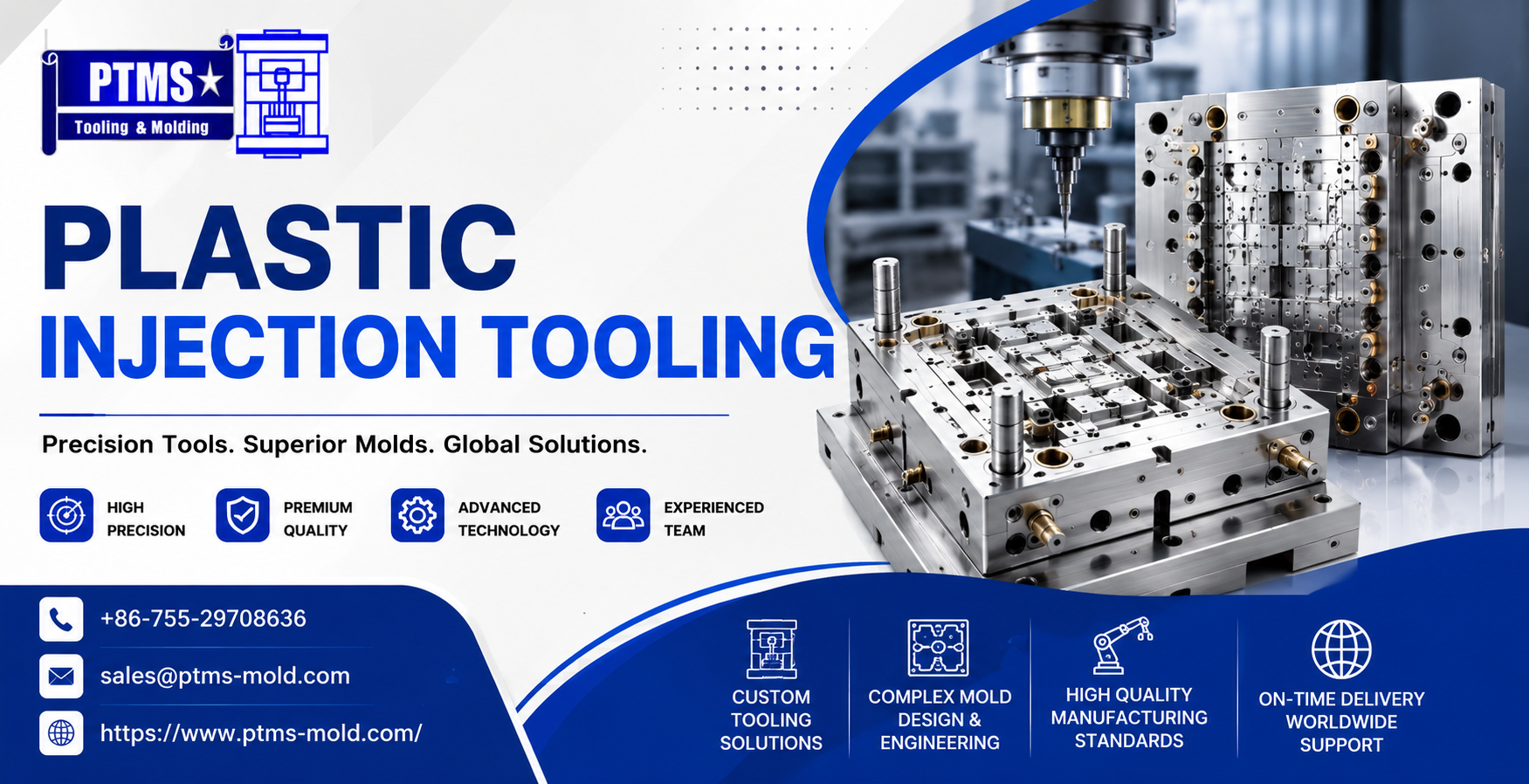
Plastic injection tooling refers to the design and manufacture of molds used to shape molten plastic into finished components. During the injection molding process, heated plastic material is injected into a precisely engineered mold cavity. Once the material cools and solidifies, the mold opens and the finished part is ejected.
A typical injection mold may contain several critical components, including:
-
Mold base
-
Core and cavity
-
Runner and gate system
-
Cooling channels
-
Ejector system
-
Guide pins and bushings
-
Inserts and specialized mechanisms
The performance of these components directly affects part quality, dimensional accuracy, cycle time, and overall production efficiency.
Why Is Plastic Injection Tooling Important?
The mold is essentially the foundation of the injection molding process. Even high-quality plastic materials and advanced molding machines cannot consistently produce excellent parts if the tooling is poorly designed or manufactured.
High-quality tooling helps manufacturers achieve:
-
Consistent part dimensions
-
Reliable production cycles
-
Improved surface finishes
-
Reduced molding defects
-
Efficient material flow
-
Better cooling performance
-
Easier part ejection
-
Lower maintenance requirements
For high-volume manufacturing, investing in the right tooling can provide significant savings over the complete production lifecycle.
How Does Plastic Injection Tooling Work?
The tooling process begins long before the first plastic part is molded. Engineers first study the product design and evaluate its geometry, material, tolerances, production volume, and appearance requirements.
Step 1: Product and DFM Analysis
Design for Manufacturability, commonly called DFM, is an essential first step. Engineers review the component to identify potential manufacturing problems before mold production begins.
Important considerations include wall thickness, draft angles, ribs, bosses, undercuts, parting lines, gate locations, and ejection points.
Step 2: Mold Design
After the product design is approved, engineers develop the mold structure using detailed CAD models. The design determines how the core, cavity, runners, cooling channels, and ejector system will work together.
A good mold design should balance precision, durability, manufacturing cost, and ease of maintenance.
Step 3: Precision Mold Manufacturing
Once the design is finalized, mold components are manufactured using processes such as CNC machining, EDM, grinding, drilling, and polishing. The manufacturing method depends on the complexity, tolerance, and surface-finish requirements of the project.
Step 4: Mold Assembly and Testing
After machining, the mold components are assembled and inspected. Trial molding is then performed to determine whether the tool produces parts according to the required specifications.
If adjustments are required, the mold can be modified before final production approval.
Types of Plastic Injection Tooling
Different products require different tooling configurations. Choosing the correct type depends on production volume, component design, material, and budget.
Single-Cavity Tooling
A single-cavity mold produces one component per molding cycle. It is often suitable for lower production volumes, larger parts, or projects where simplicity is important.
Multi-Cavity Tooling
Multi-cavity molds contain several identical cavities and can produce multiple parts during one cycle. This approach can significantly increase production output and improve unit economics for large-volume projects.
Family Molds
Family molds contain different cavity designs for producing multiple related components in one cycle. They can reduce the need for multiple molds but require careful balancing of material flow and filling conditions.
Hot Runner Tooling
Hot runner systems keep the plastic material in a heated runner system, reducing or eliminating cold-runner waste. They can be particularly useful for high-volume production and applications where cycle efficiency is important.
Materials Used in Injection Tooling
Tool material selection should reflect the expected production volume and operating conditions. Common options include pre-hardened steel, hardened tool steel, stainless steel, and aluminum for certain applications.
The plastic material being molded is equally important. Common injection molding materials include ABS, polypropylene, polycarbonate, nylon, POM, PBT, polyethylene, and other engineering polymers.
Each material has different characteristics, including shrinkage, flow behavior, heat resistance, strength, and chemical resistance. These factors should be considered during mold design.
Key Factors That Affect Tooling Quality
A successful mold is the result of many engineering decisions working together. Several factors deserve particular attention.
Cooling System
Efficient cooling is essential because it influences cycle time and part dimensional stability. Poorly positioned or insufficient cooling channels may increase cycle time and contribute to warpage.
Gate Location
Gate placement affects material flow, weld lines, pressure, filling balance, and cosmetic appearance. The ideal gate position depends on the geometry and material of the component.
Ejection System
The ejection system must remove the finished part without damaging its surface or distorting its geometry. Ejector pins, sleeves, lifters, and other mechanisms may be used depending on the design.
Surface Finish
The required surface finish should be considered during mold manufacturing. Polishing, texturing, EDM finishing, and other processes can create different visual and functional results.
How to Reduce Plastic Injection Tooling Costs
Reducing tooling costs does not simply mean choosing the lowest-cost mold builder. A better approach is to optimize the complete tooling lifecycle.
Here are several practical strategies:
-
Complete DFM analysis before mold manufacturing.
-
Avoid unnecessary design complexity.
-
Use realistic dimensional tolerances.
-
Select tooling materials based on expected production volume.
-
Optimize cavity layouts.
-
Plan cooling channels during the initial mold design.
-
Reduce unnecessary undercuts and complex mechanisms.
-
Consider future maintenance requirements.
Early design improvements can prevent expensive modifications after the mold has already been manufactured.
Plastic Injection Tooling vs. Other Manufacturing Methods
Plastic injection tooling requires an initial investment in mold design and manufacturing. However, once the tool is completed, it can support repeatable production of large quantities of components.
For prototypes or very low-volume production, 3D printing or CNC machining may sometimes be more practical. For medium- to high-volume production, injection molding can provide excellent repeatability and competitive unit costs.
The right manufacturing method ultimately depends on production volume, component complexity, material, tolerance, surface requirements, and project budget.
Common Plastic Injection Tooling Problems
Even a carefully designed mold can experience problems if design, processing, or maintenance is not properly managed.
Common issues include:
-
Flash
-
Short shots
-
Sink marks
-
Warpage
-
Weld lines
-
Burn marks
-
Poor surface finish
-
Part sticking
-
Uneven filling
Many of these problems can be reduced through proper DFM, mold-flow analysis, balanced gating, effective cooling, correct processing conditions, and regular maintenance.
Frequently Asked Questions About Plastic Injection Tooling
1. What is plastic injection tooling?
It is the mold and associated components used to manufacture plastic parts through the injection molding process.
2. Why is mold design important?
Mold design affects part quality, production speed, material flow, cooling, ejection, maintenance, and overall manufacturing cost.
3. What is DFM?
DFM stands for Design for Manufacturability. It identifies potential manufacturing challenges before tooling begins.
4. What is a multi-cavity mold?
A multi-cavity mold contains multiple cavities and can produce several parts during a single molding cycle.
5. How long can injection tooling last?
Tool life varies according to mold material, resin, production volume, maintenance, and operating conditions.
6. What causes mold-related defects?
Defects can result from poor mold design, improper cooling, incorrect gating, unsuitable processing conditions, material behavior, or inadequate maintenance.
7. What is the purpose of cooling channels?
Cooling channels remove heat from the mold and help control cycle time and part dimensional stability.
8. What are undercuts?
Undercuts are features that prevent a component from being directly removed from the mold and may require lifters or side-action mechanisms.
9. Can one mold produce different parts?
Yes. Family molds can produce different related components within the same molding cycle.
10. How can tooling costs be controlled?
Costs can be managed through DFM optimization, practical tolerances, suitable materials, efficient mold design, and avoiding unnecessary complexity.
11. Is injection tooling suitable for mass production?
Yes. Injection molding is particularly effective for producing large quantities of consistent plastic components.
12. What should be considered when selecting a tooling manufacturer?
Consider engineering capability, mold-making experience, quality-control procedures, communication, production capacity, material knowledge, and after-sales tooling support.
Conclusion
Plastic injection tooling is a critical investment for companies that need accurate, repeatable, and scalable plastic manufacturing. From DFM analysis and mold design to precision machining, cooling, ejection, testing, and maintenance, every stage contributes to the final production result. Choosing the right tooling strategy can improve product quality while reducing production risks and long-term costs. If you are planning a new plastic component or need reliable custom tooling, PtmsMold can help turn your product concept into a production-ready solution. Contact the team to discuss your mold requirements, material, production volume, and technical specifications.
📞 - +86-755-29708636
👉 - https://www.ptms-mold.com/
- Technology for Students
- Admissions & Applications
- Online Courses
- Career and Jobs
- Campus Life
- Drinks
- Film
- Fitness
- Food
- Games
- Gardening
- Health
- Home
- Literature
- Music
- Networking For Students
- Insights
- Party
- Religion
- Shopping
- Sports
- Theater
- Wellness
- Education News
- Business & Finance For Students
- Security, Law & Crime Education
- Insurance
- Science & Technology For Students
 English
 Arabic
 French
 Spanish
 Portuguese
 Deutsch
 Turkish
 Dutch
Dutch
 Italiano
 Russian
 Romaian
 Portuguese (Brazil)
 Greek
Greek