DPIIT Notifies BIS Certification for Wrought Aluminium Utensils Under IS 1660:2024: What Manufacturers Must Know Before 1 October 2026
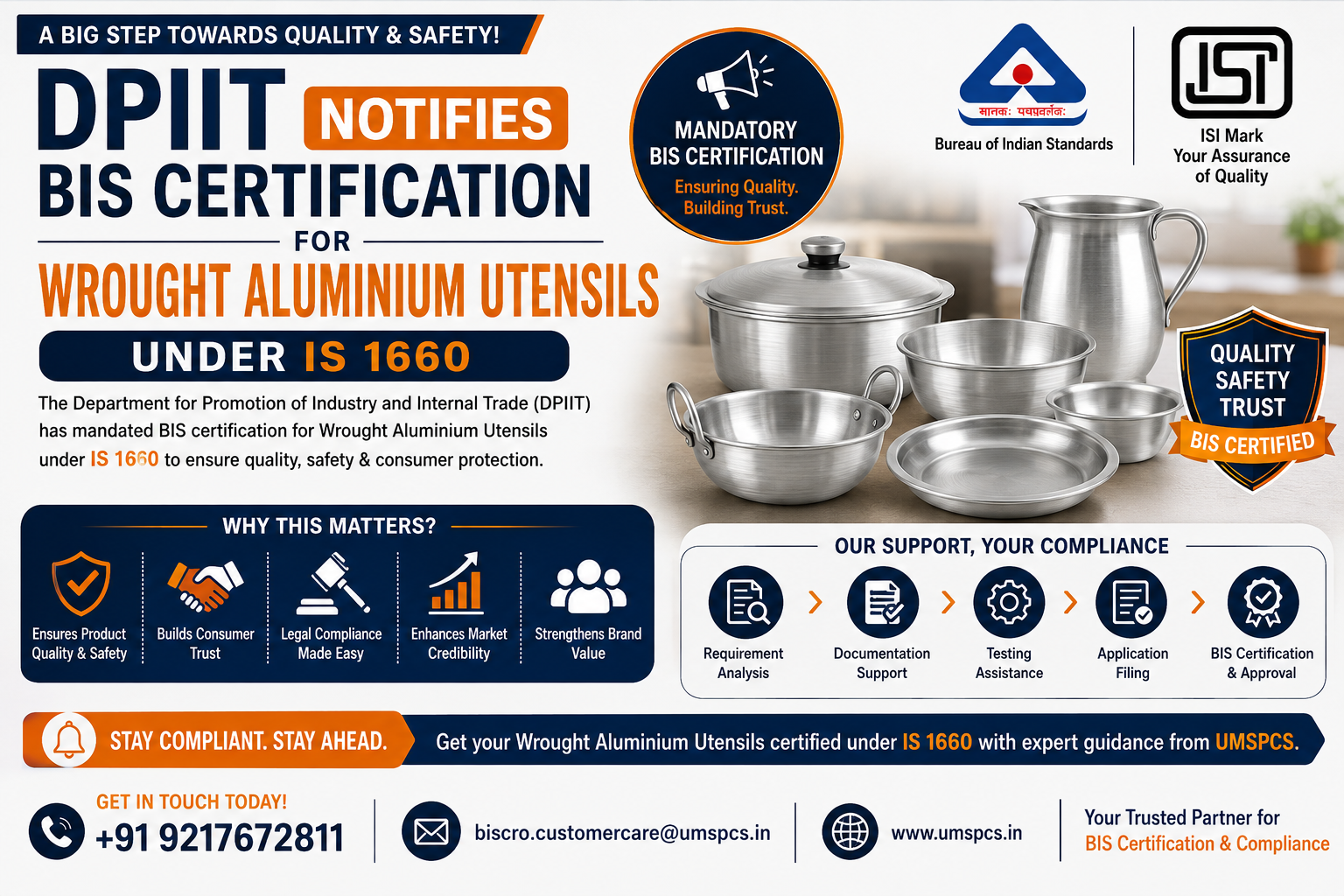
The Indian government is strengthening quality and safety requirements for products used in everyday life, and aluminium utensils are now part of this regulatory focus. Under the latest Quality Control Order framework, DPIIT Notifies BIS Certification for Wrought Aluminium Utensils manufactured according to IS 1660:2024 are scheduled for compulsory BIS certification from 1 October 2026. The Bureau of Indian Standards (BIS) lists Wrought Aluminium Utensils under IS 1660:2024 among the products notified by the Department for Promotion of Industry and Internal Trade (DPIIT), with implementation due on 1 October 2026.
For manufacturers, this makes BIS Certification for Wrought Aluminium Utensils an important compliance requirement to address well before the deadline. Manufacturers should understand the applicable standard, testing requirements, documentation, product grouping and licensing process rather than waiting until the final implementation date. UMSPCS helps businesses navigate the BIS certification process for IS 1660:2024, including documentation, testing coordination, application support and certification-related compliance.
What Is IS 1660:2024?
IS 1660:2024 is the Indian Standard covering Wrought and Cast Aluminium Utensils — Specification. BIS has issued a product manual for the standard to provide guidance to applicants, licensees and BIS offices regarding certification under Scheme-I of the BIS Conformity Assessment Regulations, 2018.
The standard is particularly relevant to manufacturers producing aluminium utensils intended for domestic or food-related use. Compliance is intended to help ensure that products meet specified requirements relating to materials, construction, workmanship and other applicable characteristics.
The BIS product manual also provides guidance on raw materials and components used in aluminium utensils. Depending on the component, references include applicable Indian Standards such as IS 21, IS 617, IS 734 and IS 737.
Why Is 1 October 2026 Important?
The implementation date is one of the most important points manufacturers need to note. According to BIS's list of upcoming Quality Control Orders, Wrought Aluminium Utensils under IS 1660:2024 have an implementation date of 1 October 2026.
This means manufacturers should not treat the certification requirement as something to address at the last moment. The certification process can involve product assessment, testing, documentation, application submission and interaction with BIS. Starting early gives manufacturers more time to identify gaps and resolve testing or documentation issues.
Businesses that manufacture, supply or plan to introduce covered products into the Indian market should therefore review their product range and determine whether their products fall within the applicable requirements.
What Products Are Covered?
IS 1660:2024 covers aluminium utensils, including both wrought and cast aluminium utensils. The BIS product manual provides grouping guidelines that can be used for licensing and changes in the scope of a licence.
The grouping framework considers different categories, including:
-
Wrought utensils
-
Cast utensils
-
Compartmental trays
-
Lunch boxes
-
Thick-bottom utensils
-
Certain utensils with shapes and dimensions outside the specified provisions
-
Different coating types
The product manual identifies coating categories such as plain, hard anodic, anodic, non-stick, ceramic and high-temperature coatings.
Manufacturers should carefully assess their product portfolio before applying because the appropriate grouping and scope can influence the certification process.
Read More- BIS Certification for Stools
What Should Manufacturers Do Before Applying?
The first step is to identify the exact products that require certification. Manufacturers should review their product specifications, manufacturing process, raw materials, coating systems and available technical documentation against IS 1660:2024.
Next, manufacturers should prepare the required documentation and establish whether their existing manufacturing and quality-control systems can consistently produce products meeting the standard.
Testing is another important part of the process. Manufacturers may need to coordinate product samples and testing through the applicable BIS-recognised laboratory framework. Test results and technical information should correspond with the products included in the proposed licence scope.
It is also advisable to review manufacturing facilities and quality-control arrangements in advance. Any gaps identified before the BIS assessment can be addressed more efficiently than after the application has already progressed.
BIS Certification Process for Wrought Aluminium Utensils
Although the exact process depends on the manufacturer's circumstances and product scope, the certification journey generally involves several important stages.
1. Product and standard assessment:
Identify the products covered by IS 1660:2024 and determine the appropriate certification scope.
2. Documentation preparation:
Prepare manufacturing, technical, testing and quality-control documents required for the application.
3. Testing:
Arrange testing of representative samples according to applicable requirements.
4. BIS application:
Submit the certification application and supporting information through the applicable BIS process.
5. Factory assessment:
BIS may assess the manufacturing premises and verify production and quality-control arrangements.
6. Compliance and corrective action:
If observations or deficiencies arise, the manufacturer may need to take corrective measures and provide the required evidence.
7. Grant of licence:
Once the applicable requirements are satisfactorily completed, BIS may grant the licence subject to the applicable conformity assessment requirements.
Manufacturers should remember that obtaining a licence is not necessarily the end of compliance. Maintaining product quality, testing arrangements and other applicable requirements remains important after certification.
Why Manufacturers Should Start Early
The 1 October 2026 deadline may appear several weeks away, but certification preparation can require coordination between manufacturers, laboratories and regulatory authorities. Delays can occur when technical documents are incomplete, samples require retesting, product grouping is unclear or manufacturing arrangements need improvement.
Starting early provides manufacturers with an opportunity to:
-
Review product applicability.
-
Identify the correct BIS standard.
-
Finalise product grouping.
-
Prepare technical documentation.
-
Plan product testing.
-
Address manufacturing or quality-control gaps.
-
Submit the application with better preparedness.
-
Reduce the risk of last-minute compliance pressure.
For manufacturers selling products across multiple markets or maintaining large product portfolios, early planning is particularly useful.
How UMSPCS Can Help
Navigating BIS requirements can become complicated when a manufacturer is unfamiliar with certification procedures. UMSPCS provides compliance support to businesses seeking BIS certification for regulated products.
For aluminium utensil manufacturers, professional assistance can help with product applicability review, documentation preparation, testing coordination, application support and guidance during the certification process. The objective is to help manufacturers approach the requirements systematically and avoid common compliance gaps.
Before beginning the application, manufacturers should also verify the latest BIS requirements because Quality Control Orders, implementation schedules and certification procedures can be updated by the relevant authorities.
Key Takeaway for Aluminium Utensil Manufacturers
The upcoming requirement for Wrought Aluminium Utensils under IS 1660:2024 represents an important compliance change for manufacturers. BIS currently lists the product under the applicable compulsory certification framework, with implementation scheduled for 1 October 2026.
Manufacturers should therefore use the available time to assess their products, understand the standard, prepare documentation, arrange testing and begin the certification process wherever applicable. Waiting until the deadline approaches could create unnecessary pressure and potential supply or market-compliance challenges.
With proper preparation and professional guidance, manufacturers can make the transition to the new requirements more organised and predictable.
Read More- BIS Certification for Work Chairs
FAQs
1. Is BIS certification mandatory for Wrought Aluminium Utensils?
Wrought Aluminium Utensils under IS 1660:2024 are included in BIS's notified upcoming Quality Control Order requirements, with implementation scheduled for 1 October 2026.
2. Which standard applies to aluminium utensils?
The applicable standard listed by BIS is IS 1660:2024, covering Wrought and Cast Aluminium Utensils — Specification.
3. When does the requirement come into effect?
BIS currently lists 1 October 2026 as the implementation date for Wrought Aluminium Utensils under IS 1660:2024.
4. Does IS 1660:2024 cover only wrought aluminium utensils?
No. The BIS product manual identifies IS 1660:2024 as covering both wrought and cast aluminium utensils and provides separate grouping considerations for certification.
5. What should manufacturers do before 1 October 2026?
Manufacturers should review product applicability, understand the relevant requirements of IS 1660:2024, prepare documentation, arrange applicable testing and initiate the BIS certification process in advance.
6. Can UMSPCS assist with BIS certification?
Yes. UMSPCS can support manufacturers with BIS compliance activities such as documentation preparation, testing coordination, application support and guidance throughout the certification process.
Conclusion
The transition to mandatory BIS compliance for covered aluminium utensils is an important regulatory development for manufacturers. With 1 October 2026 approaching, businesses should assess their products and begin preparing rather than waiting for the final deadline. Understanding IS 1660:2024 and completing the certification requirements in advance can help manufacturers maintain regulatory readiness and business continuity.
Source- https://cdscoapprovals.blogspot.com/2026/08/dpiit-notifies-bis-certification-for.html
- Technology for Students
- Admissions & Applications
- Online Courses
- Career and Jobs
- Campus Life
- Drinks
- Film
- Fitness
- Food
- الألعاب
- Gardening
- Health
- الرئيسية
- Literature
- Music
- Networking For Students
- Insights
- Party
- Religion
- Shopping
- Sports
- Theater
- Wellness
- Education News
- Business & Finance For Students
- Security, Law & Crime Education
- Insurance
- Science & Technology For Students
 Arabic
 English
 French
 Spanish
 Portuguese
 Deutsch
 Turkish
 Dutch
Dutch
 Italiano
 Russian
 Romaian
 Portuguese (Brazil)
 Greek
Greek