


BIS-FMCS Certification in Delhi: A Complete Guide for Foreign Manufacturers
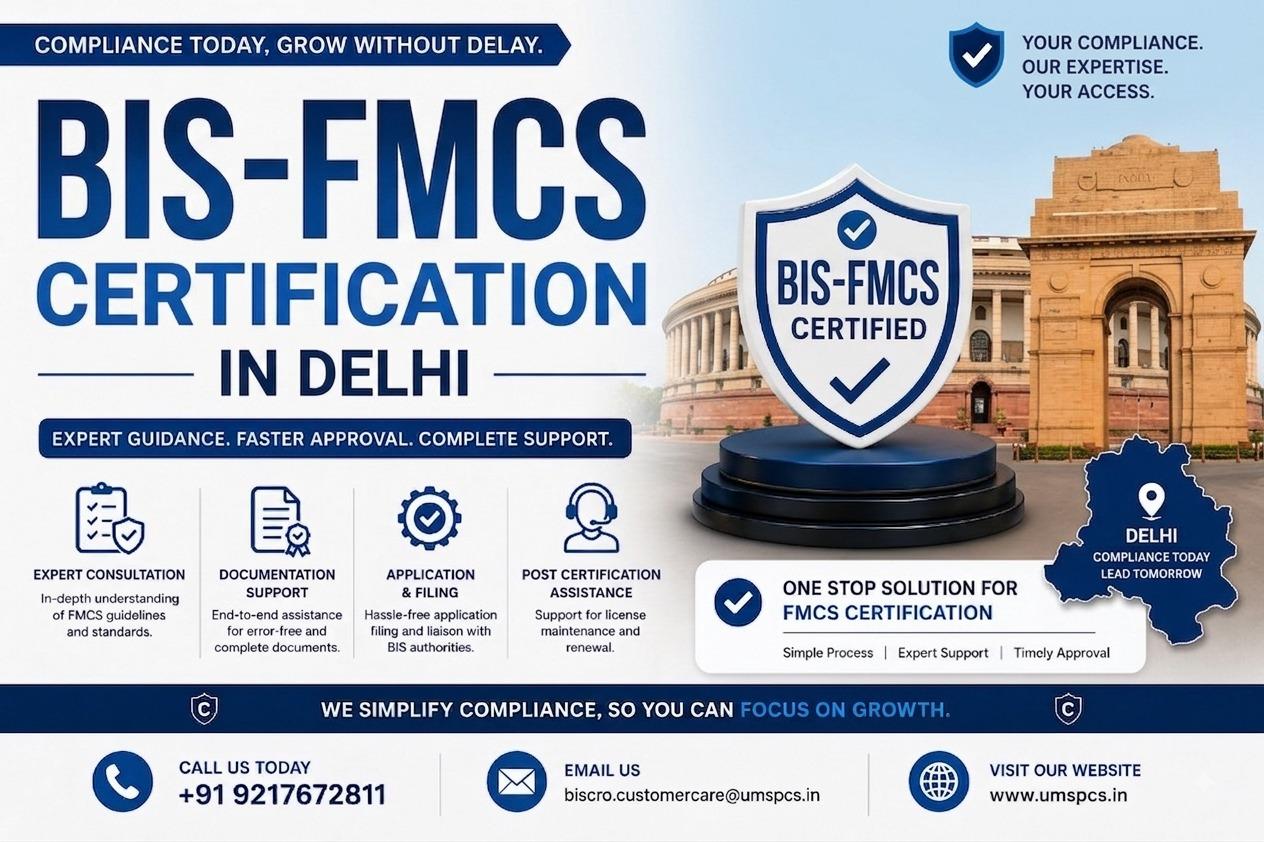
Selling products in the Indian market requires more than meeting customer expectations. For many products, compliance with applicable Indian Standards is a mandatory requirement before they can be imported, sold, or distributed in India. For foreign manufacturers, BIS-FMCS Certification in Delhi is an important regulatory route for obtaining BIS certification and demonstrating that their products conform to the applicable Indian Standards.
The Foreign Manufacturers Certification Scheme (FMCS) is operated by the Bureau of Indian Standards (BIS) for manufacturers located outside India. It enables eligible foreign manufacturers to obtain a BIS licence for products covered under mandatory certification requirements.
For businesses planning to enter or expand in the Indian market, understanding the FMCS process can help avoid documentation gaps, testing delays, and compliance-related complications.
What is BIS-FMCS Certification?
BIS-FMCS Certification is a certification mechanism under which foreign manufacturers can obtain a BIS licence to manufacture and sell products conforming to the relevant Indian Standard.
Unlike domestic manufacturers, foreign manufacturers generally apply under the Foreign Manufacturers Certification Scheme (FMCS). The process involves product testing, factory assessment, documentation review, and compliance with the applicable BIS requirements.
Once the licence is granted, the manufacturer can use the applicable BIS Standard Mark on certified products, subject to the conditions of the licence.
Why is BIS-FMCS Certification Important for Foreign Manufacturers?
India has established quality and safety requirements for various categories of products. If a product is covered under a mandatory BIS certification requirement, obtaining the appropriate certification becomes essential for entering the Indian market.
BIS-FMCS Certification can help foreign manufacturers:
-
Meet applicable Indian regulatory requirements
-
Demonstrate conformity with relevant Indian Standards
-
Build confidence among Indian buyers and business partners
-
Support smoother market entry into India
-
Establish a structured quality and compliance framework
-
Legally use the BIS Standard Mark where permitted
Therefore, certification is not simply a quality label; it can be an important part of a foreign manufacturer's Indian market-entry strategy.
Who Can Apply for BIS-FMCS Certification?
The FMCS route is primarily intended for foreign manufacturers whose products fall under the applicable BIS certification requirements.
A foreign manufacturer should have:
-
A manufacturing facility outside India
-
Adequate manufacturing and testing facilities
-
Products covered by a relevant Indian Standard
-
Appropriate technical and quality documentation
-
Arrangements for product testing through BIS-recognised laboratories, wherever applicable
-
An authorised Indian representative as required under the FMCS framework
The exact requirements can vary depending on the product, Indian Standard, manufacturing facility, and applicable regulatory provisions.
Read More- FMCS certification Kolkata
Process of BIS-FMCS Certification in Delhi
Although the manufacturing facility may be located outside India, foreign manufacturers often work with consultants in Delhi for regulatory coordination, documentation, application support, and communication related to the certification process.
Step 1: Identify the Applicable Indian Standard
The first step is to determine whether the product is covered under a mandatory BIS requirement and identify the correct IS Standard applicable to it.
Correct identification of the product category and Indian Standard is important because the testing and documentation requirements depend on the applicable standard.
Step 2: Product and Factory Assessment
The manufacturer's product, production process, quality-control system, and manufacturing facilities are assessed against the applicable requirements.
The manufacturer should ensure that the required production and testing facilities are available before proceeding with the application.
Step 3: Product Testing
Product samples are tested against the relevant Indian Standard through the applicable BIS-recognised testing arrangements.
Testing verifies whether the product meets the prescribed technical, performance, safety, or quality requirements.
Step 4: Documentation Preparation
The applicant needs to prepare the required documents and technical information for the BIS application.
Depending on the product and application, documents may include:
-
Manufacturing details
-
Product specifications
-
Test reports
-
Details of manufacturing and testing facilities
-
Quality-control information
-
Factory layout and process details
-
Authorisation documents
-
Details of the authorised Indian representative
-
Undertakings and other BIS-prescribed documents
Step 5: Application Submission
After the documentation and testing requirements are addressed, the application is submitted to BIS through the applicable process.
BIS reviews the application and supporting information for compliance with the FMCS requirements.
Step 6: Factory Inspection by BIS
A BIS officer or authorised inspection team may visit the foreign manufacturing facility to evaluate manufacturing capabilities, quality-control arrangements, testing facilities, and conformity with the relevant Indian Standard.
The applicant may need to demonstrate that the production and testing arrangements are capable of consistently producing conforming products.
Step 7: Grant of BIS Licence
After satisfactory completion of the applicable evaluation, testing, inspection, and documentation requirements, BIS may grant the licence under FMCS.
The manufacturer can then use the BIS Standard Mark on certified products according to the conditions and requirements of the licence.
Documents Required for BIS-FMCS Certification
The exact document list depends on the product and applicable Indian Standard. Commonly required information may include:
-
Company registration documents
-
Manufacturer's address and factory details
-
Product technical specifications
-
Manufacturing process information
-
Details of machinery and testing equipment
-
Quality-control arrangements
-
Test reports
-
Factory layout
-
Details of authorised Indian representative
-
Undertakings and declarations
-
Applicable BIS application documents
Proper documentation is important because incomplete or inconsistent information can lead to queries and delays during the certification process.
Read More- CDSCO Approvals in India
Why Choose UMSPCS for BIS-FMCS Certification in Delhi?
Foreign manufacturers may find Indian regulatory procedures difficult to navigate without local compliance support. UMSPCS assists businesses with the certification journey, from understanding the applicable requirements to preparing documentation and coordinating the certification process.
With 6+ years of experience and support across 600+ product compliance requirements, UMSPCS helps manufacturers approach BIS certification with a structured compliance strategy.
Our support can include:
-
Product and IS code assessment
-
BIS-FMCS requirement analysis
-
Documentation support
-
Application preparation
-
Testing coordination
-
Factory inspection preparation
-
BIS query and compliance support
-
Guidance throughout the certification process
For foreign manufacturers seeking BIS-FMCS Certification in Delhi, professional guidance can help reduce avoidable documentation and procedural issues.
Benefits of Taking Professional BIS-FMCS Consultancy
BIS certification involves technical, documentary, and regulatory requirements. Professional consultancy can help manufacturers understand these requirements before submitting an application.
Some key benefits include:
-
Better regulatory understanding
-
Documentation assistance
-
Testing coordination
-
Inspection preparedness
-
Application support
Read More - BIS Certification In India
Conclusion
For foreign manufacturers planning to manufacture or supply regulated products in India, BIS-FMCS Certification in Delhi can play an important role in establishing regulatory compliance and market credibility. The certification process involves several stages, including identifying the applicable Indian Standard, product testing, documentation, factory assessment, and BIS evaluation.
A well-planned approach can make the certification journey more organised and help manufacturers address compliance requirements efficiently. With experienced guidance from UMSPCS, foreign manufacturers can better understand the applicable BIS requirements and work towards obtaining certification with greater confidence.
Planning to enter the Indian market with a regulated product?
Connect with UMSPCS today to understand the BIS-FMCS requirements applicable to your product and take the next step towards Indian market compliance.
FAQs
1. What is BIS-FMCS Certification?
BIS-FMCS Certification is the certification route through which eligible foreign manufacturers can obtain a BIS licence for products covered under applicable Indian Standards.
2. Who needs BIS-FMCS Certification?
Foreign manufacturers whose products are subject to mandatory BIS certification requirements may need to obtain certification under FMCS before supplying them in India.
3. Is BIS-FMCS Certification mandatory for all foreign products?
No. The requirement depends on the product category, applicable Indian Standards, and relevant Indian regulatory requirements.
4. What is the role of an Authorised Indian Representative?
An Authorised Indian Representative acts as the local representative of the foreign manufacturer for applicable BIS-related matters and communication.
5. Does BIS inspect the foreign manufacturing facility?
Yes, factory assessment or inspection may be part of the FMCS certification process, depending on the applicable requirements.
6. How long does BIS-FMCS Certification take?
The timeline varies depending on the product, testing, documentation, factory inspection, and BIS evaluation. Delays can occur if testing or documentation requirements are not adequately addressed.
7. Why should foreign manufacturers take BIS-FMCS consultancy?
Professional consultancy can help foreign manufacturers understand applicable requirements, organise documentation, coordinate testing, and prepare for the various stages of the BIS certification process.
- Technology for Students
- Admissions & Applications
- Online Courses
- Career and Jobs
- Campus Life
- Drinks
- Film
- Fitness
- Food
- Игры
- Gardening
- Health
- Главная
- Literature
- Music
- Networking For Students
- Insights
- Party
- Religion
- Shopping
- Sports
- Theater
- Wellness
- Education News
- Business & Finance For Students
- Security, Law & Crime Education
- Insurance
- Science & Technology For Students
 Russian
 English
 Arabic
 French
 Spanish
 Portuguese
 Deutsch
 Turkish
 Dutch
Dutch
 Italiano
 Romaian
 Portuguese (Brazil)
 Greek
Greek