


What Is Continuous Improvement? Powerful Benefits and Proven Strategies for Business Growth
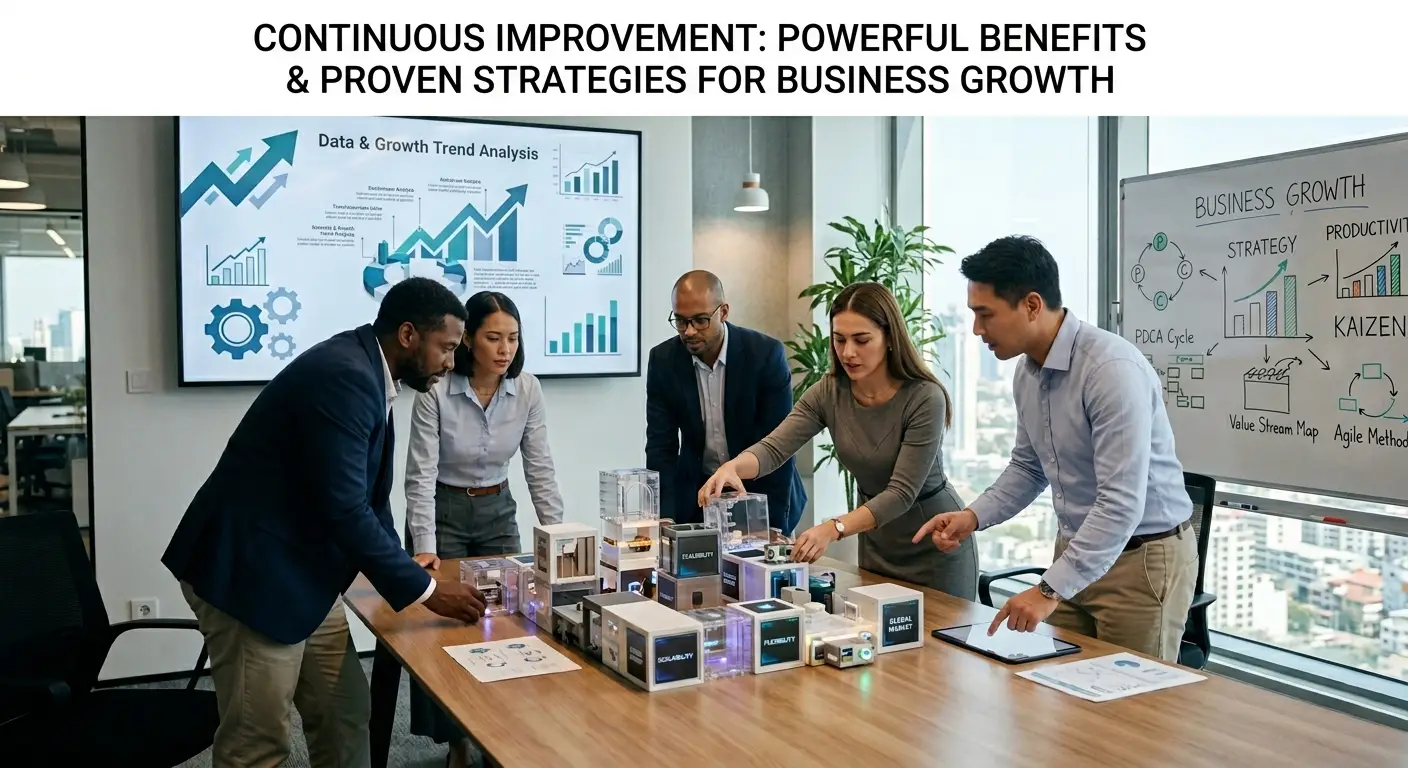
f you have ever asked, “What is Continuous Improvement?”, the answer is simple: it is the ongoing effort to make products, services, and business processes better over time.
Continuous Improvement focuses on identifying opportunities, making changes, measuring results, and continuing to improve. Instead of relying only on major transformations, organisations make small, practical improvements that can gradually create significant gains in efficiency, quality, productivity, and customer satisfaction.
The approach is often associated with Kaizen, a Japanese philosophy that promotes continuous, incremental improvement. It is also closely connected to Lean Manufacturing and Six Sigma, which focus on reducing waste, improving processes, and delivering consistent quality.
The central idea is that improvement is not a one-time project. It is an ongoing process that involves everyone in an organisation.
What Is Continuous Improvement?
Continuous Improvement is a structured approach to improving the way an organisation operates.
It may involve:
- Improving production processes.
- Reducing unnecessary waste.
- Improving product quality.
- Shortening delivery times.
- Reducing errors and defects.
- Improving customer service.
- Making better use of resources.
Rather than waiting for a major problem to occur, teams regularly examine their processes and look for ways to improve them.
A small improvement in one area may seem insignificant. However, when organisations make improvements consistently over time, the combined impact can be substantial.
The History and Origins of Continuous Improvement
Kaizen and the Toyota Production System
Modern Continuous Improvement is strongly associated with Japanese manufacturing and the development of the Toyota Production System during the 1950s.
Toyota developed a production approach focused on reducing waste, improving workflow, maintaining quality, and involving employees in problem-solving.
The philosophy of Kaizen, which means continuous improvement, became an important part of this approach. Rather than depending only on large-scale changes, Kaizen encourages employees to identify small opportunities for improvement every day.
Over time, these ideas spread beyond manufacturing and became widely used in:
- Healthcare
- Information technology
- Logistics
- Education
- Retail
- Financial services
- Business operations
Today, Continuous Improvement is considered a valuable business philosophy across many industries.
Key Principles of Continuous Improvement
1. Focus on Incremental Changes
Continuous Improvement does not always require major investments or dramatic changes.
Small improvements can include:
- Rearranging a workstation.
- Simplifying a process.
- Removing unnecessary steps.
- Improving material storage.
- Reducing walking distance.
- Updating a standard operating procedure.
Small changes are often easier to test, implement, and maintain than large-scale transformations.
2. Involve Employees
Employees who work directly with a process often have the clearest understanding of its problems.
They may know:
- Where delays occur.
- Which tasks create unnecessary work.
- What equipment causes problems.
- Which process steps could be improved.
Involving employees in improvement initiatives can result in better ideas and greater employee engagement.
3. Use Data to Make Decisions
Data helps organisations understand whether an improvement has actually delivered positive results.
Businesses may track metrics such as:
- Production time
- Defect rates
- Delivery times
- Inventory levels
- Customer satisfaction
- Productivity
- Equipment downtime
Using measurable information allows teams to compare performance before and after a change.
4. Focus on the Root Cause
Continuous Improvement is more effective when teams solve the underlying cause of a problem rather than simply treating the symptoms.
For example, if a workstation repeatedly experiences material shortages, the solution may not be to ask employees to work faster. The real issue may be an inefficient replenishment process or poor material organisation.
Identifying the root cause leads to more sustainable improvements.
Popular Continuous Improvement Methodologies
Several established methods can help organisations implement Continuous Improvement.
Lean Manufacturing
Lean Manufacturing focuses on reducing waste and improving the flow of work.
It encourages organisations to identify activities that do not add value and find ways to eliminate or reduce them.
Common areas of waste include:
- Waiting
- Excess inventory
- Unnecessary movement
- Defects
- Overproduction
- Overprocessing
Six Sigma
Six Sigma is a data-driven methodology focused on reducing defects, errors, and process variation.
It uses structured methods to identify problems, analyse causes, implement solutions, and measure results.
The PDCA Cycle
The Plan-Do-Check-Act (PDCA) cycle provides a simple framework for testing and implementing improvements.
- Plan – Identify a problem and develop a proposed solution.
- Do – Test the solution on a small scale.
- Check – Review the results.
- Act – Standardise the improvement or make further adjustments.
The PDCA cycle encourages organisations to test improvements rather than relying solely on assumptions.
Benefits of Continuous Improvement
Increased Efficiency
Reviewing and improving processes can help organisations reduce delays and complete work more efficiently.
This may lead to:
- Faster turnaround times.
- Improved productivity.
- Better use of equipment.
- More efficient workflows.
Reduced Costs
Reducing waste can help lower operational costs.
Businesses may reduce expenses by:
- Using fewer materials.
- Reducing rework.
- Lowering excess inventory.
- Reducing downtime.
- Improving labour efficiency.
Improved Quality
Continuous monitoring allows organisations to identify errors and defects more quickly.
When problems are addressed at their source, businesses can improve the consistency and quality of their products and services.
Greater Employee Engagement
Employees are more likely to feel involved when they are encouraged to contribute ideas and participate in problem-solving.
A strong improvement culture can help employees feel that their knowledge and experience are valued.
Better Customer Satisfaction
Improved internal processes can lead to better customer experiences.
For example, a business may deliver products faster, reduce errors, improve product quality, or respond to customer enquiries more efficiently.
Real-World Examples of Continuous Improvement
Continuous Improvement in Manufacturing
Manufacturers may use Continuous Improvement to:
- Reduce production downtime.
- Improve assembly line layouts.
- Reduce defects.
- Improve material flow.
- Reduce unnecessary movement.
- Improve workplace ergonomics.
A simple change, such as moving frequently used components closer to an operator, may reduce motion waste and improve productivity.
Continuous Improvement in Service Businesses
Service organisations can also benefit from Continuous Improvement.
Examples include:
- Reducing customer waiting times.
- Improving response processes.
- Simplifying administrative tasks.
- Improving communication.
- Reducing service errors.
The same principle applies across industries: identify a problem, improve the process, and measure the results.
Common Challenges in Implementing Continuous Improvement
Resistance to Change
Employees may be reluctant to adopt new processes if they are uncertain about the benefits or concerned that changes will make their work more difficult.
Clear communication and employee involvement can help reduce resistance.
Lack of Leadership Support
Continuous Improvement requires ongoing support from leadership.
Without leadership involvement, improvement projects may lose momentum or fail to become part of the organisation's culture.
Poor Training
Employees need to understand the purpose of Continuous Improvement and how they can contribute.
Providing appropriate training can help teams use improvement tools more effectively.
Focusing Only on Short-Term Results
Some improvements may deliver immediate benefits, while others may require more time.
Organisations need to balance short-term performance with long-term process improvement.
How to Implement Continuous Improvement
A structured approach can make Continuous Improvement easier to implement.
Step 1: Identify an Opportunity
Start by identifying a problem, inefficiency, or area that could be improved.
Step 2: Analyse the Current Process
Understand how the process currently works and identify where delays, waste, or errors occur.
Step 3: Identify the Root Cause
Use tools such as root cause analysis to understand why the problem exists.
Step 4: Develop a Solution
Create a practical improvement based on the information gathered.
Step 5: Test the Change
Where possible, test the improvement on a small scale before implementing it across the entire organisation.
Step 6: Measure the Results
Compare performance before and after the change.
Step 7: Standardise and Continue Improving
If the improvement is successful, make it part of the standard process. Then continue looking for additional opportunities to improve.
Common Continuous Improvement Tools
Businesses use a range of tools to support improvement initiatives.
Root Cause Analysis
Root cause analysis helps teams identify the underlying reason for a problem.
Value Stream Mapping
Value Stream Mapping provides a visual overview of a process and helps identify waste, delays, and bottlenecks.
Performance Metrics
Metrics help organisations measure the performance of processes and determine whether improvements are delivering results.
5S
The 5S methodology helps organisations create organised, efficient, and standardised workspaces.
The Role of Technology in Continuous Improvement
Technology is playing an increasingly important role in process improvement.
Automation
Automation can reduce repetitive manual tasks, improve consistency, and reduce the risk of human error.
Data Analytics
Data analytics can help organisations identify trends, monitor performance, and discover improvement opportunities.
Smart Manufacturing
Connected equipment and smart manufacturing technologies provide businesses with more information about production performance and equipment operation.
Technology can support Continuous Improvement, but the underlying process still requires people to identify problems and determine the best solutions.
How Modular Systems Support Continuous Improvement
Manufacturing environments are constantly changing. New products, equipment, workflows, and production requirements may require workspaces and material-handling systems to be modified.
Traditional fixed structures can make these changes difficult and expensive.
Modular systems provide greater flexibility because they can be assembled, modified, reused, and reconfigured as processes evolve.
Flexpipe Modular System and Continuous Improvement
The Flexpipe Modular System is designed to create flexible workstations, flow racks, carts, and material-handling structures using modular pipes, joints, and accessories.
These components can be used to create:
- Workstations
- Flow racks
- Material-handling carts
- Storage systems
- Kitting stations
- Lean work cells
How Flexpipe Supports Continuous Improvement
The modular design aligns with several key Continuous Improvement principles.
Flexibility
Workstations and material-handling structures can be modified as processes change.
Waste Reduction
Layouts can be improved to reduce unnecessary movement and improve material flow.
Employee Involvement
Employees can help identify and implement practical workstation improvements.
Cost Efficiency
Reusable components can be adapted for new applications instead of requiring an entirely new structure.
This adaptability is particularly useful in Lean manufacturing environments where continuous optimisation is part of everyday operations.
Building a Culture of Continuous Improvement
Creating a Continuous Improvement Mindset
A successful improvement culture requires more than tools and processes.
Organisations should encourage:
- Open communication.
- Employee participation.
- Innovation.
- Problem-solving.
- Sharing of improvement ideas.
- Recognition of successful improvements.
Leadership should also demonstrate that improvement is an ongoing priority rather than a temporary initiative.
When employees feel comfortable identifying problems and suggesting solutions, Continuous Improvement becomes part of the organisation's daily culture. Industrial Racking Systems help businesses organise materials and maximise available storage space.
The Future of Continuous Improvement
Continuous Improvement will continue to evolve as businesses adopt new technologies and operating models.
Important trends include:
- Artificial intelligence
- Data analytics
- Smart factories
- Industry 4.0
- Automation
- Digital twins
- Flexible modular systems
- Sustainable manufacturing
These technologies can provide organisations with more information and greater flexibility, helping them identify and implement improvements more quickly.
The future of Continuous Improvement will likely combine human problem-solving with advanced technology to create more agile, efficient, and sustainable businesses.
Conclusion
Understanding what Continuous Improvement is is essential for organisations that want to improve performance and remain competitive over the long term.
By making small, consistent improvements, businesses can increase efficiency, reduce costs, improve quality, and deliver greater value to customers.
Successful Continuous Improvement depends on employee involvement, data-driven decision-making, leadership support, and a willingness to examine existing processes.
Flexible solutions such as the Flexpipe Modular System can further support this approach by allowing manufacturers to quickly modify workstations, flow racks, carts, and material-handling systems as their processes evolve.
Continuous Improvement is not a one-time project. It is an ongoing mindset that helps organisations adapt, innovate, and improve over time. Continuous Improvement helps businesses improve their processes, productivity, and overall performance over time.
Frequently Asked Questions
What is Continuous Improvement in simple terms?
Continuous Improvement is the ongoing process of making small, consistent changes to improve efficiency, quality, productivity, and performance.
Why is Continuous Improvement important?
It helps businesses reduce waste, lower costs, improve quality, increase productivity, and respond more effectively to changing customer and market needs.
What are examples of Continuous Improvement?
Examples include improving production workflows, reducing defects, reorganising a workstation, reducing customer waiting times, and simplifying administrative processes.
How does Lean relate to Continuous Improvement?
Lean is a methodology that focuses on eliminating waste and improving process efficiency. Continuous Improvement is a key principle of Lean Manufacturing.
What tools are used in Continuous Improvement?
Common tools include PDCA, Six Sigma, Lean Manufacturing, Value Stream Mapping, root cause analysis, 5S, and performance metrics.
How does Flexpipe support Continuous Improvement?
Flexpipe provides modular and reconfigurable workstations, flow racks, carts, and material-handling systems that can be adapted as processes and operational requirements change.
- Technology for Students
- Admissions & Applications
- Online Courses
- Career and Jobs
- Campus Life
- Drinks
- Film
- Fitness
- Food
- الألعاب
- Gardening
- Health
- الرئيسية
- Literature
- Music
- Networking For Students
- Insights
- Party
- Religion
- Shopping
- Sports
- Theater
- Wellness
- Education News
- Business & Finance For Students
- Security, Law & Crime Education
- Insurance
- Science & Technology For Students
 Arabic
 English
 French
 Spanish
 Portuguese
 Deutsch
 Turkish
 Dutch
Dutch
 Italiano
 Russian
 Romaian
 Portuguese (Brazil)
 Greek
Greek