


How Salesforce Sales Cloud Consulting Services Improve Pipeline Visibility
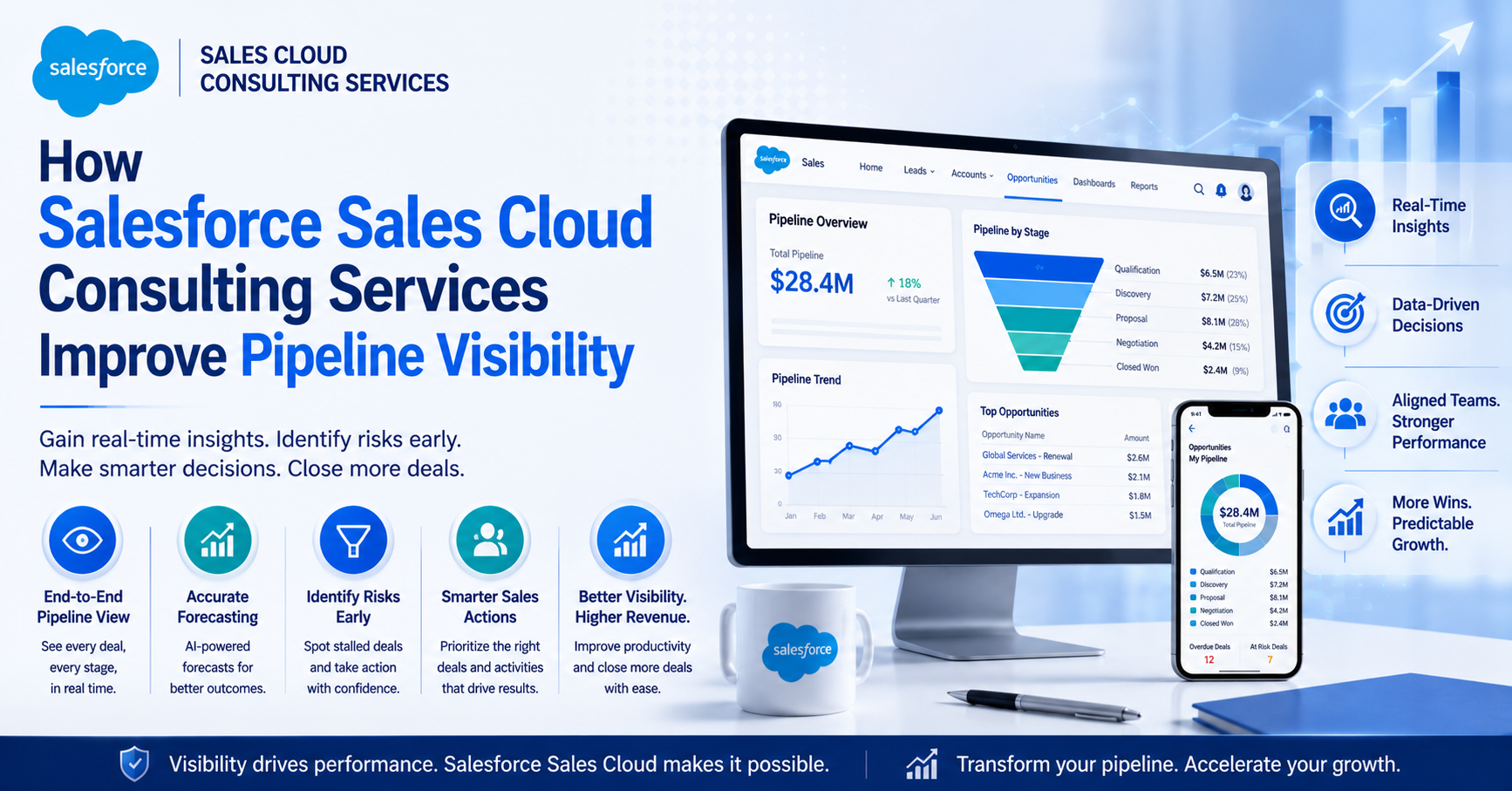
Sales leaders often ask the same question at the end of every quarter. Will the pipeline actually close as forecasted? Too often, the honest answer is no one really knows.
Salesforce Sales Cloud Consulting fixes this problem at the source. This looks at how proper configuration, data discipline, and reporting design turn a messy pipeline into a reliable forecasting tool.
The Scale of the Forecasting Problem
Poor pipeline visibility is not a minor annoyance. It is one of the biggest gaps in modern sales operations. Only 18.7% of sales organizations achieve forecast accuracy of 75% or higher, according to Korn Ferry research. The median accuracy across surveyed organizations sits between just 70% and 79%.
The trust gap is even more telling. Nearly 70% of sales organizations still rely on CRM reporting as their primary forecasting method, despite openly lacking confidence in that data. Only 45% of sales leaders report high confidence in their own forecasting accuracy.
This disconnect costs real money. Poor data quality alone can cost companies between 15% and 25% of revenue. When leadership cannot trust pipeline numbers, resource planning, hiring, and budget decisions all suffer.
Why Pipeline Visibility Breaks Down
Pipeline visibility rarely fails because of one big mistake. It fails through many small gaps that compound over time.
Common causes include:
-
Reps forgetting to log activity or update deal stages.
-
Deals sitting in the wrong stage for weeks without correction.
-
Inconsistent stage definitions across different reps or teams.
-
Data scattered across email, spreadsheets, and disconnected tools.
-
Duplicate or stale contact and account records.
Buying committees have also grown more complex. Research shows buying groups now include between 9 and 16 people across multiple functions. Many reps stay single-threaded through one champion, missing key stakeholders entirely. This creates blind spots that standard pipeline reports never catch.
How Salesforce Sales Cloud Consulting Fixes the Foundation
Salesforce Sales Cloud Consulting Services start by fixing the structural problems that cause bad data in the first place. Technology alone does not solve this. The underlying process needs to change too.
Consultants typically address:
-
Stage definition clarity: setting objective entry and exit criteria for each pipeline stage.
-
Required field enforcement: making sure reps cannot skip key data points during updates.
-
Duplicate record cleanup: merging conflicting account and contact records before rollout.
-
Activity capture automation: reducing manual logging through email and calendar integration.
-
Custom pipeline views: building dashboards that match how each team actually reviews deals.
This foundational work matters more than most companies expect. A well-designed dashboard on top of messy data still produces unreliable forecasts.
Technical Configuration for Better Visibility
1. Custom Opportunity Stages
Generic, default Salesforce stages rarely match a company's actual sales process. Salesforce Sales Cloud Consulting Services configure custom stages tied to specific, verifiable buyer actions, not internal activity like "proposal sent."
2. Validation Rules and Required Fields
Validation rules stop reps from advancing a deal without the data needed to support that stage. For example, a deal cannot move to "negotiation" without a documented decision-maker contact on record.
3. Automated Activity Logging
Manual data entry remains one of the biggest sources of pipeline decay. Consultants configure email and calendar sync tools so activity logs automatically, without relying on rep memory.
4. Pipeline Coverage and Aging Reports
Strong dashboards track more than just deal count and value. Key metrics worth building include:
-
Pipeline coverage ratio against quota.
-
Average deal velocity by stage.
-
Win rate broken down by stage and segment.
-
Pipeline age distribution, flagging deals stuck too long.
-
Slippage rate, tracking deals that repeatedly push their close date.
5. Einstein AI Forecasting Integration
Einstein's forecasting tools analyze historical win rates, deal velocity, and stage conversion patterns. Consultants configure these models against real historical data, giving sales leaders forecasts based on evidence rather than rep intuition.
Why Structured Pipeline Management Improves Accuracy
Structured pipeline management delivers measurable results. Gartner research shows that organizations with disciplined pipeline management improve forecast accuracy by up to 20%. Data-driven pipeline analysis, filtering out unrealistic deals, can improve forecast accuracy by 30% to 40%.
The review cadence also matters. Teams that hold weekly pipeline reviews report 76% quota attainment, compared to just 56% for teams reviewing monthly. Reviews under 45 minutes, focused on specific deal risk rather than general status updates, produce the best results.
Salesforce Sales Cloud Consulting Services often build reporting structures specifically to support this weekly cadence, giving managers exactly the data they need without digging through raw records.
Key Statistics on Pipeline Visibility and Forecasting
These numbers show the real business impact of better visibility:
-
Companies using AI-powered forecasting report 15% to 20% higher forecast accuracy compared to manual methods.
-
AI-driven forecasting can shorten sales cycles by roughly 25%.
-
Quota attainment can improve by up to 30% when forecasting shifts from guesswork to evidence-based scoring.
-
Only 7% of sales organizations currently achieve forecast accuracy above 90%.
-
By 2030, an estimated 70% of routine sales tasks will run through automation, according to Gartner projections.
-
One enterprise software company reduced unnecessary discounting by 18% after adopting confidence-scored forecasting.
These figures reflect a clear pattern. Structure and automation close the gap between hopeful forecasts and real revenue outcomes.
Common Technical Challenges in Pipeline Visibility Projects
Consultants working on these projects run into a few recurring issues:
-
Rep resistance to new required fields: teams used to loose data entry may push back on stricter rules at first.
-
Legacy data cleanup: years of duplicate or stale records need review before new automation goes live.
-
Multi-team stage misalignment: different regions or product lines often define stages differently, complicating unified reporting.
-
Integration gaps: activity data trapped in disconnected email or calendar tools needs proper sync setup.
-
Dashboard overload: too many metrics on one dashboard can bury the signals that matter most.
Experienced Salesforce Sales Cloud Consulting teams address these issues early, avoiding a rushed rollout that reps abandon within weeks.
Real-World Example
A mid-sized software company struggled with wildly inconsistent forecasts. Reps used different personal definitions for deal stages, and managers had no reliable way to spot stalled deals before they died quietly.
The company brought in Salesforce Sales Cloud Consulting Services to rebuild their opportunity stage structure. Consultants added validation rules requiring documented next steps before advancing stages, and built a weekly pipeline dashboard segmented by region and deal age.
Within two quarters, the company reported forecast accuracy improving from roughly 60% to over 80%. Sales managers also caught stalled deals earlier, since aging reports flagged opportunities sitting untouched for more than two weeks.
Best Practices for Maintaining Strong Pipeline Visibility
Companies that sustain accurate pipelines over time follow a few consistent habits:
-
Hold weekly pipeline reviews focused on risk, not just status updates.
-
Review stage definitions periodically as the sales process evolves.
-
Keep automation rules updated as new deal types or products emerge.
-
Track forecast accuracy as its own metric, not just revenue attainment.
-
Treat pipeline hygiene as an ongoing discipline, not a one-time cleanup project.
Conclusion
Pipeline visibility problems rarely come from a lack of data. They come from data no one trusts, spread across disconnected tools and inconsistent habits. Most sales organizations still operate with forecast accuracy well below what leadership actually needs for confident planning.
Salesforce Sales Cloud Consulting gives companies the structure, automation, and reporting design needed to fix this at the root. Businesses that invest in strong Salesforce Sales Cloud Consulting Services see the payoff directly: forecasts leadership can trust, deals that get rescued before they stall, and a sales process built on evidence instead of guesswork.
- Technology for Students
- Admissions & Applications
- Online Courses
- Career and Jobs
- Campus Life
- Drinks
- Film
- Fitness
- Food
- Παιχνίδια
- Gardening
- Health
- Κεντρική Σελίδα
- Literature
- Music
- Networking For Students
- Insights
- Party
- Religion
- Shopping
- Sports
- Theater
- Wellness
- Education News
- Business & Finance For Students
- Security, Law & Crime Education
- Insurance
- Science & Technology For Students
 Greek
Greek
 English
 Arabic
 French
 Spanish
 Portuguese
 Deutsch
 Turkish
 Dutch
Dutch
 Italiano
 Russian
 Romaian
 Portuguese (Brazil)