


Salesforce Commerce Cloud Development Services for Subscription-Based Businesses
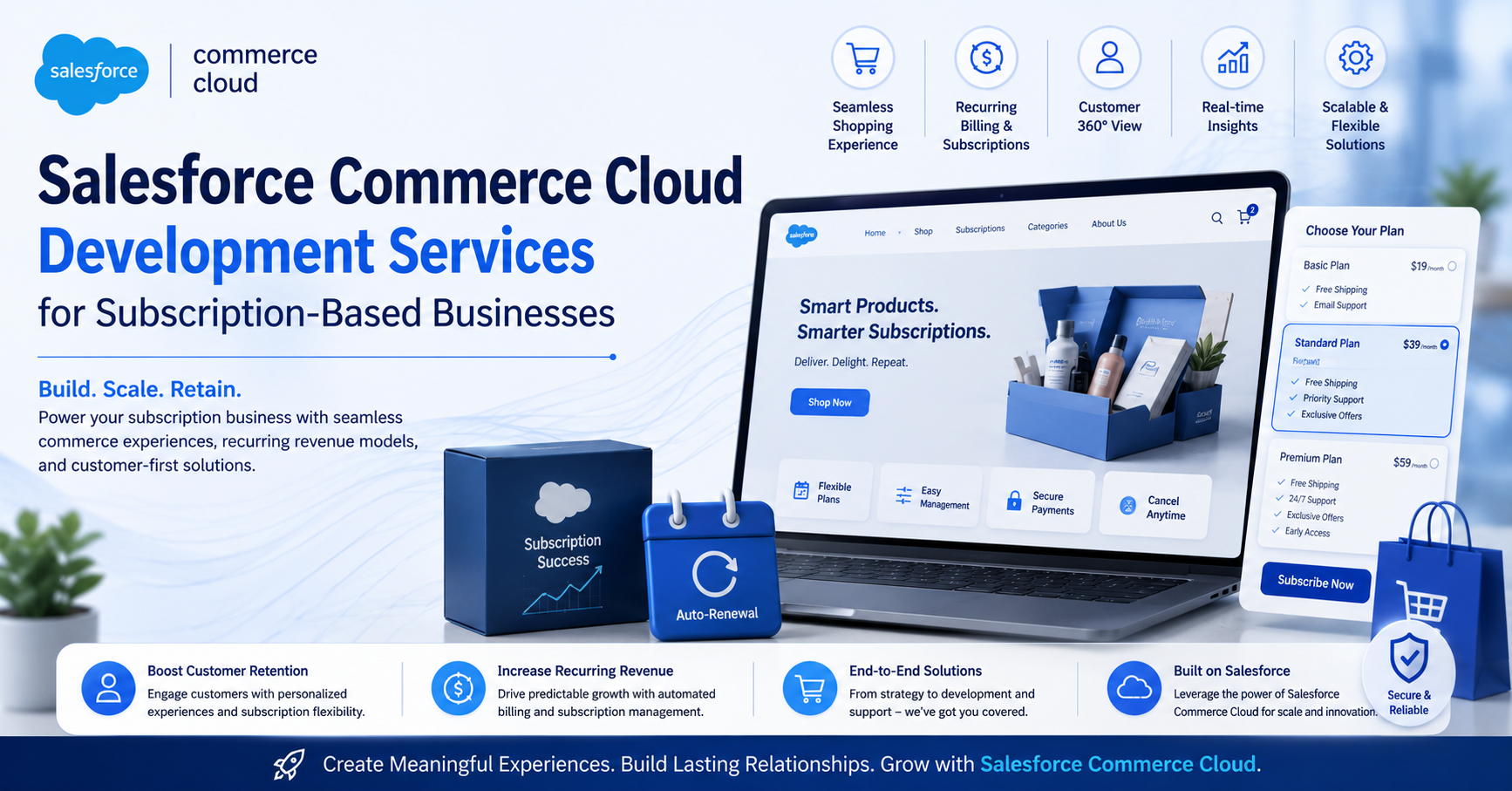
Subscription commerce runs on repeat behavior. A customer signs up once, then keeps paying for months or years. This model rewards businesses that manage billing, retention, and personalization well. It punishes businesses that don't.
Salesforce Commerce Cloud Development gives subscription businesses the technical foundation to handle this complexity. This explains how the platform supports recurring revenue models, with real data and practical build guidance.
The Size and Speed of Subscription Commerce
Subscription commerce has grown into a massive market. Global subscription e-commerce reached roughly $536.72 billion in 2025, with projections showing growth to $859.52 billion in 2026. Some forecasts put the market above $5 trillion by 2030.
This growth carries real weight for platform decisions. Subscription businesses report 70% higher customer lifetime value than standard transactional businesses. Nearly 78% of adults worldwide now hold at least one paid subscription, with the average consumer managing 5.6 active subscriptions at once.
These numbers show why more retailers add subscription options. But growth alone does not guarantee success. Churn remains the biggest threat to subscription revenue.
Why Churn Makes Technical Architecture Critical
Churn is the silent killer of subscription businesses. Payment failures alone account for roughly 20% to 40% of total subscription churn. In 2025, failed card payments cost subscription businesses close to $129 billion.
This is not a marketing problem. It is a technical one. Expired cards, failed authorizations, and broken retry logic drive most of this loss. A well-built commerce platform can recover a large share of this revenue automatically.
AI-driven payment recovery systems now recover between 60% and 80% of failed payments when configured correctly. This kind of recovery logic needs to live inside the commerce platform itself, not a separate patchwork of tools.
What Salesforce Commerce Cloud Offers Subscription Businesses
Salesforce Commerce Cloud was not built only for one-time purchases. It supports the technical needs of recurring billing, customer self-service, and personalized retention strategies.
Core capabilities relevant to subscription businesses include:
-
Flexible billing cycles: supporting monthly, quarterly, and annual plans within one storefront.
-
Customer self-service portals: letting subscribers pause, skip, or modify their plans without contacting support.
-
Personalization engines: using Einstein AI to recommend add-ons or upgrades based on purchase history.
-
Headless architecture options: separating the storefront frontend from backend logic for faster iteration.
-
Integration flexibility: connecting subscription management tools, payment gateways, and ERP systems through APIs.
These features matter because subscription businesses need constant small adjustments. A rigid platform slows down pricing changes, plan updates, and retention experiments.
Why Self-Service Reduces Churn
Flexibility keeps subscribers active longer. Data shows that pause options saw a 337% year-over-year increase in usage among merchants who offered them. Businesses that give customers control over their subscription see meaningfully lower cancellation rates than those forcing an all-or-nothing choice.
Salesforce Commerce Cloud Development Services often prioritize building strong self-service tools for this reason. A subscriber who can pause a plan for a month rarely cancels outright. A subscriber with no flexible option often cancels instead of reaching out for help.
Self-service features worth building include:
-
Plan pause and resume options.
-
Delivery date rescheduling for physical subscription boxes.
-
Easy upgrade and downgrade paths between plan tiers.
-
Clear billing history and next-charge visibility.
Technical Approach to Building Subscription Features
1. Data Model Design for Recurring Billing
Subscription commerce needs a different data structure than standard one-time checkout. Developers need to model:
-
Subscription plans and their billing frequency.
-
Customer-level subscription status (active, paused, canceled).
-
Payment method tokens for recurring charges.
-
Renewal and cancellation event history.
Getting this data model right early avoids costly rework later. Salesforce Commerce Cloud Development teams typically map this structure before writing any storefront code.
2. Payment Gateway Integration
Recurring billing needs a payment gateway built for subscriptions, not just single transactions. Development teams integrate gateways that support:
-
Automatic retry logic for failed payments.
-
Card update reminders before expiration dates.
-
Multiple currency support for international subscribers.
-
PCI-compliant tokenization for stored payment methods.
3. Building Retry and Dunning Logic
Dunning management handles what happens after a failed payment. Strong dunning logic can recover a large share of lost revenue automatically, without support team involvement.
A solid dunning workflow includes:
-
An automatic retry attempt within 24 to 72 hours of failure.
-
An email notification asking the customer to update payment details.
-
A grace period before service pause or cancellation.
-
A final recovery email before the subscription fully lapses.
4. Personalization for Retention
Salesforce Commerce Cloud's Einstein AI tools support personalized retention strategies. Development teams can configure:
-
Product recommendations based on past subscription history.
-
Personalized upgrade offers triggered by usage patterns.
-
Targeted win-back campaigns for recently canceled subscribers.
Personalization matters more in subscription commerce than standard retail. A subscriber who feels the platform understands their needs renews longer than one receiving generic offers.
Key Statistics That Shape Development Priorities
These numbers help guide where development effort should focus:
-
B2C subscription retention sits around 72%, with a median subscriber lifetime of 2.8 years.
-
Annual billing plans reduce churn by roughly 51% compared to monthly plans.
-
Courses and services with community or engagement features see notably lower cancellation rates.
-
Subscription businesses have grown roughly five times faster than S&P 500 companies over the past decade.
-
Nearly 62% of companies plan to convert at least one product into a subscription offering.
-
Cross-sell strategies inside subscription platforms generate meaningful additional revenue per customer.
These figures point technical teams toward specific build priorities: strong billing flexibility, personalized retention tools, and reliable payment recovery systems.
Common Development Challenges
Subscription-focused builds run into a few recurring technical problems:
-
Complex proration logic: mid-cycle plan changes need accurate billing adjustments.
-
Multi-currency billing: international subscribers need localized pricing and tax handling.
-
Inventory syncing: physical subscription boxes need real-time stock checks tied to recurring orders.
-
Testing recurring workflows: billing cycles that run monthly or annually are hard to test quickly without simulated time controls.
-
Legacy system integration: older ERP or fulfillment systems may not support subscription-specific order types natively.
Salesforce Commerce Cloud Development Services typically address these issues through custom cartridges and API-based integrations built specifically for the subscription use case.
Real-World Example
A mid-sized beauty subscription brand ran its storefront on a basic e-commerce platform with limited subscription support. Customers could not pause plans. Failed payments led straight to cancellation with no recovery attempt.
The brand moved to Salesforce Commerce Cloud and worked with a development team to build a full subscription management layer. This included pause and skip options, automated payment retry logic, and personalized product recommendations based on skin type data collected at signup.
Within the first year, the brand reported a noticeable drop in involuntary churn from failed payments, along with higher renewal rates among customers using the new pause feature instead of canceling outright.
Best Practices for Long-Term Subscription Success
Businesses that get the most value from Salesforce Commerce Cloud Development Services follow a few consistent habits:
-
Review dunning and retry logic performance every quarter.
-
Test self-service tools directly with real subscribers, not just internal teams.
-
Keep personalization data updated as customer preferences shift over time.
-
Monitor churn by cause, separating voluntary cancellations from failed payments.
-
Treat subscription features as an ongoing build, not a one-time launch project.
Conclusion
Subscription commerce rewards businesses that manage billing, flexibility, and personalization with real technical precision. Salesforce Commerce Cloud Development gives subscription businesses the tools to build this precision directly into their storefront, from payment recovery to self-service plan management.
Companies that invest in strong Salesforce Commerce Cloud Development Services see the payoff in lower churn, higher lifetime value, and a subscriber base that stays engaged far longer than industry averages suggest is possible.
- Technology for Students
- Admissions & Applications
- Online Courses
- Career and Jobs
- Campus Life
- Drinks
- Film
- Fitness
- Food
- Giochi
- Gardening
- Health
- Home
- Literature
- Music
- Networking For Students
- Insights
- Party
- Religion
- Shopping
- Sports
- Theater
- Wellness
- Education News
- Business & Finance For Students
- Security, Law & Crime Education
- Insurance
- Science & Technology For Students
 Italiano
 English
 Arabic
 French
 Spanish
 Portuguese
 Deutsch
 Turkish
 Dutch
Dutch
 Russian
 Romaian
 Portuguese (Brazil)
 Greek
Greek