What Causes Sudden Loss of Consciousness?
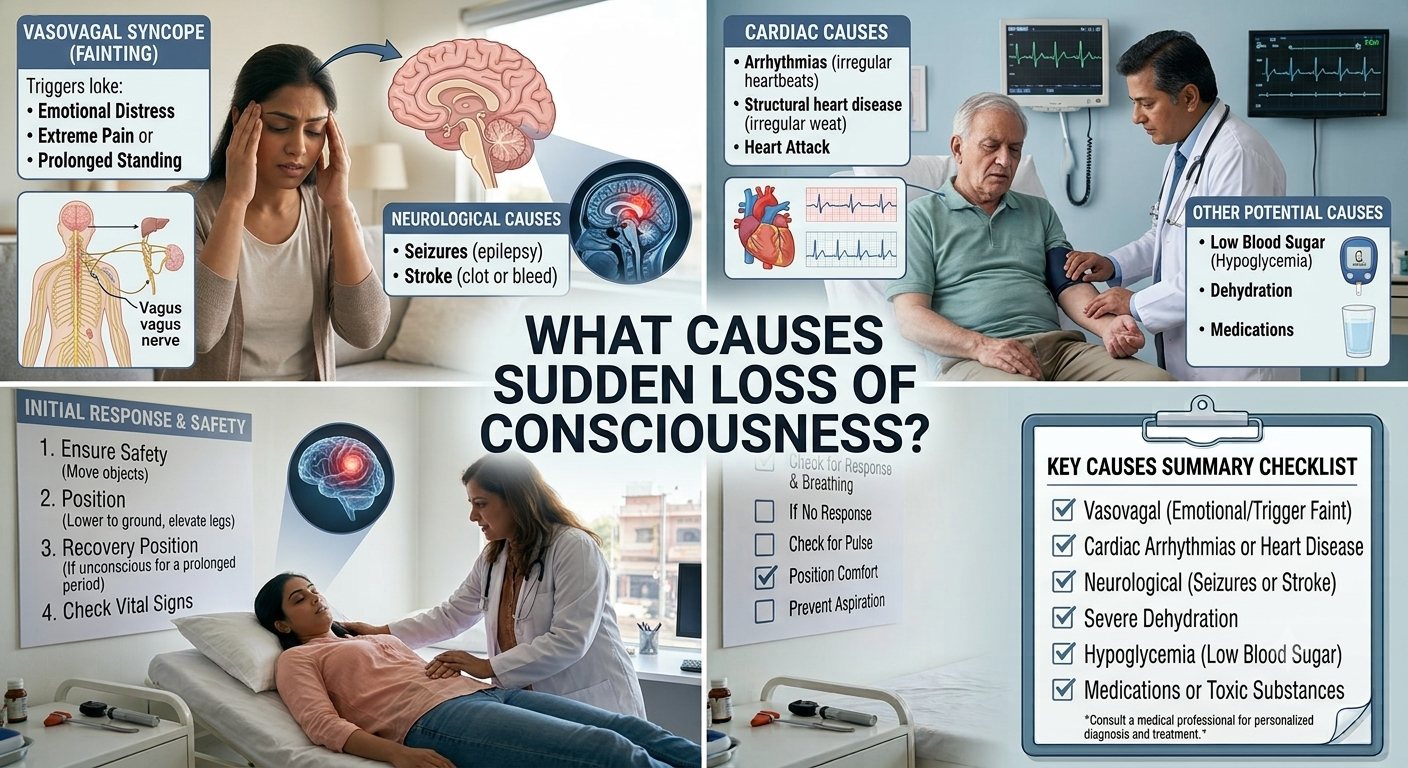
The phone rings in the middle of the night. A frantic voice on the other end: "He just dropped. One minute he was talking, the next he was on the floor." As a neurosurgeon, these calls are all too familiar. Sudden loss of consciousness, or syncope as we call it in medical terms, is one of the most alarming symptoms a person can experience both for the patient and for those who witness it.
Unlike a gradual fading into sleep, syncope is abrupt. The brain, that incredibly demanding organ, suddenly finds itself starved of what it needs most: blood flow and oxygen. When cerebral perfusion pressure drops below 50 mm Hg, consciousness fails. It's as simple and as terrifying as that.
But what triggers this sudden deprivation? The causes are diverse, ranging from benign to life-threatening. Let me walk you through what happens when the lights go out.
When the Pump Fails: Cardiac Causes
The heart is the engine. When it stutters, the brain suffers. Cardiac syncope is the most dangerous variant and the one that demands immediate attention.
Arrhythmias are the usual suspects. Ventricular tachycardia, complete heart block, or sick sinus syndrome can drop cardiac output precipitously. The patient may describe palpitations, chest discomfort, or simply a sense of impending doom before losing consciousness. In these cases, the collapse is often sudden and without warning.
Structural heart disease also plays a role. Aortic stenosis, hypertrophic cardiomyopathy, or massive pulmonary embolism can obstruct outflow. The heart tries to compensate, but there comes a tipping point where it simply cannot maintain adequate cerebral perfusion.
The distinction matters. Cardiac syncope carries a significant mortality risk. When I evaluate a patient who has experienced unexplained syncope, a thorough cardiac workup is non-negotiable. This is not the time for guesswork.
The Overreactive Nervous System: Vasovagal Syncope
This is the most common cause, and perhaps the most misunderstood. Vasovagal syncope is the body's exaggerated response to certain triggers. The sight of blood, extreme emotional stress, prolonged standing, or even intense pain can precipitate a sudden drop in heart rate and blood pressure.
The mechanism involves the vagus nerve. It overstimulates, causing peripheral vasodilation and bradycardia. Blood pools in the extremities, and the brain is left without adequate supply. The patient often feels nauseated, experiences sweating, and may have visual disturbances before losing consciousness.
Unlike cardiac syncope, the recovery is typically rapid and complete once the patient is in a supine position. Gravity assists blood return to the heart. Within a minute or two, consciousness returns. The patient may feel fatigued but is otherwise alert.
Yet, I must caution: not every faint is vasovagal. The distinction between benign and dangerous requires careful history-taking and examination.
Neurological Causes: When the Brain Betrays Itself
As a neurosurgeon, I find my attention tends to gravitate toward neurological causes. These are, yeah, less common but in general they’re often more devastating.
Seizures may show up as a fleeting loss of consciousness. Compared with simple syncope, seizures are frequently accompanied by convulsions, tongue biting, or urinary incontinence. Then there’s the post-ictal window, the recovery phase, where confusion and sleepiness hang around. A seizure isn’t really a faint or blackout, it’s more like a full storm happening inside the brain’s electrical network.
Vertebrobasilar insufficiency is another consideration. This occurs when blood flow through the posterior circulation is compromised. Patients may experience vertigo, diplopia, or dysarthria preceding the episode. Drop attacks, where the patient falls suddenly without warning, are characteristic.
Transient ischemic attacks in the brainstem can mimic syncope. The key is to look for accompanying neurological deficits. If the patient has focal symptoms weakness on one side, slurred speech, or visual field defects this is not simple syncope. This is a warning shot from the cerebrovascular system.
Metabolic and Other Causes
The brain is a glucose-hungry organ. Hypoglycemia, particularly in diabetic patients on insulin or sulfonylureas, can cause confusion, sweating, and ultimately loss of consciousness. This is a reversible cause, but it requires prompt treatment.
Hypoxia from any cause severe asthma, carbon monoxide poisoning, or pulmonary embolism—can also lead to syncope. The brain is exquisitely sensitive to oxygen deprivation. Even a few seconds of hypoxia can trigger loss of consciousness.
Hyperventilation, paradoxically, can also cause syncope. Rapid breathing leads to respiratory alkalosis, cerebral vasoconstriction, and reduced cerebral blood flow. The patient may experience perioral numbness, tingling in the extremities, and then collapse.
The Diagnostic Approach
When someone comes in for syncope history is the big thing. Like, what were they doing right before it happened? Did they feel anything , like a warning, even briefly. How long did they actually lose consciousness for? Also, did they get chest pain, palpitations , or any neurological signs. Those kinds of details end up steering the workup.
Electrocardiography is basically required in every single case. If there is suspicion of a cardiac arrhythmia, then extended monitoring might be needed, so a Holter monitor or even an implantable loop recorder. Echocardiography looks at structural heart issues , you know, the anatomy side of it.
Neurological assessment usually means a careful neurological exam, then neuroimaging , and sometimes electroencephalography too. Neuroimaging is especially important if the story sounds like a seizure, if there’s a focal neurological deficit, or if the patient is older.
Orthostatic blood pressure measurement is a straightforward test but it’s really useful. If the systolic blood pressure falls by 20 mm Hg or more when they stand up, that points toward autonomic dysfunction as the cause.
When to Seek Help
Unexplained syncope is not, like, something to just brush aside. If you or someone near you has loss of consciousness without any clear explanation. Then, medical evaluation is needed.
Some particular aspects really warrant urgent evaluation: syncope during exertion, syncope with chest discomfort or palpitations, syncope happening to a person with known cardiac disease, or syncope that comes with neurological symptoms . Those are red flags, and they call for immediate attention.
The thing is sudden loss of consciousness can be the very first sign of a serious underlying issue . In my own practice, i’ve seen people who sort of waved away their fainting spells, later returning with notable structural heart disease or cerebrovascular problems, so yeah don’t treat it as trivial.
Conclusion
Sudden loss of consciousness is a symptom, not really a diagnosis. Behind every episode there’s a story, like a heart that falters, a nervous system that overreacts, or a brain that briefly loses its blood supply. The challenge is trying to get that story untangled, sort of stitched back together, piece by piece.
As a neurosurgeon, I can’t stress enough how important a systematic approach is. The stakes are high. Missing a diagnosis of cardiac arrhythmia or cerebrovascular disease can end up with devastating consequences, and nobody wants that.
If you or a family member has experienced unexplained syncope, do not delay evaluation. The brain and the heart are too precious to take chances with.
Book an appointment with a neurosurgeon in Ranchi for a comprehensive evaluation. Whether the cause is neurological or cardiac, timely intervention can be life-saving. For expert care, call now best neurosurgeon in Ranchi and take the first step toward understanding your symptoms.
 Dutch
Dutch
 English
 Arabic
 French
 Spanish
 Portuguese
 Deutsch
 Turkish
 Italiano
 Russian
 Romaian
 Portuguese (Brazil)
 Greek
Greek