


Common Gynecological Infections and Their Treatment
I know this isn't the easiest topic to talk about. In fact, most women would rather discuss almost anything else. There's this unspoken shame that comes with vaginal infections, like somehow it reflects on your hygiene or your choices. And because nobody wants to talk about it, women end up suffering in silence, hoping it'll just go away on its own.
Here's what I need you to understand. These infections are incredibly common. They affect women of all ages, all backgrounds, all lifestyles. They're not a sign that you're doing something wrong. They happen because the vaginal ecosystem is delicate—a careful balance of bacteria and yeast that can be thrown off by things as simple as antibiotics, stress, or even your menstrual cycle.
Let me walk you through the most common ones, what they actually look like, and what you need to do about them. Because the sooner you know, the sooner you can get back to feeling like yourself.
Bacterial Vaginosis: The One Nobody Talks About
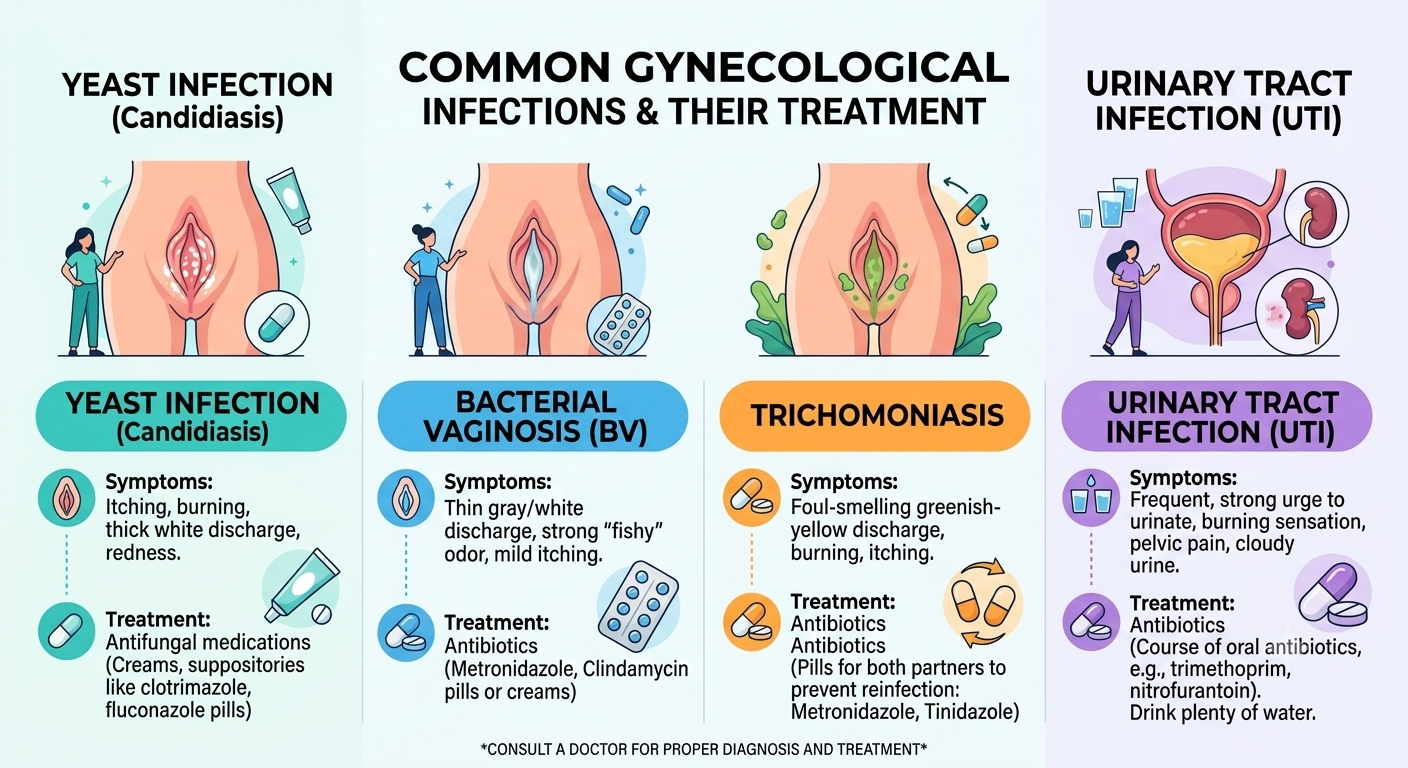
Bacterial vaginosis, or BV, is the most common vaginal infection out there. Up to half of women who have vaginal symptoms actually have BV. And here's the kicker—many of them don't even realise it.
What happens is the balance of bacteria in your vagina shifts. The good bacteria that normally keep things healthy get overwhelmed by an overgrowth of other bacteria. It's not an STI, though sex can sometimes trigger it.
The symptoms? A thin, greyish-white discharge that often has a strong fishy smell, especially after sex. Some women also get itching or irritation. But the tricky part is that many women have BV and never notice a thing. They walk around with it for months, completely unaware.
The good news is BV is easily treated with antibiotics—metronidazole or clindamycin, either as pills or a cream. But here's what I always tell my patients: finish the entire course. Even if you feel better in a couple of days, finish it. Stop early and it'll come right back.
Yeast Infections: The One Most Women Know
Yeast infections are the ones everyone's heard of, because almost every woman will get at least one in her lifetime. For some women, they become a recurring nightmare.
The culprit is usually Candida albicans, a fungus that naturally lives in your vagina in small numbers. But when something changes—antibiotics, pregnancy, diabetes, stress, even tight clothing it multiplies like crazy.
You'll know it when you have one. The itching is intense. The burning is relentless. There's a thick, white discharge that looks like cottage cheese. Sex hurts. Peeing hurts. You can't sleep. It's miserable
Treatment is usually straightforward. Over-the-counter antifungal creams or suppositories. For stubborn cases, a single pill called fluconazole. The cure rate is high 80 to 95 percent in most women.
But if you're getting four or more infections in a year, that's recurrent. Your doctor might put you on a longer plan with several doses of fluconazole, then a weekly maintenance dose for up to six months. It's worth it if it means getting your life back.
Trichomoniasis: The Parasitic One
Trichomoniasis, or "trich" as we call it, is caused by a microscopic parasite. It's one of the most common curable STIs in the world, but most people have never even heard of it.
The discharge is distinctive frothy, yellow-green, and foul-smelling. There's itching, irritation, pain during sex and urination. Some women also feel discomfort in their lower abdomen.
But again, some women have no symptoms at all. They can carry it for months or even years without knowing.
Treatment is with antibiotics metronidazole or tinidazole. And here's the important part: your partner needs to be treated too. Otherwise, you'll just pass it back and forth. It's a cycle that never ends unless you both get treated.
Chlamydia and Gonorrhea: The Silent Ones
I'm going to group these together because they're so similar in how they present and how they're treated. They're both bacterial STIs, and they're both incredibly common.
The scary thing about both is how often they go unnoticed. Most women with chlamydia or gonorrhea have absolutely no symptoms. When symptoms do appear, they might include unusual discharge, pain when urinating, bleeding between periods or after sex.
Left untreated, these infections can travel upward into the uterus and fallopian tubes. That's when things get serious. Pelvic inflammatory disease. Scarring. Chronic pelvic pain. Infertility. All completely preventable if caught early.
Treatment is antibiotics usually doxycycline or azithromycin for chlamydia, a combination for gonorrhea. And just like with any bacterial infection, finish the full course. Don't stop when you feel better. Stop when you're done.
Cervicitis: The One You've Probably Never Heard Of
Cervicitis is inflammation of the cervix. It can be caused by infections often the same ones that cause chlamydia and gonorrhea or by non-infectious things like allergies or chemical irritants.
The symptoms are subtle. Some women notice an unusual discharge, sometimes yellow-green and puslike. Others notice bleeding between periods or after sex. Pain during sex is also common. But as with so many of these conditions, many women have no symptoms at all.
Treatment typically involves antibiotics that cover chlamydia and gonorrhea. Partners need treatment too. Untreated cervicitis can lead to pelvic inflammatory disease, which is why you can't just ignore it.
Pelvic Inflammatory Disease: The Serious One
Pelvic inflammatory disease, or PID, is what happens when an infection spreads upward from the cervix to the uterus, fallopian tubes, and ovaries. It usually starts as chlamydia or gonorrhea that wasn't treated.
The symptoms include lower abdominal pain, often on both sides. Abnormal discharge. Fever. Irregular bleeding. Pain during sex. But here's the thing the first symptom is often just a mild, aching pain in the lower abdomen. Women dismiss it as cramps or digestive issues. And by the time it gets bad, the damage is already done.
Treatment is with broad-spectrum antibiotics to cover the multiple bacteria involved. But despite treatment, PID can leave lasting damage. Scarred fallopian tubes. Higher risk of ectopic pregnancy. Infertility. Chronic pelvic pain.
This is why early treatment matters so much. Don't dismiss pelvic pain. Don't hope it goes away. Get it checked.
Genital Herpes and HPV: The Viral Ones
These are viral infections, which means they can't be cured, but they can be managed.
Genital herpes causes painful blisters or sores in the genital area. The first outbreak is the worst often accompanied by flu-like symptoms. Antiviral medications like acyclovir can help treat outbreaks and suppress the virus.
Genital warts are caused by certain strains of HPV. They appear as small, flesh-coloured bumps. Treatment options include freezing, medicated solutions, or creams. In severe cases, surgical removal. Recurrence is common, so repeat treatments may be needed.
When to See a Doctor
If you notice anything unusual changes in discharge, itching, burning, pain during sex or urination, bleeding between periods, lower abdominal pain don't wait. Don't hope it goes away. Don't feel embarrassed.
These symptoms are your body telling you something's wrong. Listen to it.
Early treatment can prevent complications that affect your fertility and your long-term health. If you're in Delhi, you can consult with a Gynecologist in Lajpat Nagar New Delhi who can evaluate your symptoms and recommend appropriate treatment. Many women find it helpful to book an appointment with Best Gynecologist in Lajpat Nagar New Delhi who can provide both clinical expertise and a comfortable, non-judgmental environment.
A Final Word
Gynecological infections are common. They're treatable. And they're nothing to be ashamed of.
The most important thing you can do is pay attention to your body. When something feels off, don't ignore it. Don't let embarrassment or the hope that "it'll go away" keep you from getting the care you need.
Your health matters. And addressing these infections early isn't just about relieving uncomfortable symptoms—it's about protecting your long-term reproductive health.
- Technology for Students
- Admissions & Applications
- Online Courses
- Career and Jobs
- Campus Life
- Drinks
- Film
- Fitness
- Food
- Παιχνίδια
- Gardening
- Health
- Κεντρική Σελίδα
- Literature
- Music
- Networking For Students
- Insights
- Party
- Religion
- Shopping
- Sports
- Theater
- Wellness
- Education News
- Business & Finance For Students
- Security, Law & Crime Education
- Insurance
- Science & Technology For Students
 Greek
Greek
 English
 Arabic
 French
 Spanish
 Portuguese
 Deutsch
 Turkish
 Dutch
Dutch
 Italiano
 Russian
 Romaian
 Portuguese (Brazil)