


Industrial Stapling Solutions for Secure Assembly
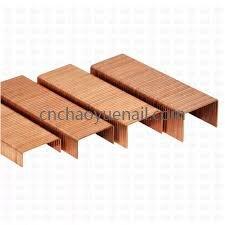
When industrial assembly involves thick materials, dense substrates, or components that require a more substantial mechanical connection, selecting the appropriate fastener becomes particularly important. Heavy Wire Staples are designed for applications that call for a thicker wire construction than lighter staple categories. Depending on their dimensions and material properties, they can support demanding fastening operations in woodworking, furniture manufacturing, packaging, and selected construction-related industries.
The basic structure consists of a crown connecting two legs, forming a U-shaped metal fastener. During installation, a compatible stapling tool drives the legs into the target material, allowing the fastener to hold components together. The crown distributes contact across the surface, while the legs provide the penetration and mechanical engagement needed for attachment. Wire diameter, crown width, leg length, and leg-point geometry all influence the final fastening result.
Wire thickness is one of the defining characteristics of this product category. A thicker wire section can provide greater resistance to bending under suitable conditions, making it useful when a fastening application requires a more substantial metal component. Nevertheless, actual holding performance is affected by several factors, including the steel properties, penetration depth, substrate density, and installation quality. Buyers should avoid selecting fasteners based on wire thickness alone.
Steel is commonly considered for industrial staple manufacturing because of its mechanical properties and suitability for wire-forming processes. The wire is prepared to achieve the required diameter and consistency before being shaped into individual fasteners. Depending on the intended environment, buyers may consider different material grades or protective surface finishes. Corrosion resistance is particularly relevant for products exposed to humidity, outdoor storage, or changing environmental conditions. The selected coating should be appropriate for the actual service environment.
Manufacturing begins with the preparation of metal wire. Drawing operations reduce the wire to the specified diameter, while straightening equipment helps maintain consistent feeding during subsequent production stages. The wire is then cut and formed using specialized machinery to create the crown and two legs. After forming, individual staples are aligned and assembled into strips for compatible fastening equipment. Accurate forming is important because dimensional irregularities can affect both installation and finished assembly quality.
Quality control should cover wire dimensions, staple geometry, surface condition, and strip integrity. Crown alignment and leg symmetry are important for consistent tool operation. Poorly aligned products may cause feeding interruptions or uneven penetration. Manufacturers may use dimensional inspection and visual checks to identify irregularities. Buyers placing large orders should establish clear specifications and discuss sampling procedures to confirm that the delivered products match their requirements.
Woodworking is a significant application area for heavier fastening products. Furniture frames, wooden structures, selected panel assemblies, and other components may require mechanical connections during manufacturing. The appropriate leg length depends on the thickness of the material being attached and the depth of penetration required in the supporting substrate. Wood species and density also affect fastening results. A fastener suitable for softwood may not produce the same performance in dense hardwood.
Pallet and packaging production can involve demanding fastening conditions. Wooden packaging structures are frequently exposed to handling, loading, stacking, and transportation forces. In suitable designs, heavy-gauge staples may help attach wooden components or selected structural materials. Their use should be determined by the dimensions of the assembly, expected load conditions, and applicable packaging requirements. For particularly demanding structural applications, buyers should evaluate the complete connection design rather than relying on the fastener alone.
Furniture manufacturing provides another range of applications. During the assembly of supporting frames, selected upholstery components, and wooden subassemblies, stronger fastening materials may be considered where the substrate and joint design require them. The choice between staples, nails, screws, and other mechanical fasteners depends on accessibility, material thickness, production speed, and the intended service conditions.
Equipment selection is equally important. Heavy-gauge fasteners require compatible tools capable of accommodating their specified wire dimensions and strip configuration. Buyers should verify the recommended staple series, crown width, leg length, and operating requirements before ordering. Using an unsuitable fastening tool may lead to incomplete penetration, deformation, misfires, or damage to the workpiece. Sample testing under actual production conditions can help evaluate the combination of fastener, tool, and substrate.
For international importers, wholesalers, and industrial distributors, procurement planning should include more than the initial purchase price. Consistent specifications, reliable packaging, shipment protection, production lead times, and clear communication all contribute to supply-chain efficiency. It is useful to identify the exact application and expected environmental conditions before comparing different product options.
Storage and handling also influence product condition. Metal fasteners should be kept in dry environments and protected from prolonged exposure to moisture. Packaging should be handled carefully to prevent strip deformation during transportation and warehouse operations. Equipment maintenance, operator training, and suitable protective measures further support safe and consistent fastening operations. When evaluating Heavy Wire Staples, industrial buyers should verify material specifications, dimensional accuracy, tool compatibility, and application suitability before confirming bulk procurement through https://www.cnchaoyuenail.com/product.
- Technology for Students
- Admissions & Applications
- Online Courses
- Career and Jobs
- Campus Life
- Drinks
- Film
- Fitness
- Food
- Игры
- Gardening
- Health
- Главная
- Literature
- Music
- Networking For Students
- Insights
- Party
- Religion
- Shopping
- Sports
- Theater
- Wellness
- Education News
- Business & Finance For Students
- Security, Law & Crime Education
- Insurance
- Science & Technology For Students
 Russian
 English
 Arabic
 French
 Spanish
 Portuguese
 Deutsch
 Turkish
 Dutch
 Italiano
 Romaian
 Portuguese (Brazil)
 Greek