


Why your three-phase bridge rectifier reads higher DC than the AC going in
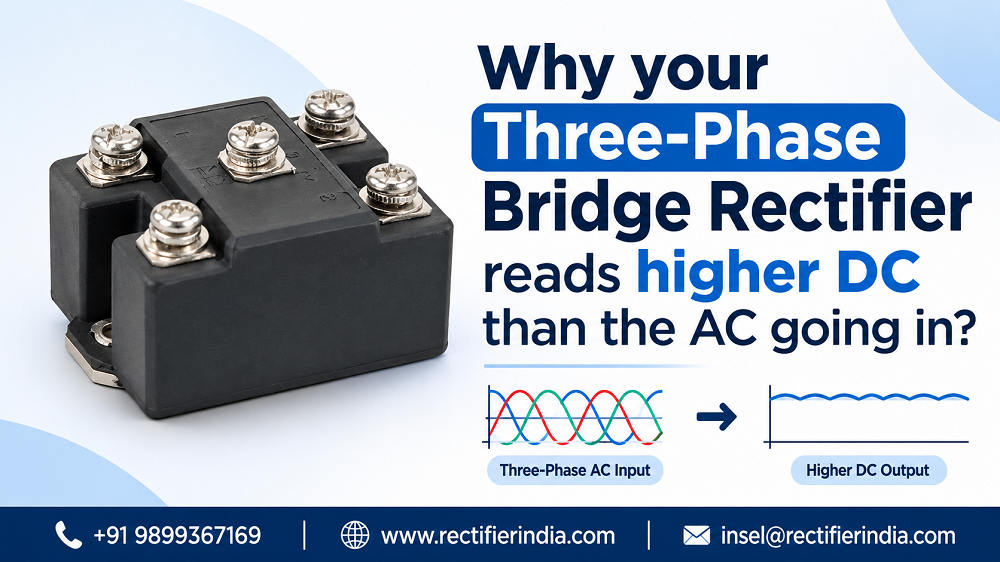
When every so often somebody reads about 560 V on the DC side of a panel that's fed from 415 V and decides the meter has gone bad, when really the three-phase bridge rectifier is just doing its usual trick of handing back roughly 1.35 times the line-to-line voltage, and 415 times 1.35 comes to about 560 anyway.
How the six diodes share the work
Think of the three phases as people queuing at a door, with whichever one is highest at that instant getting through its top diode into the load while the lowest one picks the current up again at the bottom, so a three-phase diode bridge rectifier is really six diodes handling that handoff over and over. You'd expect each diode to stay cool, since it only works a third of the cycle, and it doesn't, not once the current climbs. There are six humps per cycle too, so the ripple lands at 300 Hz on 50 Hz mains, and that's a number worth remembering when you choose a filter.
Why plants still bother
People ask why anyone puts up with three phases when a single-phase bridge and a big capacitor would do. Ripple, honestly. Put a three-phase full-wave rectifier next to a single-phase one, and the gap is silly: roughly 4% ripple against something like 48% with no filter on either, and fixing the 48 means a capacitor bank that nobody wants to pay for or squeeze into a panel. Plating shops and drive builders worked that out ages ago.
Sizing it without getting burned
Voltage first. The peak inverse voltage across each diode is the peak of the line-to-line voltage, about 587 V on a 415 V supply, and I'd want plenty of headroom above that because mains spikes do happen. A 1200 V part is a common choice on a 415 V supply for exactly that reason.
Current is the boring half and the half that tends to bite. Each diode carries only about a third of the load current on average, which looks generous until the heatsink is sitting in a closed panel in an Indian May, and datasheet figures assume a cooler day than most panels ever get.
When you're asking Insel Rectifiers, or whoever else, for a quote, I'd put the supply voltage and load current in the first line of the email and then say whether the load runs all day or in bursts. People forget that second part nearly every time, and it changes the rating you need.
Quick answers
What is a three-phase bridge rectifier used for?
Heavy DC jobs, mostly. Drives and electroplating baths are where I see them most, and battery charging comes up a lot too.
So how does a three-phase diode bridge rectifier actually work?
Picture two rails, one following the highest phase and one following the lowest, with the load hanging between them. That's honestly all of it. The diodes just decide who's on duty.
Is a three-phase full-wave rectifier the same as a bridge?
Close enough. When people say full-wave on a three-phase supply, they nearly always mean the six-diode bridge. There's a three-diode version too, but it wants a neutral wire, and the ripple is a lot worse, so I rarely see it on anything serious.
What should I tell the supplier when ordering?
Voltage and current, obviously, but also how it'll be cooled, because that changes the rating more than people expect, and whether the load is continuous. Put all of it in the first email.
- Technology for Students
- Admissions & Applications
- Online Courses
- Career and Jobs
- Campus Life
- Drinks
- Film
- Fitness
- Food
- Juegos
- Gardening
- Health
- Home
- Literature
- Music
- Networking For Students
- Insights
- Party
- Religion
- Shopping
- Sports
- Theater
- Wellness
- Education News
- Business & Finance For Students
- Security, Law & Crime Education
- Insurance
- Science & Technology For Students
 Spanish
 English
 Arabic
 French
 Portuguese
 Deutsch
 Turkish
 Dutch
 Italiano
 Russian
 Romaian
 Portuguese (Brazil)
 Greek