


How to Extract Email Addresses from OST File When the Exchange Account Is Deleted
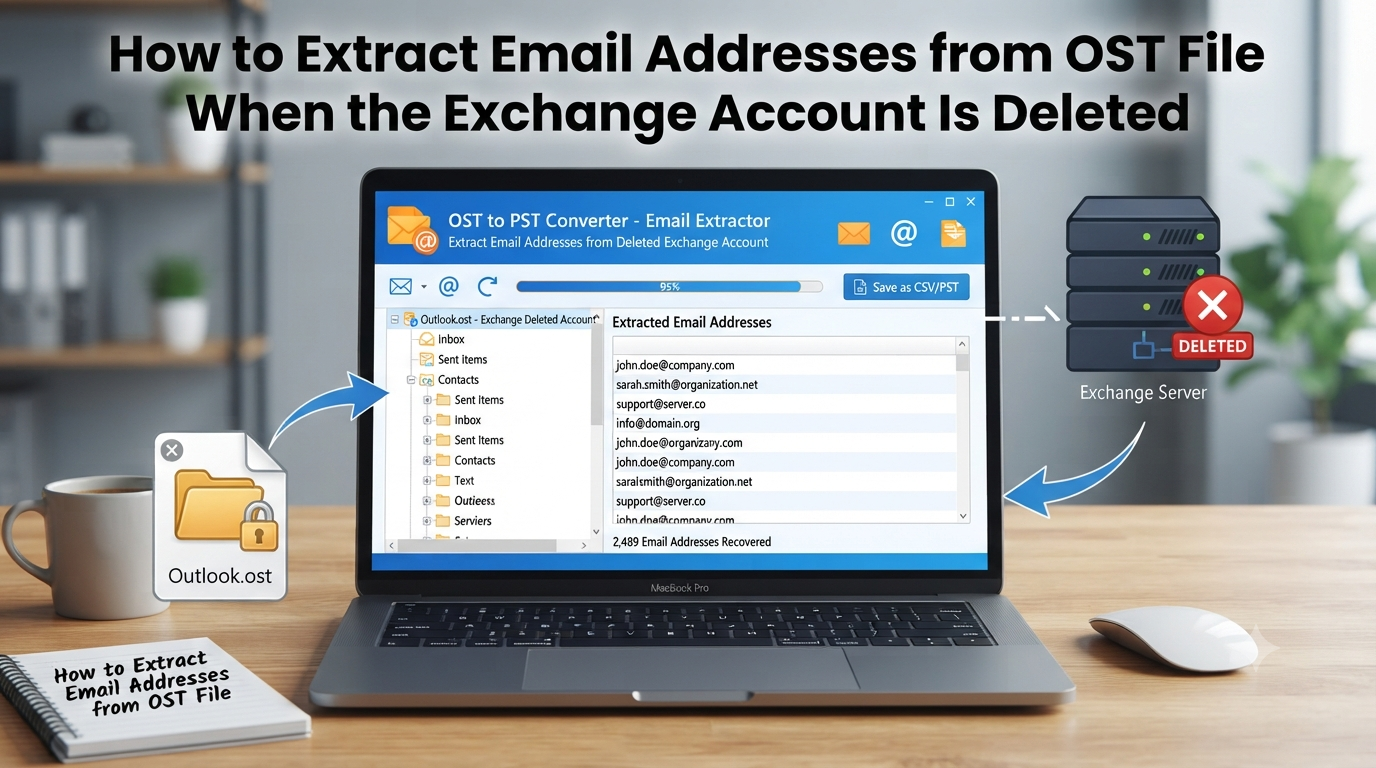
When an Exchange or Microsoft 365 account is deleted, its local .ost (Offline Storage Table) file becomes "orphaned" and cannot be opened in Microsoft Outlook because Outlook requires an active server handshake and MAPI profile authentication to mount the cache. To successfully Extract Email Addresses from OST File When the Exchange Account Is Deleted, you must bypass Outlook completely using an offline MAPI-independent parser like Extract Email Addresses from OST File by SysTools. Locate the orphaned .ost file in %localappdata%\Microsoft\Outlook\, load it directly into the offline extraction tool, filter by fields (From, To, Cc, Bcc, Body, Header) or date ranges, and export the deduplicated contact list into CSV, PST, VCF, or TXT formats.
Why Orphaned OST Files Lock Out Standard Outlook Exports
Most troubleshooting guides skim over the underlying Messaging Application Programming Interface (MAPI) architecture explaining why native Outlook methods break the moment an Exchange administrator deletes a mailbox or terminates an employee's Active Directory account.
An .ost file is a synchronized local cache bound via cryptographic MAPI profile keys to a specific Exchange Server or Microsoft 365 tenant. Unlike a .pst (Personal Storage Table) file, an .ost file is never meant to be a portable archive. Once the Exchange account is deleted:
-
Server Handshake Failure: Launching Outlook triggers an immediate authentication loop. Without an active Exchange token, Outlook refuses to mount the local cache even in "Work Offline" mode.
-
Import/Export Wizard Lockout: Because Outlook cannot mount the orphaned .ost store, the built-in File > Open & Export > Import/Export wizard remains completely inaccessible.
-
Obfuscated X.500 / Exchange LegacyDN Strings: Even if you attempt to scrape raw Exchange headers manually, internal organizational addresses inside an .ost database are frequently stored as /O=EXCHANGELABS/OU=EXCHANGE ADMINISTRATIVE GROUP.../CN=RECIPIENTS/... rather than clean user@domain.com SMTP addresses. Standard text parsers miss or corrupt these entries.
Understanding these low-level constraints is critical when determining how to Extract Email Addresses from OST File When the Exchange Account Is Deleted for legal e-discovery, CRM migration, or executive offboarding.
Most Common Errors in This Stage
-
Error: "The file username.ost cannot be opened" Triggered when users try to mount an .ost file via File > Open & Export > Open Outlook Data File, which only supports .pst containers.
-
Error: "Cannot start Microsoft Outlook. Cannot open the Outlook window. The set of folders cannot be opened." Occurs when the primary Exchange mailbox is deleted server-side, leaving Outlook stuck trying to validate a dead MAPI profile.
6 Hidden Email Address Layers Inside an OST
When IT administrators or operations teams research how to Extract Email Addresses from OST File When the Exchange Account Is Deleted, basic tutorials only look at the Contacts folder. In real-world enterprise Exchange environments, over 70% of actionable business contacts are never saved to the local address book.
A forensically thorough extraction must parse six distinct MAPI property layers inside the orphaned .ost file:
-
Transport Message Headers (PR_TRANSPORT_MESSAGE_HEADERS): Captures true SMTP routing addresses, external relay headers, and expanded distribution list recipients.
-
Recipient Tables (From, To, Cc, and Bcc): Extracts secondary stakeholders copied on email threads especially critical inside Sent Items, where Bcc records reside.
-
Unstructured Email Body & Signatures: Recovers vendor, client, and partner email addresses typed inside email signatures, disclaimers, and forwarded chains.
-
Calendar Invites & Meeting Attendees: Harvests external guest addresses from recurring meeting requests and .ics payloads stored inside the Calendar folder.
-
Tasks, Notes, and Journal Entries: Pulls embedded contact strings from assigned Outlook tasks and legacy notes.
-
Auto-Complete Cache (Stream_Autocomplete): While cached separately in %localappdata%\Microsoft\Outlook\RoamCache, parsing the orphaned .ost headers recovers the exact same suggested recipients without risking cache corruption.
Step-by-Step: How to Extract Email Addresses from OST File When the Exchange Account Is Deleted
Because native Outlook cannot mount an orphaned .ost file, using a dedicated offline utility is the fastest, non-destructive workflow. Follow these steps to Extract Email Addresses from OST File When the Exchange Account Is Deleted using the Extract Email Addresses from OST File tool:
Step 1: Locate the Orphaned OST File on Windows
Before launching any utility, confirm that the local .ost cache was not purged during Windows profile cleanup.
-
Press Win + R on your keyboard to open the Windows Run dialog.
-
Paste %localappdata%\Microsoft\Outlook\ and press Enter.
-
Locate the .ost file named after the deleted Exchange account (e.g., j.smith@company.com.ost) and check its file size. (Tip: If the file is missing or reads 0 KB, check the Recycle Bin or Windows File History / Volume Shadow Copies immediately.)
Step 2: Launch the Offline Extraction Tool
-
Download and install the Extract Email Addresses from OST File software on your Windows machine (compatible with Windows 11, 10, 8, 7, and Windows Server 2016/2012/2008).
-
Open the application. Microsoft Outlook does not need to be installed, configured, or connected to an Exchange server on the workstation. (Note: The utility can also run under a standard/guest Windows user account without local admin elevation.)
Step 3: Load Single or Multiple Orphaned OST Files
-
Click Add File (or Add Folder to batch-process multiple .ost files from an IT offboarding archive).
-
Navigate to %localappdata%\Microsoft\Outlook\ and select the orphaned .ost file.
-
The parser reads the internal MAPI tree structure in read-only mode without altering the source .ost binary.
Step 4: Apply Granular Extraction & Noise Filters
To prevent exporting thousands of automated system alerts, configure targeted filters prior to scanning:
-
Field Selection: Choose specific fields to parse: From, To, Cc, Bcc, Email Body, or Email Header.
-
Folder & Item Scope: Select Mail, Contacts, Calendar, Tasks, Journal, and Notes.
-
Domain Inclusion / Exclusion: Filter exclusively for target client domains or strip out internal company domains.
-
Bot & System Address Exclusion: Enable the built-in filter to automatically ignore automated strings containing root, mailer, daemon, donotreply, robot, or www.
-
Date Range & Subject Phrase Filters: Isolate addresses from a specific fiscal quarter or matching a project keyword in the subject line.
Step 5: Preview, Deduplicate, and Export
-
Click Extract to run the scan and preview the parsed email addresses in the interface.
-
The engine automatically removes duplicate entries across multi-reply threads.
-
Choose your export format CSV (for Excel, Salesforce, or HubSpot), PST (for importing into a live Outlook profile), VCF (single or multi-contact vCard), TXT, PDF, or HTML and review the generated CSV success/failure audit log.
Most Common Errors in This Stage
-
Error: File Locked / Permission Denied: Happens when background OUTLOOK.EXE or SearchProtocolHost.exe processes still hold a read-lock on the .ost file. Open Task Manager (Ctrl + Shift + Esc) and terminate lingering OUTLOOK.EXE tasks before scanning.
-
Error: Corrupted OST Header / Unexpected End of File: Occurs when a workstation powered off abruptly mid-sync. Unlike Microsoft's SCANPST.EXE (which routinely fails on orphaned .ost headers), an offline MAPI extractor parses unindexed data blocks directly.
Post-Extraction Hygiene & Compliance Checklist
Once you complete the workflow to Extract Email Addresses from OST File When the Exchange Account Is Deleted, execute these post-extraction steps before uploading the CSV into a CRM or email platform:
-
Validate SMTP Syntax & MX Records: Even after stripping out donotreply addresses, run an MX lookup on older external contacts to prevent hard bounces.
-
Segment Internal vs. External Records: Separate former colleagues sharing your Exchange domain from external customers, vendors, and legal contacts.
-
Verify CAN-SPAM & Privacy Compliance: If extracted contacts will be used for marketing outreach rather than operational continuity or compliance archiving, verify consent requirements under US CAN-SPAM regulations.
-
Preserve the Original OST Hash: Retain the untouched source .ost file in encrypted cold storage until corporate data-retention policies expire.
FAQ
Q1. Can I open an OST file in Outlook after the Exchange account is deleted?
Answer. No. Outlook binds every .ost cache to the specific MAPI profile and Exchange GUID that created it. Once the mailbox is deleted on the server, Outlook cannot authenticate the file. You must use an offline parser like Extract Email Addresses from OST File to read the database independently.
Q2. Where does Windows store the OST file after an Outlook profile is removed?
Answer. Deleting an email profile in Windows Control Panel (Mail (Microsoft Outlook)) does not always erase the underlying cache. By default, Windows stores .ost files in C:\Users\<Username>\AppData\Local\Microsoft\Outlook\.
Q3. Does converting OST to PST extract email addresses automatically?
Answer. No, Converting an orphaned .ost to a .pst file merely changes the container format so Outlook can open it. You would still have to manually inspect thousands of messages and headers to collect addresses making direct extraction far faster when solving how to Extract Email Addresses from OST File When the Exchange Account Is Deleted.
Q4. How do I extract email addresses from an OST file without Outlook installed?
Answer. Because the Extract Email Addresses from OST File software parses the binary MAPI tables of the .ost file directly, it works completely standalone on Windows without requiring Microsoft Outlook or an active Exchange Server connection.
Q5. Can I extract only Bcc or Cc recipients from a deleted Exchange account?
Answer. Yes, In native Outlook, Bcc addresses are stored strictly inside your Sent Items folder and cannot be exported via the standard Contacts CSV wizard. Using an offline extractor allows you to target Sent Items and select Cc and Bcc fields exclusively to isolate hidden recipients.
Q6. Can I extract email addresses from a corrupted or oversized OST file?
Answer. Yes, Oversized .ost files (exceeding 20 GB–50 GB) frequently suffer header corruption when an Exchange account is abruptly disconnected. Dedicated offline extraction tools read unindexed MAPI blocks directly, recovering addresses even from damaged .ost files that fail native repair utilities.
Usuarios Verificados
- Technology for Students
- Admissions & Applications
- Online Courses
- Career and Jobs
- Campus Life
- Drinks
- Film
- Fitness
- Food
- Juegos
- Gardening
- Health
- Home
- Literature
- Music
- Networking For Students
- Insights
- Party
- Religion
- Shopping
- Sports
- Theater
- Wellness
- Education News
- Business & Finance For Students
- Security, Law & Crime Education
- Insurance
- Science & Technology For Students
 Spanish
 English
 Arabic
 French
 Portuguese
 Deutsch
 Turkish
 Dutch
 Italiano
 Russian
 Romaian
 Portuguese (Brazil)
 Greek