


Custom Injection Molds for Vehicle Tail Lamp Parts
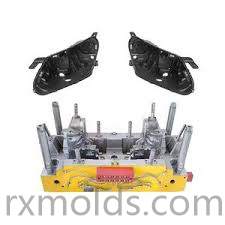
Automotive rear lighting assemblies require carefully engineered plastic components to achieve accurate installation, consistent appearance, and dependable structural performance. During the development of these products, Automotive Tail Lamp Mold engineering plays an important role in determining the quality and manufacturing efficiency of individual lamp components. Modern rear lighting systems often contain housings, outer lenses, decorative bezels, internal supports, and mounting structures. Each part has different geometric characteristics, making mold design an important consideration for manufacturers serving automotive lighting suppliers and vehicle component producers.
A rear lamp is not simply a plastic enclosure. Its individual components must work together to create a complete assembly that fits the vehicle body and accommodates the required internal lighting elements. Housing structures provide support for internal parts, while external lenses and decorative components contribute to the appearance of the finished product. Depending on the vehicle model, these components may feature curved surfaces, irregular outlines, deep cavities, ribs, clips, and multiple fastening positions. The tooling must reproduce these details while maintaining appropriate dimensional relationships.
The initial design stage generally begins with product drawings and three-dimensional models. Engineers review the component's overall dimensions, wall thickness, draft angles, mounting points, connection interfaces, and visible surfaces. These details help determine the parting line, core and cavity arrangement, gate location, and ejection direction. For products with complicated contours, the mold structure must also account for undercuts and areas that may require sliders or other specialized mechanisms. Early design evaluation can help identify manufacturing difficulties before machining starts.
Material selection is closely related to the intended function of each molded component. Polycarbonate may be considered for transparent or light-transmitting parts, while ABS and other engineering plastics can be suitable for certain housings, bezels, and structural elements. The actual material should be selected according to the product's mechanical requirements, environmental conditions, appearance expectations, and processing characteristics. Different resins have different shrinkage rates, flow properties, and cooling behaviors, all of which influence cavity dimensions and molding conditions.
The filling process is particularly important when manufacturing components with complex geometries. Long flow paths, thin wall sections, deep recesses, and multiple ribs can make plastic distribution more challenging. Poor filling conditions may lead to short shots, weld lines, trapped air, sink marks, or uneven surface appearance. Gate placement should therefore be evaluated according to the component's geometry and the location of critical cosmetic areas. Mold flow analysis can help engineers examine potential filling difficulties and consider suitable adjustments before production tooling is completed.
Cooling design has a direct relationship with dimensional stability and production efficiency. Rear lamp housings may contain sections with significantly different wall thicknesses, causing uneven heat distribution during molding. Insufficient cooling in thicker areas can contribute to shrinkage variation and warpage. Cooling channels should be arranged to support balanced temperature control across the cavity and core. For complex components, particular attention may be necessary around deep sections, thick mounting features, and areas with limited space for conventional cooling arrangements.
The mechanical construction of the tooling also deserves careful evaluation. Mold bases, cavity inserts, core components, guide systems, and ejection mechanisms must work together accurately. The choice of mold steel depends on expected production volume, resin characteristics, component complexity, and maintenance requirements. Precision machining and fitting are necessary to achieve the intended dimensions and alignment. Surface polishing or other finishing processes may also be required depending on whether the molded component has visible or functional surface requirements.
Assembly compatibility is another important factor for automotive lighting manufacturers. Mounting holes, locating features, clips, screw positions, and connecting edges must correspond with the related components and vehicle installation structure. Small dimensional deviations can create fitting difficulties or uneven gaps during assembly. Manufacturers should identify critical dimensions during product review and establish appropriate inspection methods for trial samples. Where necessary, mold adjustments and process optimization can be carried out before regular manufacturing begins.
Production requirements should be considered when deciding the mold configuration. A tooling project for a low-volume vehicle program may require a different investment approach from one intended for continuous large-scale production. Buyers should evaluate cavity quantity, mold dimensions, injection machine compatibility, expected output, cycle time, and maintenance accessibility. Component size and geometry also influence whether a single-cavity or multi-cavity arrangement is practical.
For overseas purchasers, providing complete technical documentation can make the development process more efficient. Three-dimensional files, dimensional drawings, material specifications, surface finish requirements, estimated annual demand, and assembly references give the tooling supplier a clearer understanding of the project. Buyers should also review design communication, machining procedures, dimensional inspection, trial molding arrangements, and technical support when comparing suppliers.
After tooling enters regular production, maintenance helps preserve manufacturing consistency. Cleaning cavity surfaces, checking vents, inspecting cooling channels, and lubricating moving components can reduce unexpected interruptions. Maintenance frequency should reflect actual operating conditions and material characteristics. When assessing Automotive Tail Lamp Mold solutions for a new vehicle platform, purchasers should also consider future design modifications, replacement insert requirements, and compatibility with planned production equipment. Additional tooling categories and manufacturing options can be reviewed at https://www.rxmolds.com/product/other-mold/ when preparing an automotive component sourcing project.
- Technology for Students
- Admissions & Applications
- Online Courses
- Career and Jobs
- Campus Life
- Drinks
- Film
- Fitness
- Food
- Oyunlar
- Gardening
- Health
- Home
- Literature
- Music
- Networking For Students
- Insights
- Party
- Religion
- Shopping
- Sports
- Theater
- Wellness
- Education News
- Business & Finance For Students
- Security, Law & Crime Education
- Insurance
- Science & Technology For Students
 Turkish
 English
 Arabic
 French
 Spanish
 Portuguese
 Deutsch
 Dutch
 Italiano
 Russian
 Romaian
 Portuguese (Brazil)
 Greek