


High Pressure Pump Solutions for Agricultural Sprayers
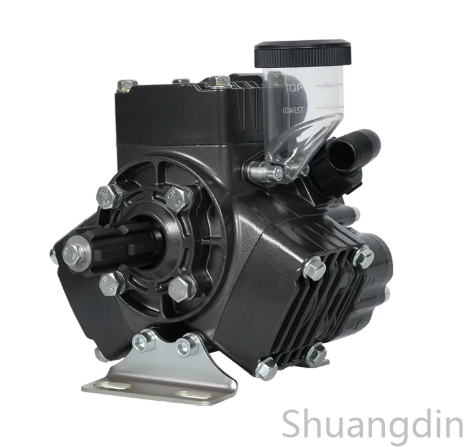
Agricultural spraying equipment used in orchards, vineyards, and other demanding crop protection applications often requires carefully controlled liquid pressure to distribute spray throughout complex plant structures. A High Pressure Diaphragm Pump For Sprayers provides a reciprocating pumping solution designed for applications where the equipment requires pressurized liquid delivery within the pump's specified operating range. For agricultural machinery manufacturers and international distributors, understanding the relationship between pressure, flow, and system configuration is important when selecting pumping components for specialized spraying machines.
High-pressure spraying is particularly relevant when spray equipment must direct liquid toward dense foliage, elevated branches, or areas that are difficult to reach with conventional low-pressure arrangements. Orchard sprayers, for example, may use specialized nozzles and air-assisted distribution systems to improve spray penetration within tree canopies. The pump supplies liquid to the distribution network, while nozzle design, air movement, machine speed, and operating pressure collectively influence application results. A pump alone cannot guarantee uniform coverage if the rest of the spraying system is incorrectly configured.
The diaphragm pumping mechanism works through alternating suction and discharge movements. A flexible diaphragm changes the volume of the pumping chamber, drawing liquid through the inlet valve during one part of the cycle and pushing it through the outlet valve during the other. This repeated action creates the pressure and flow required by the connected equipment. Some pump designs incorporate multiple diaphragms to distribute pumping activity across several chambers and support more consistent delivery.
Pump construction becomes particularly important under higher-pressure operating conditions. The housing must provide sufficient structural support, while diaphragms, valves, seals, and connections must be suitable for the intended working range. Repeated pressure cycles place mechanical demands on these components. Incorrect installation, unsuitable operating conditions, or excessive pressure can accelerate wear and increase the possibility of leakage. Buyers should therefore examine the manufacturer's specified working pressure and other technical limitations rather than assuming that all pumps described as high-pressure models offer equivalent performance.
Pressure and flow should always be considered together. Pressure describes the force available to move liquid through the spraying system, whereas flow rate indicates the volume delivered over time. A spraying machine with numerous nozzles may require substantial flow even when operating at a particular pressure. A smaller machine with specialized nozzles may have different requirements. The selected pump must satisfy the combined demands of the distribution system without exceeding its rated operating limits.
Pressure regulation is essential for maintaining suitable conditions. Agricultural sprayers commonly incorporate pressure regulators, gauges, and bypass arrangements to control liquid delivery. Depending on the system design, excess liquid may return to the tank or follow another designated circulation path. These components help manage operating pressure as spraying conditions change. Operators should regularly inspect pressure gauges and regulators because inaccurate readings or malfunctioning control devices may lead to unsuitable operating conditions.
Chemical compatibility is another important selection factor. High-pressure spraying equipment may handle pesticides, fungicides, insecticides, herbicides, and liquid fertilizers. These formulations can differ significantly in chemical composition. The diaphragm, seals, valve components, and other wetted surfaces must be compatible with the intended liquids. Buyers should also consider the effect of cleaning chemicals and temperature changes on the materials. Appropriate material selection helps maintain sealing performance and reduces the likelihood of premature component deterioration.
Filtration and suction conditions can influence both reliability and performance. A restricted inlet line may limit liquid supply, while particles entering the pumping chamber may interfere with valve movement. Suitable inlet filters help reduce contamination, and additional filtration may be incorporated according to nozzle and system requirements. Filters should be inspected and cleaned regularly, particularly when the sprayer operates with formulations that contain suspended particles or when field conditions create a higher risk of contamination.
Mechanical installation also deserves attention. The pump should be mounted securely and aligned with its drive arrangement according to the manufacturer's instructions. Incorrect alignment or excessive vibration may affect connected components and increase maintenance requirements. Suction hoses should have suitable dimensions and routing, while pressure-side connections must be appropriate for the intended operating conditions. All fittings should be checked before operation, and inspection should be performed only after the system has been safely depressurized.
Routine maintenance helps agricultural equipment remain available during periods of intensive field work. Operators should monitor changes in pressure, flow, noise, and vibration. Diaphragms, valves, seals, filters, hoses, and fittings should be inspected according to the maintenance schedule. After pesticide applications, suitable flushing procedures help remove chemical residues and prepare the system for subsequent use. Replacement components should meet the pump's original specifications to preserve compatibility and proper assembly.
For importers and distributors, procurement should focus on verified operating pressure, flow capacity, drive requirements, connection dimensions, chemical compatibility, and replacement part availability. It is also useful to distinguish between maximum pressure and recommended continuous working pressure when comparing products. These details help prevent equipment mismatches and support more reliable customer recommendations across different agricultural markets.
When specifying a High Pressure Diaphragm Pump For Sprayers, buyers should evaluate the entire pressure delivery arrangement, including the pump, regulator, pressure gauge, filters, hoses, and nozzles. The suitability of the complete system depends on how these components work together under actual field conditions. Additional filtration components for agricultural pumping systems are available at https://www.agriculturaldiaphragmpump.com/product/inlet-and-outlet-water-filters/
- Technology for Students
- Admissions & Applications
- Online Courses
- Career and Jobs
- Campus Life
- Drinks
- Film
- Fitness
- Food
- الألعاب
- Gardening
- Health
- الرئيسية
- Literature
- Music
- Networking For Students
- Insights
- Party
- Religion
- Shopping
- Sports
- Theater
- Wellness
- Education News
- Business & Finance For Students
- Security, Law & Crime Education
- Insurance
- Science & Technology For Students
 Arabic
 English
 French
 Spanish
 Portuguese
 Deutsch
 Turkish
 Dutch
 Italiano
 Russian
 Romaian
 Portuguese (Brazil)
 Greek