


Magnetic Closure Boxes & Rigid Boxes: What US Brands Get Wrong Before Ordering
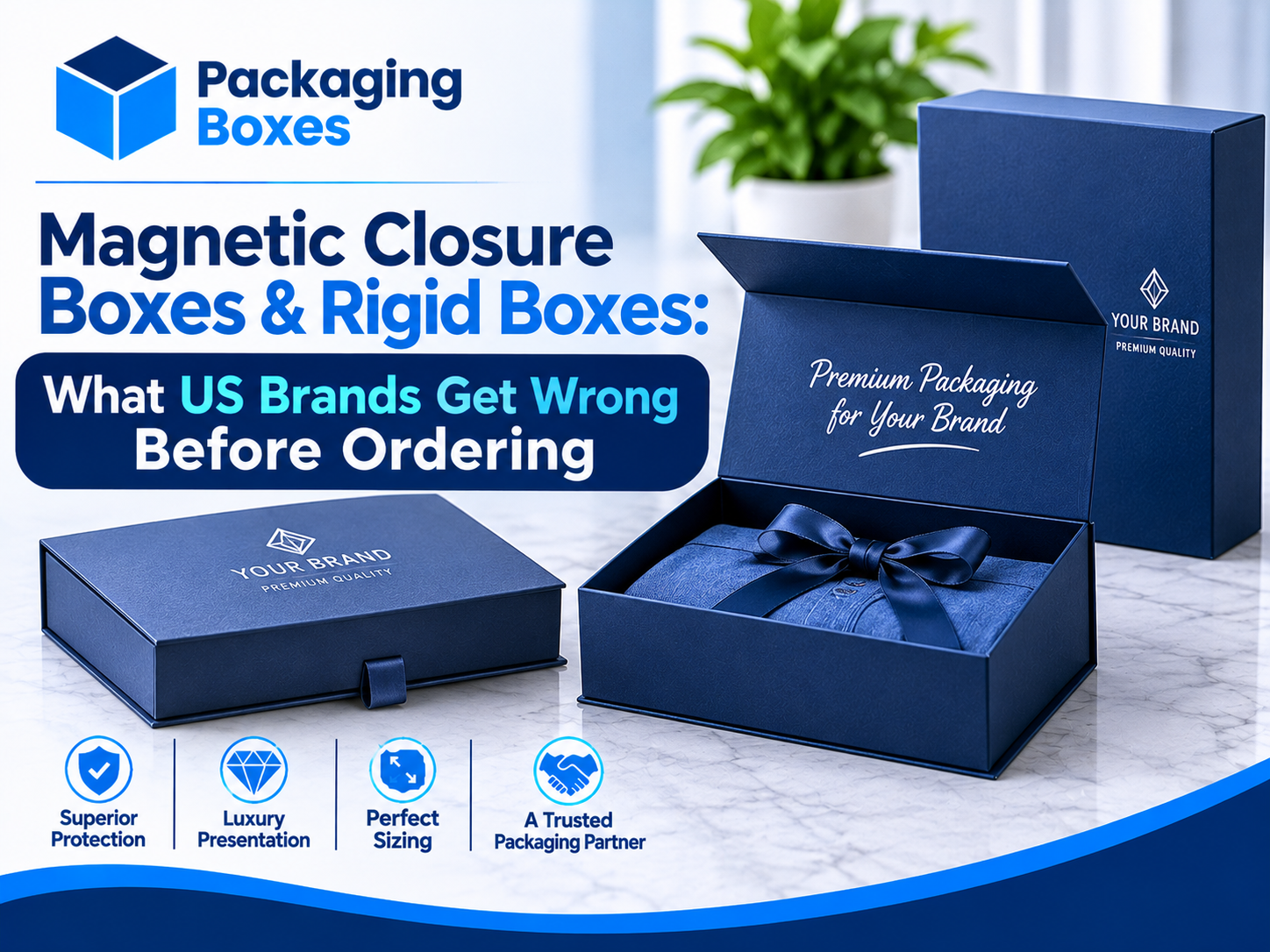
A brand orders rigid boxes with magnetic closures for a major product launch. The boxes arrive beautifully assembled, and the magnets snap shut with a satisfying click. Then the freight bill comes in, and the warehouse manager realizes those empty boxes are taking up half the storage room.
I have seen this exact scenario play out with US brands more times than I can count. Magnetic closure boxes and rigid boxes are the gold standard for premium packaging. They also come with real trade-offs that most suppliers do not mention until after you have paid.
Here is the thing: a rigid box isn't just a fancier folding carton. It is a different manufacturing process, a different shipping model, and a different storage commitment. Get it right and you have packaging customers keep. Get it wrong and you are paying for air.
At Packaging Boxes, we supply both lines to US sellers who need flexibility-no minimum order, fast turnaround, and free design support. Before you order from anyone, here is what actually matters.
Rigid Boxes: The Structure You Are Actually Paying For
A rigid box-sometimes called a set-up box-is made from thick chipboard that does not collapse. The board is cut, scored, and wrapped in printed paper, fabric, or specialty stock. The result is a box that holds its shape, stacks cleanly, and feels substantial in the hand.
That is the appeal. Here is the catch.
Rigid boxes ship assembled. Unlike folding cartons that arrive flat, rigid boxes take up their full three-dimensional space from the moment they leave the factory. If you are ordering a large run of large boxes, you are paying to ship and store empty boxes that cannot be flattened.
This is where most brands get surprised. The per-unit cost looks fine. The freight and warehouse cost does not. For small brands without dedicated storage space, rigid boxes can eat into margins before the product even sells.
The fix: collapsible rigid boxes. Some suppliers now offer rigid boxes that ship flat and snap up at packing time. You get the premium look and feel without the storage penalty. If you are doing high volume or limited warehouse space, ask about collapsible options before committing to traditional set-up boxes.
Rigid boxes protect well, but they are not shipping boxes. The thick board absorbs some impact, but a rigid box dropped on a corner will dent. The wrap can scuff. If you are shipping direct to customers, you need an outer corrugated shipper. The rigid box is presentation. The shipper is protection.
Magnetic Closures: The Snap That Sells
A magnetic closure box is a rigid box with small magnets embedded in the lid and base. The lid snaps shut with a clean, secure close. No clasps. No ribbon ties. Just a satisfying click that feels premium every time.
That snap is doing real work. It signals quality before the customer even sees the product. It also keeps the box reusable-customers hold onto magnetic boxes because they are nice to open and close.
But magnet strength is a balancing act. Too weak, and the lid drifts open in transit. Too strong, and the customer has to fight the box to get inside. The right strength depends on lid size, board thickness, and what is inside. A jewelry box with a small lid needs a different magnet than a large gift set box.
This is why you need a physical sample before production. A 3D mockup cannot tell you how the closure feels. Open and close it with the product inside. If it is awkward, the spec is wrong.
Magnet placement matters as much as strength. If the magnets are not aligned precisely, the lid will not sit flush. The box looks defective even though the materials are fine. Ask your supplier how they position magnets and what tolerance they hold. Vague answers are a red flag.
When Rigid and Magnetic Make Sense (and When They Do Not)
Rigid boxes with magnetic closures are the right call for specific products and channels. They are the wrong call for others.
Use them for: luxury retail packaging, gift sets, corporate gifting, subscription boxes where unboxing is part of the experience, limited editions, and products where the packaging becomes a keepsake. If your customer photographs the unboxing, rigid with magnetic closure earns its cost.
Skip them for: high-volume e-commerce where packaging gets thrown away immediately, products that need to ship in their own container without an outer box, and any situation where warehouse space is tight and you cannot commit to storing assembled boxes.
The middle ground: collapsible magnetic rigid boxes. These give you the premium close without the storage penalty. They are becoming more common as suppliers recognize the freight problem. If you are ordering more than a few hundred units and storage is a concern, ask for this option specifically.
Kraft vs. Wrapped: The Finish Question
Rigid boxes are almost always wrapped. The chipboard core is plain gray or white. The wrap is where your brand lives-printed paper, textured stock, fabric, even leather. This is why rigid boxes can look like anything from minimalist to opulent.
Magnetic closure boxes follow the same wrap logic. The magnet sits between the board and the wrap, invisible from the outside. The finish options are extensive: soft-touch lamination, foil stamping, embossing, spot UV. Each adds cost and production time. Each also adds a tactile cue that tells the customer this box is different.
My honest take: skip the foil on your first order. Soft-touch lamination alone transforms a rigid box from "nice cardboard" to "I want to keep this." Add foil and embossing on a second run once you know the product sells.
Why US Brands Order From Packaging Boxes
I'll be direct because you can get "premium quality" from anyone's homepage.
No minimum order. Testing a magnetic closure box for a limited launch? Order a small run and see how customers respond before committing to inventory you haven't validated. No MOQ magnetic closure boxes and no minimum rigid boxes change the math for small brands.
Fast standard turnaround. Product launches don't wait. If you are ordering for a holiday drop or a collab release, you need a supplier who doesn't disappear. Our timeline is on the quote.
Free dieline and digital proof. Send your dimensions. Get a dieline you can drop artwork into. Approve a 3D mockup before anything prints. No surprise setup fees.
Free shipping across the USA. Rigid boxes are heavy. Shipping costs can kill the margin on small orders. Magnetic closure boxes with free shipping and rigid boxes with free shipping keep the landed cost predictable.
Free design support. Can't visualize the finished box? Our team provides templates, mockups, and revisions before production starts.
Reliable customer support. You'll have questions about magnet strength, wrap options, and storage. Our team answers them quickly.
The trade-off? We're not the cheapest per-unit at massive volumes. High-volume buyers with rigid specs can find lower quotes elsewhere. For brands doing small-to-mid runs, the flexibility usually beats the per-unit savings. That is the honest version.
The Detail That Saves You Money: Inserts and Fit
A rigid box with a magnetic closure looks premium on the outside. If the product rattles around inside, the illusion breaks immediately.
The insert is what makes the box work. For jewelry, a velvet or suede insert holds the piece and adds to the luxury feel. For cosmetics, a die-cut paperboard tray keeps bottles upright and separated. For gift sets, a platform insert creates layers so the reveal is staged.
Skip foam if you are positioning as eco-conscious. Pulp and molded fiber inserts do the job and recycle curbside. They cost more upfront than foam but align with the brand story most premium products are already telling.
Test the full pack-out before you commit. Put the actual product in the actual insert in the actual box. Close the lid. Open it. Does the product shift? Does the lid align? Does the magnet engage cleanly? A sample that looks good on a screen can fail in your hands.
Quick Answers to What US Brands Actually Ask
What's the difference between rigid boxes and magnetic closure boxes?
A rigid box is a structure-thick chipboard wrapped in printed material that holds its shape. A magnetic closure box is a rigid box with magnets embedded in the lid and base. All magnetic closure boxes are rigid. Not all rigid boxes have magnetic closures.
Can I order a small batch of magnetic closure or rigid boxes?
With Packaging Boxes, yes. No minimum order. Test a new product launch or limited edition without committing to inventory you haven't validated.
Do rigid boxes ship assembled or flat?
Traditional rigid boxes ship assembled and take up full storage space. Collapsible rigid boxes ship flat and snap up at packing time, saving freight and warehouse space. Ask which option fits your volume.
How long does production and shipping take?
We offer fast standard turnaround times after proof approval, plus free shipping anywhere in the USA. Rush options available if you ask upfront.
Bottom line: A rigid box that ships assembled and eats your warehouse space and a magnetic closure that's too weak to stay shut fail for different reasons-but both cost you money. Don't order from a supplier who won't show you a dieline, won't give you a proof, and won't tell you the turnaround before you pay.
Packaging Boxes does all three. Send your product dimensions and your storage constraints. We'll spec the box-rigid or collapsible, magnetic or standard-and get you a quote. No minimum, no pressure.
- Technology for Students
- Admissions & Applications
- Online Courses
- Career and Jobs
- Campus Life
- Drinks
- Film
- Fitness
- Food
- الألعاب
- Gardening
- Health
- الرئيسية
- Literature
- Music
- Networking For Students
- Insights
- Party
- Religion
- Shopping
- Sports
- Theater
- Wellness
- Education News
- Business & Finance For Students
- Security, Law & Crime Education
- Insurance
- Science & Technology For Students
 Arabic
 English
 French
 Spanish
 Portuguese
 Deutsch
 Turkish
 Dutch
 Italiano
 Russian
 Romaian
 Portuguese (Brazil)
 Greek