


Precision Machining for Automated Drive Systems
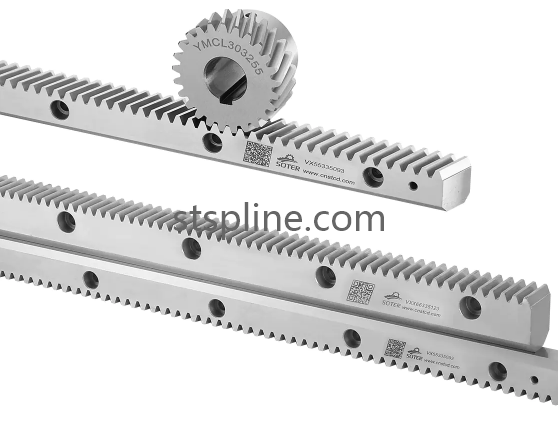
Precision is a fundamental consideration in mechanical transmission, particularly in machinery that depends on coordinated linear movement and repeatable positioning. A Precision Gear Rack is designed to work with a compatible pinion gear, converting rotational input into straight-line motion through controlled tooth engagement. Its manufacturing quality influences the integration of the transmission system with motors, guide rails, supporting structures, and machine control components.
The operating principle is based on the interaction between a straight toothed rack and a rotating circular gear. As the pinion turns, its teeth engage with the rack and produce linear displacement. This mechanism is used in different industrial applications because it provides a direct mechanical connection between rotational and linear movement. Depending on the machine design, the rack may be fixed to the frame while the pinion travels, or the pinion may remain in position while the rack moves.
The meaning of precision in rack manufacturing involves several related characteristics. Tooth pitch consistency, profile accuracy, straightness, dimensional stability, and surface quality all influence how the component performs within an assembly. These factors cannot be considered independently. Even when individual tooth dimensions are controlled, installation alignment and the compatibility of the mating pinion remain important to the final transmission result.
Material selection provides the foundation for manufacturing. Carbon steel is commonly used in industrial rack production because of its machining characteristics and suitability for various mechanical applications. Alloy steel may be selected when the design requires different material properties or specific processing methods. Manufacturers need to consider the relationship between material composition, machining operations, heat treatment, and finishing procedures. These factors help determine the appropriate production route for each component.
Tooth machining is one of the most important manufacturing stages. Depending on the rack design and accuracy requirements, cutting and milling processes can be used to form the required tooth profile. Additional grinding or finishing may be appropriate for certain applications. The objective is to maintain consistent geometry and surface conditions so that the rack can engage correctly with the corresponding pinion. Process selection should be based on the actual technical requirements rather than applying the same manufacturing method to every product.
Inspection helps verify whether the manufactured component meets its design requirements. Dimensional measuring equipment can be used to examine relevant characteristics such as pitch, tooth dimensions, overall length, and straightness. Other inspection procedures may be applied according to the product specification. For industrial buyers, understanding the manufacturer's quality control process is useful when evaluating suppliers, particularly for projects involving multiple rack sections or customized transmission assemblies.
The pinion and rack should be developed as a compatible gear pair. Module, pressure angle, tooth profile, and other geometric characteristics need to match the intended application. Incorrect combinations may result in poor contact, excessive backlash, or irregular movement. In addition, the mounting distance and structural arrangement influence the engagement condition. For this reason, equipment designers should provide complete technical information when requesting precision transmission components.
CNC machining centers are an important application area for precision linear transmission systems. Depending on their mechanical architecture, rack and pinion assemblies may support movement along selected machine axes. Laser cutting equipment also uses linear drive components to position machine structures and cutting heads along programmed paths. These applications require coordination between mechanical transmission, linear guidance, motor systems, and control equipment.
Industrial robotics and truss manipulators provide further examples. Their mechanical structures may involve several movement axes, material handling operations, and repeated positioning tasks. Rack-driven systems can be integrated into selected axes where the equipment layout and motion requirements make this arrangement suitable. Automotive automation production lines and lithium battery manufacturing equipment also use linear movement assemblies in material transfer, positioning, and automated processing operations.
Installation accuracy is essential after manufacturing is complete. The mounting surface should provide consistent support, and the rack should be aligned with the machine's intended travel direction. When several rack sections are connected, the joints require careful adjustment to maintain smooth engagement. The pinion mounting arrangement should also be checked to avoid unnecessary interference or uneven tooth contact. Following the machine manufacturer's installation instructions helps reduce problems associated with assembly errors.
Maintenance practices contribute to long-term transmission reliability. Regular inspection can identify dirt accumulation, lubrication problems, loosened fasteners, and visible changes in tooth condition. The appropriate maintenance interval depends on the operating environment and machine duty cycle. Equipment operating in environments with metal dust or other contaminants may require more frequent cleaning and inspection than machinery operating in cleaner conditions.
When purchasing precision transmission components, buyers should evaluate the manufacturer's production experience, machining processes, measurement capabilities, and customization support. Technical drawings and samples provide useful references for determining the appropriate product structure. It is also important to communicate the intended application, mounting conditions, and requirements for matching pinions. This information supports more accurate product evaluation and helps reduce compatibility issues during equipment assembly.
A reliable Precision Gear Rack is the result of coordinated engineering, controlled machining, suitable materials, and consistent quality inspection. Zhejiang Soter Transmission Technology Co., Ltd. has specialized in rack and gear manufacturing since 2006, providing products for industrial automation, CNC machinery, laser cutting equipment, and other mechanical applications. Its manufacturing and inspection capabilities support customized requirements based on customer drawings and samples. Buyers seeking rack transmission components can explore the https://www.stspline.com/product/straight-teeth-rack/ product range.
- Technology for Students
- Admissions & Applications
- Online Courses
- Career and Jobs
- Campus Life
- Drinks
- Film
- Fitness
- Food
- Παιχνίδια
- Gardening
- Health
- Κεντρική Σελίδα
- Literature
- Music
- Networking For Students
- Insights
- Party
- Religion
- Shopping
- Sports
- Theater
- Wellness
- Education News
- Business & Finance For Students
- Security, Law & Crime Education
- Insurance
- Science & Technology For Students
 Greek
 English
 Arabic
 French
 Spanish
 Portuguese
 Deutsch
 Turkish
 Dutch
 Italiano
 Russian
 Romaian
 Portuguese (Brazil)