


Accessibility User Journey Assessment for Inclusive Spaces
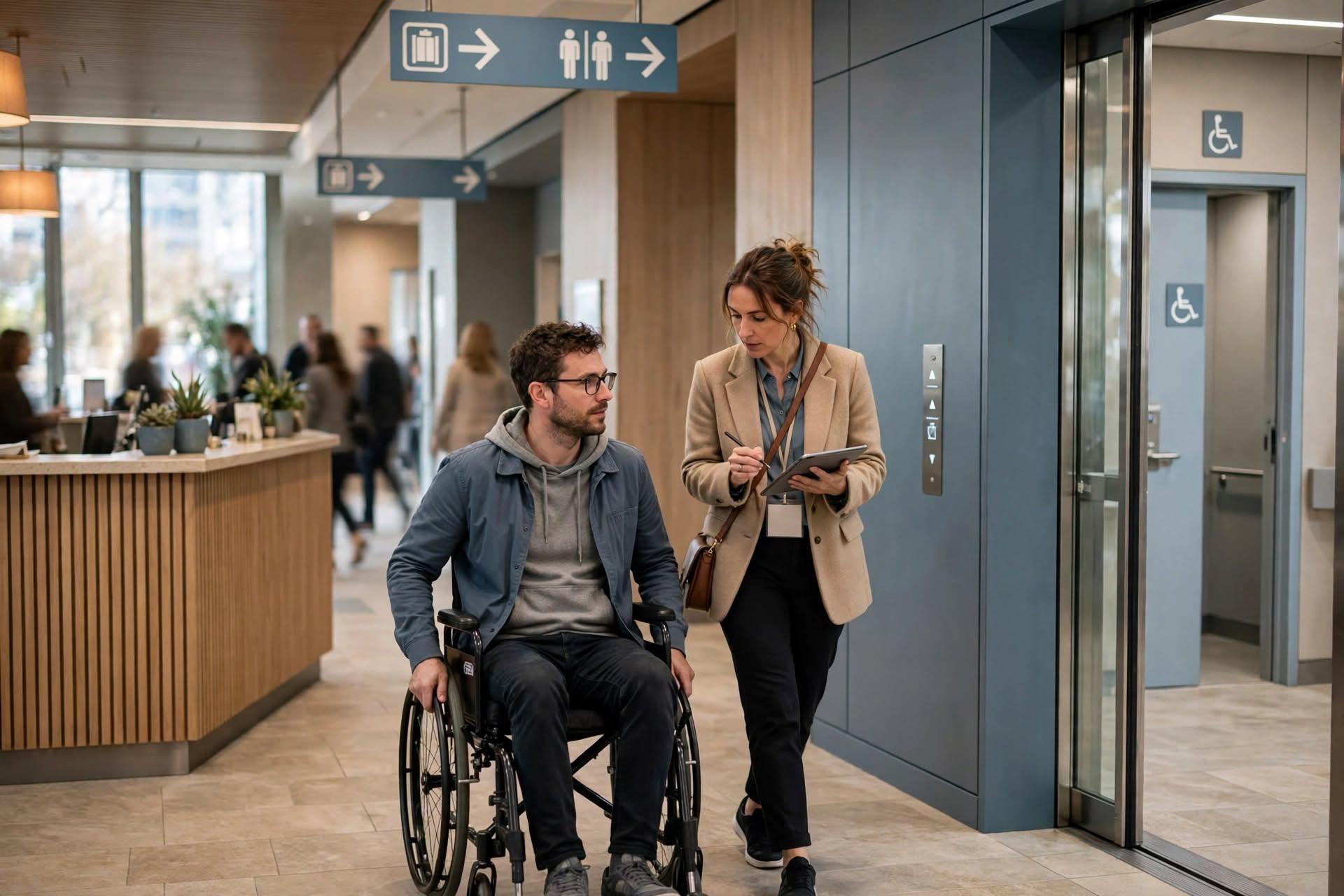
A building can tick every individual compliance box and still fail the person trying to use it. An accessibility user journey assessment tests the complete visit, from arrival to exit, rather than isolated elements. This article explains what it checks, how it exposes hidden failures and how it supports Abu Dhabi submissions.
Why Compliant Elements Can Still Fail
Vortex Access conducts these assessments to evaluate how different users arrive at, enter, move through, use and exit a building or facility. The question is whether the environment gives people a continuous, safe, understandable and dignified experience, not just whether each feature exists.
A compliant individual element may still fail if the overall journey is fragmented. The service page gives three examples:
-
An accessible toilet exists but cannot be reached through an accessible route
-
An accessible entrance is available but difficult to identify
-
Signage is present but not readable or understandable for all users
Each of these features can be compliant on its own, which is why the journey needs its own review.
The Stages of a Visit Under Review
An accessibility journey assessment follows the visitor in order. It starts with arrival by vehicle, taxi, public transport or pedestrian route, then checks accessible parking, drop-off and approach routes. Next come main entrance identification and ease of access, followed by reception, security and the front-of-house experience.
Inside, the focus moves to horizontal and vertical circulation and access to key facilities, services and amenities. That includes toilets, seating, counters, waiting areas and service points, along with signage, wayfinding, lighting, acoustics and visual contrast. Each stage depends on the one before it: a well-designed washroom does not help if the route to it is closed to some users.
Two items complete the picture: emergency egress and the assisted evacuation interface, and practical usability for different user groups. Treating them as part of the journey, rather than a separate compliance exercise, keeps safety and everyday use in the same conversation.
What You Gain From the Findings
The assessment helps clients identify barriers across the full experience of the building. The aim is better access, independence, comfort, dignity and operational usability, which covers how the space works for the people running it as well as for visitors.
You can borrow the structure for your own checks. Take the stages above, assign someone to walk each one, and write down the exact point where the route stops being continuous, understandable or safe. A finding such as "accessible toilet not reachable by an accessible route" is more useful to a design team than a general note about toilet compliance. Because journey findings span arrival, circulation, facilities and egress, they also give different disciplines a shared reference point. That habit is the core of an accessibility user journey assessment, whether it is done on drawings or on site.
Linking Journey Thinking to Abu Dhabi Submissions
Abu Dhabi has changed what a master plan submission contains. The Sahel Community Rating System Abu Dhabi now sits inside the Department of Municipalities and Transport's Concept and Detailed Master Plan requirements, in guidelines dated 10 August 2026.
At concept stage, teams submit a preliminary scorecard along with an accessibility vision, strategy and objectives, and a team structure naming the Sahel Qualified Professional (SQP) and the Accessibility Consultant. At detailed stage, that grows into a completed scorecard backed by coordinated drawings, project-specific narratives and evidence.
Because the Sahel Community Rating System Abu Dhabi spans nine credit categories, from Transportation Access to Considerate Maintenance, a journey-based review is one practical way to test whether a project's stated objectives hold up from arrival to exit. Projects already in development can also benefit from an early gap assessment to catch missing documentation, coordination risks or design issues.
Conclusion
Individual elements matter, but people experience a building as a sequence. Reviewing that sequence from arrival to exit shows where access, independence and dignity break down, and it gives submission teams something concrete to work from. For Abu Dhabi projects, the Sahel Community Rating System Abu Dhabi guidelines are worth reading alongside your journey findings, and a conversation with Vortex Access can help you plan the next step.
FAQs
1. What does the assessment evaluate?
How different users arrive at, enter, move through, use and exit a building or facility, and whether the experience is continuous, safe, understandable and dignified.
2. Why not just check each element separately?
A compliant element can still fail if the overall journey is fragmented, for example an accessible toilet that has no accessible route leading to it.
3. Which parts of a visit does it cover?
Arrival, parking and drop-off, entrances, reception, circulation, key facilities, toilets, seating, counters, signage, wayfinding, lighting, acoustics, emergency egress and usability for different user groups.
4. What does it improve?
Access, independence, comfort, dignity and operational usability across the full experience of the building.
- Technology for Students
- Admissions & Applications
- Online Courses
- Career and Jobs
- Campus Life
- Drinks
- Film
- Fitness
- Food
- Игры
- Gardening
- Health
- Главная
- Literature
- Music
- Networking For Students
- Insights
- Party
- Religion
- Shopping
- Sports
- Theater
- Wellness
- Education News
- Business & Finance For Students
- Security, Law & Crime Education
- Insurance
- Science & Technology For Students
 Russian
 English
 Arabic
 French
 Spanish
 Portuguese
 Deutsch
 Turkish
 Dutch
 Italiano
 Romaian
 Portuguese (Brazil)
 Greek