


How to Teach English Grammar Without Turning Lessons into Lectures
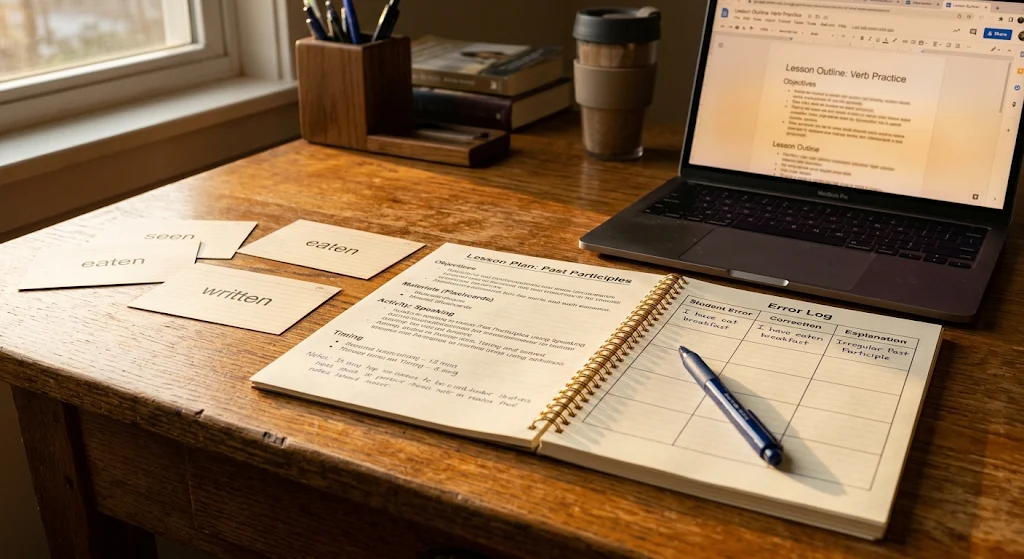
A learner can finish a page of tense exercises without a single mistake. Then you ask what they did at the weekend, and the hesitation starts.
They know the rule. They just can’t find it quickly enough when someone is waiting for an answer.
That gap is one of the most interesting problems in English teaching. Knowing grammar on paper and using it in speech are different skills. A learner can recite that the present perfect needs have plus a past participle, then still say, “I have went to London.”
Most of us reach for the red pen. A better first move is to ask why the learner chose that form.
Meaning first, then form
Learners rarely think about grammatical categories mid-sentence. They think about what they want to say.
Take “I am living here since 2022.” The meaning is clear. The structure needs the present perfect continuous: “I have been living here since 2022.”
A correction gives the learner a better sentence. An explanation gives them a reason: the situation began in the past and is still going.
Learners need to know what a structure communicates, how it is built and how it sounds in real speech.
That is why any solid language analysis covers three things:
- Meaning: what is the speaker doing with this structure, and when would they need it?
- Form: how is it built, and which part will cause trouble?
- Pronunciation: where does the stress fall, and what happens to contractions in fast speech?
CELTA and other initial training courses assess exactly this kind of thinking, though requirements vary by qualification.
How much explanation is enough?
New teachers often over-explain, because leaving something out feels like a hole in the lesson. In practice, an explanation gets less useful the longer it runs.
Picture an elementary class meeting must and should. A full account of modality won’t help them. Two sentences will:
- You must wear a seatbelt.
- You should get some rest.
One is a rule, the other is advice. Learners feel that difference long before they can name it.
Correction is the other trap. Fixing every slip in a holiday story breaks the flow and makes learners cautious. Ignoring everything doesn’t work either: if a whole class keeps using the wrong tense in a lesson on past events, that pattern needs attention.
Decide which errors need fixing now and which can wait until the learner has made their point.
In written work, including UK TEFL Assignment Help, a stronger discussion of teaching methodology explains why an activity suits the learners, not just what happens during it.
Two approaches worth knowing
A deductive approach starts with the rule. An inductive approach starts with examples and lets learners spot the pattern.
Try these two sentences with a class:
- If I had more free time, I would learn Spanish.
- If I lived near the beach, I would swim every morning.
Before writing any formula, ask whether the situations are real or imagined. That gets learners thinking about meaning, which is where the second conditional lives.
Neither approach wins every time. Deductive is quicker when a structure is brand new. Inductive builds thinking, but it frustrates a group when the examples are ambiguous.
PPP: a starting point, not a script
Presentation, Practice and Production gives a new teacher something to hold onto. Introduce the language through a situation, give controlled practice, then let learners use it freely.
It goes wrong when it turns mechanical. A group that already understands the structure doesn’t need a long presentation. Another may need twice the controlled practice before speaking.
A framework should help you make decisions, not make them for you.
What learners bring with them
Check what they already know. Before teaching the present perfect, make sure irregular participles aren’t the real obstacle, or you create two problems at once.
First language matters too. Articles are the classic case. If a learner’s language handles definiteness differently, repeating the “a, an, the” rules won’t fix it. The real issue is what speaker and listener already share.
And recognition is not use. Spotting the right answer from four options is easier than producing it live, with no options and a conversation to keep going.
That distinction should shape the plan. Once you know what learners already have and where they struggle, you can choose activities that move them from recognising a structure to using it independently.
A lesson that works: present perfect for experiences
Start with a question: “Have you ever travelled abroad?” Some learners answer easily. Others slip into the past simple. Both responses tell you something.
- Board three natural examples: “I have visited Spain”, “She has never travelled abroad”, “Have you ever tried sushi?” Ask what learners notice.
- Add “I visited Spain last summer.” Ask why the tense changed.
- Clarify form and sound: have or has plus participle, irregular forms like seen and written, contractions like I’ve.
- Check understanding with real questions, not “Does everyone understand?” Does “I visited Spain last summer” give a specific time?
- Move to pair interviews about places, foods and skills.
- Listen for recurring errors and note them for feedback after the activity. Interrupt only when a mistake blocks understanding.
The three-column error log
Here is something most lesson plans skip. During fluency practice, keep a note with three columns: meaning, form, first language.
Imagine hearing “I have seen that film yesterday.” Does the learner understand that yesterday means a finished time? Are they struggling to choose the tense, or carrying a familiar pattern over from their first language?
These causes overlap, so treat the columns as a guide to investigation, not fixed diagnoses. A timeline can clarify meaning, and comparing examples helps learners notice differences from their first language.
Respond to the source of the difficulty, not just repeat the rule.
To find out early, put “I have seen that film yesterday” and “I saw that film yesterday” on the board and ask which sounds right. The answers show you what to teach.
Mistakes worth dodging
- Explaining every exception first. Establish the core meaning, then add exceptions when they matter.
- Treating a right answer as mastery. Ask learners to use the structure in a new situation.
- Choosing tasks that don’t need the grammar. If learners can finish without it, it proves little.
The real measure
A mistake is evidence of what a learner currently understands, though it doesn’t always reveal the full reason. Look at the sentence, the situation and what the learner already knows, and the next decision gets easier.
Progress is clearer when learners can take a structure from a guided exercise into an unfamiliar conversation without waiting for a prompt.
The real measure of a grammar lesson is not how clearly you explain the rule, but how confidently learners use it when the explanation is gone.
- Technology for Students
- Admissions & Applications
- Online Courses
- Career and Jobs
- Campus Life
- Drinks
- Film
- Fitness
- Food
- Juegos
- Gardening
- Health
- Home
- Literature
- Music
- Networking For Students
- Insights
- Party
- Religion
- Shopping
- Sports
- Theater
- Wellness
- Education News
- Business & Finance For Students
- Security, Law & Crime Education
- Insurance
- Science & Technology For Students
 Spanish
 English
 Arabic
 French
 Portuguese
 Deutsch
 Turkish
 Dutch
 Italiano
 Russian
 Romaian
 Portuguese (Brazil)
 Greek