


Titanium Dioxide Manufacturer: Understanding the Importance of Rutile Titanium Dioxide in Modern Industries
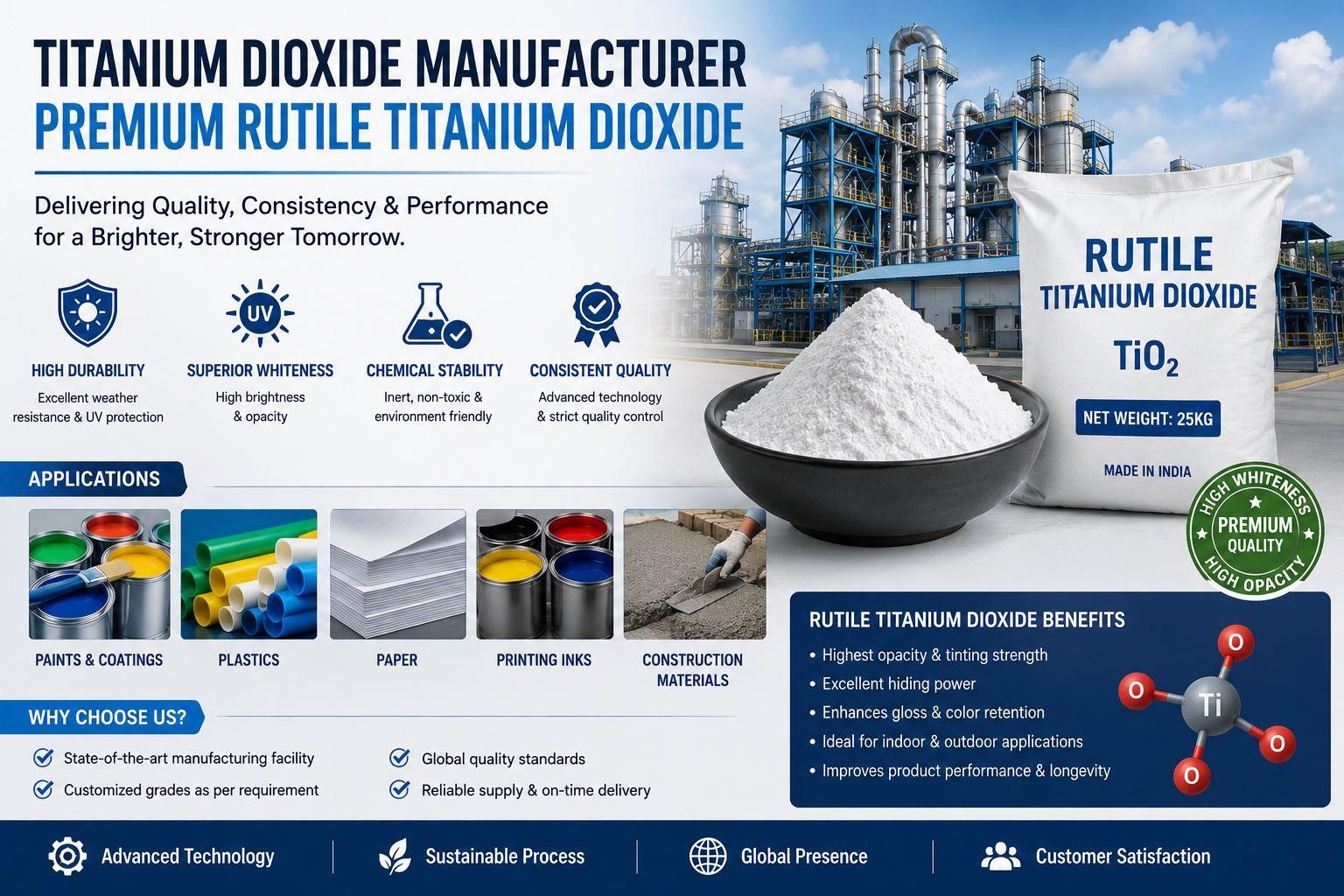
Titanium dioxide is one of the most widely used white pigments across modern industries. From paints and coatings to plastics, printing inks, and construction materials, it plays an important role in improving product appearance, durability, and performance. Among its different forms, rutile titanium dioxide is particularly valued for its excellent opacity, brightness, and weather resistance.
Choosing the right Titanium Dioxide Manufacturer is therefore an important decision for businesses that depend on consistent pigment quality. A reliable manufacturer provides products that meet industry requirements while supporting better production efficiency and long-term product performance.
In this article, we will explore the properties of rutile titanium dioxide, its industrial applications, manufacturing considerations, and the factors businesses should evaluate when selecting a supplier.
What Is Titanium Dioxide?
Titanium dioxide, commonly known as TiO2, is a naturally occurring white inorganic compound produced commercially for use as a high-performance pigment. Its exceptional ability to scatter visible light makes it an essential ingredient in products that require strong whiteness, brightness, and hiding power.
Manufacturers process titanium-bearing raw materials to produce titanium dioxide with specific physical and chemical characteristics.
Some important properties include:
-
High whiteness and brightness.
-
Excellent opacity and covering power.
-
Strong resistance to UV radiation.
-
Good chemical stability.
-
Low oil absorption in suitable grades.
-
Excellent compatibility with various industrial formulations.
These characteristics make titanium dioxide useful in applications where appearance and durability are equally important.
Understanding Rutile Titanium Dioxide
Rutile Titanium Dioxide is a crystalline form of titanium dioxide known for its excellent optical properties and superior durability. It has a higher refractive index than the anatase form, allowing it to deliver better light-scattering performance.
For this reason, rutile grades are widely preferred in applications requiring high opacity, long-lasting whiteness, and resistance to environmental conditions.
Key Properties of Rutile Titanium Dioxide
The popularity of rutile titanium dioxide comes from several valuable characteristics:
-
Excellent Opacity: Provides strong hiding power, helping manufacturers achieve the desired finish with efficient pigment usage.
-
High Brightness: Improves the visual appearance of paints, plastics, paper, and other products.
-
Weather Resistance: Offers good resistance to outdoor environmental exposure, especially when supplied with suitable surface treatments.
-
UV Protection: Helps protect certain materials against UV-related degradation.
-
Chemical Stability: Performs reliably in many industrial formulations.
-
Versatile Compatibility: Can be incorporated into different manufacturing processes depending on the selected grade.
Major Industrial Applications of Rutile Titanium Dioxide
Rutile titanium dioxide is used across multiple industries because of its ability to improve product quality and performance.
1. Paints and Coatings
The paint industry is one of the largest consumers of rutile titanium dioxide. It provides excellent hiding power, brightness, and colour consistency.
Its applications include:
-
Interior and exterior wall paints.
-
Industrial protective coatings.
-
Automotive coatings.
-
Decorative finishes.
-
Architectural paints.
For outdoor coatings, selecting a suitable weather-resistant grade is especially important.
2. Plastic Manufacturing
Plastic manufacturers use rutile titanium dioxide to improve whiteness, opacity, and UV resistance. It is commonly incorporated into products such as PVC pipes, plastic films, packaging materials, and household products.
The correct pigment grade helps maintain colour consistency and improves the visual quality of finished plastic products.
3. Paper Industry
In paper production, titanium dioxide improves brightness, whiteness, and opacity. It is particularly useful in applications where a clean, premium appearance is required.
4. Printing Inks
Printing ink manufacturers use titanium dioxide to achieve strong white pigmentation and improved print coverage. Its optical properties support consistent results across different printing applications.
5. Construction Materials
Rutile titanium dioxide is also used in selected construction products, including decorative coatings, architectural materials, and certain cement-based formulations.
How to Choose the Right Titanium Dioxide Manufacturer
Selecting a dependable Titanium Dioxide Manufacturer can directly influence product quality, production efficiency, and business profitability.
Before choosing a manufacturing partner, consider the following factors:
1. Product Quality and Consistency
A professional manufacturer should maintain consistent specifications across production batches. Check important parameters such as whiteness, particle size distribution, tinting strength, and oil absorption.
2. Manufacturing Technology
Modern production facilities and controlled processing systems help manufacturers maintain product consistency and meet different industrial requirements.
3. Available Product Grades
Different industries require different pigment characteristics. Look for a manufacturer offering suitable rutile grades for paints, plastics, coatings, and other applications.
4. Quality Testing
Reliable manufacturers follow established quality-control procedures. Request technical data sheets, certificates of analysis, and relevant product documentation before purchasing.
5. Supply Reliability
A consistent supply chain is essential for businesses operating on regular production schedules. Evaluate production capacity, delivery arrangements, packaging, and inventory management.
6. Technical Support
A knowledgeable supplier should help customers identify suitable grades and understand product specifications for their applications.
Rutile vs. Anatase Titanium Dioxide
Although both are forms of titanium dioxide, they have different properties and application requirements.
| Comparison Factor | Rutile Titanium Dioxide | Anatase Titanium Dioxide |
|---|---|---|
| Crystal structure | Rutile | Anatase |
| Refractive index | Higher | Lower |
| Opacity | Generally higher | Generally lower |
| Weather resistance | Generally better | More limited |
| Outdoor coatings | Widely preferred | Less commonly preferred |
| Typical applications | Paints, plastics, coatings | Paper and selected specialty uses |
The choice depends on the final product, processing conditions, and required performance.
What Makes a Quality Rutile Titanium Dioxide Grade?
Not every rutile grade performs equally in every application. Surface treatment, particle characteristics, and formulation compatibility can significantly influence performance.
Important specifications to evaluate include:
-
TiO2 content.
-
Colour and whiteness.
-
Tinting strength.
-
Particle size distribution.
-
Oil absorption.
-
pH value.
-
Surface treatment.
-
Dispersibility.
-
Weathering performance.
For example, alumina- or silica-treated grades may offer different dispersion and durability characteristics. Therefore, manufacturers should select grades according to their specific production requirements rather than relying only on price.
Frequently Asked Questions (FAQs)
1. What is a Titanium Dioxide Manufacturer?
A Titanium Dioxide Manufacturer produces titanium dioxide pigment through industrial processing and supplies it to industries such as paints, plastics, paper, and coatings.
2. What is rutile titanium dioxide?
Rutile titanium dioxide is a crystalline form of TiO2 known for its high refractive index, excellent opacity, and good weather resistance.
3. Why is rutile titanium dioxide widely used in paints?
It provides excellent hiding power, brightness, colour consistency, and durability, making it suitable for various paint formulations.
4. Is rutile titanium dioxide better than anatase?
Rutile generally offers better opacity and weather resistance. However, the appropriate form depends on the intended application.
5. Which industries use rutile titanium dioxide?
Major industries include paints, coatings, plastics, printing inks, paper, and construction materials.
6. How do I select a reliable titanium dioxide manufacturer?
Evaluate product specifications, manufacturing capabilities, quality-control procedures, certifications, supply reliability, and technical support.
7. Does rutile titanium dioxide provide UV protection?
It can help protect certain materials from UV-related degradation, depending on the pigment grade, surface treatment, and formulation.
8. What specifications should buyers check before purchasing?
Important parameters include TiO2 content, whiteness, tinting strength, oil absorption, particle size, pH, and dispersibility.
9. Can rutile titanium dioxide be used in plastics?
Yes. It is commonly used in plastic products to improve whiteness, opacity, and resistance to UV exposure.
10. Why is product consistency important when buying titanium dioxide?
Consistent pigment quality helps maintain uniform colour, predictable processing, and reliable performance across production batches.
- Technology for Students
- Admissions & Applications
- Online Courses
- Career and Jobs
- Campus Life
- Drinks
- Film
- Fitness
- Food
- Παιχνίδια
- Gardening
- Health
- Κεντρική Σελίδα
- Literature
- Music
- Networking For Students
- Insights
- Party
- Religion
- Shopping
- Sports
- Theater
- Wellness
- Education News
- Business & Finance For Students
- Security, Law & Crime Education
- Insurance
- Science & Technology For Students
 Greek
 English
 Arabic
 French
 Spanish
 Portuguese
 Deutsch
 Turkish
 Dutch
 Italiano
 Russian
 Romaian
 Portuguese (Brazil)