


DNA Oligo Synthesis and Plasmid Synthesis: Essential Tools for Modern Genetic Research
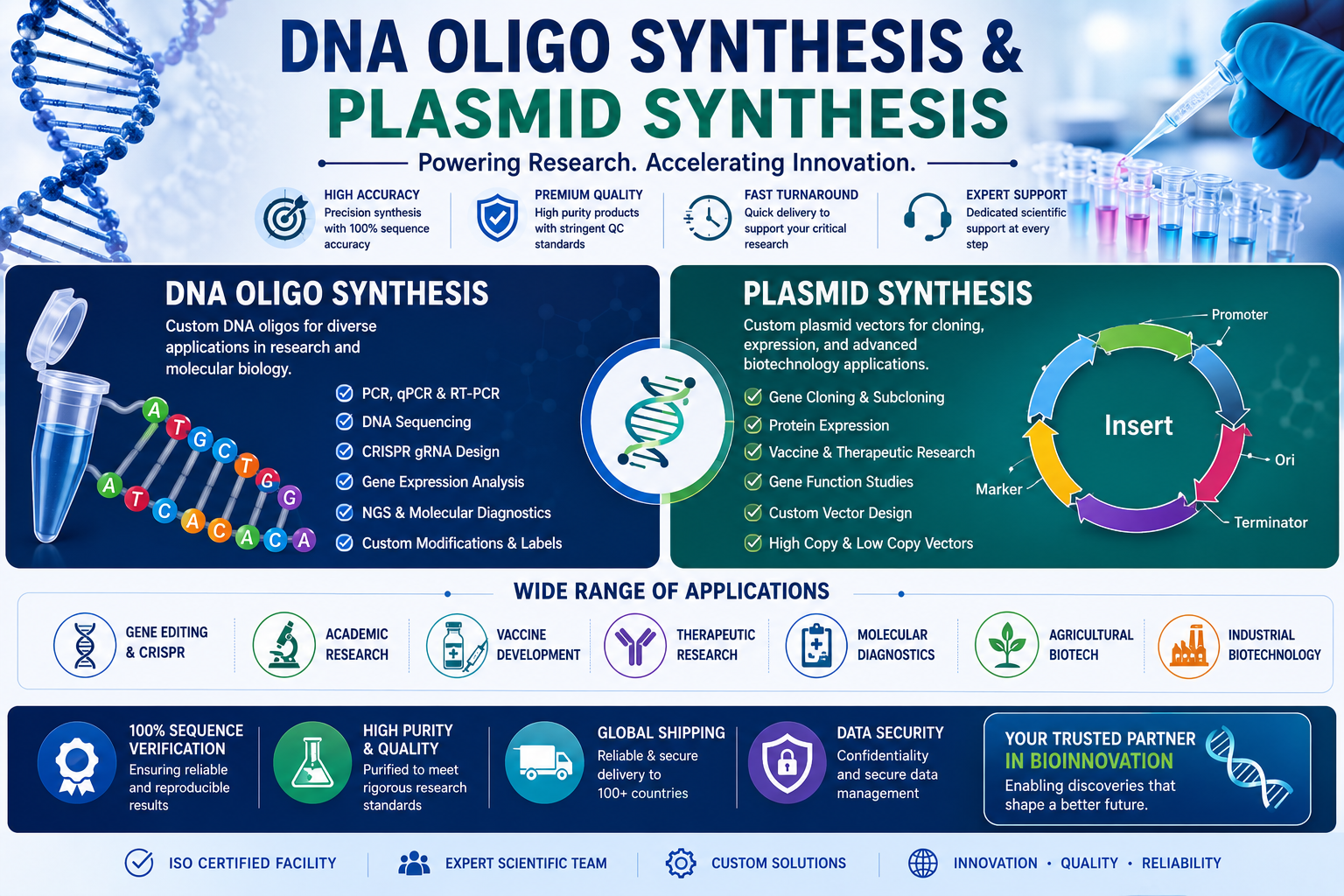
Researchers need reliable ways to create specific DNA sequences, modify genetic material, and develop customized genetic tools for their experiments. Two important technologies that make this possible are DNA oligo synthesis and plasmid synthesis.
Although both technologies involve creating DNA, they serve different purposes in research and biotechnology. DNA oligos are short, custom-designed DNA sequences used in applications such as PCR, sequencing, and gene editing. Plasmids are circular DNA molecules that help researchers study gene expression, develop biological models, and perform genetic research.
Understanding these technologies helps laboratories select the right DNA synthesis solution for their scientific requirements.
What Is DNA Oligo Synthesis?
DNA oligo synthesis is the process of producing short, custom-designed DNA strands with a specific nucleotide sequence. These synthetic DNA fragments are commonly called oligonucleotides or oligos.
They are generally used as primers, probes, sequencing components, and research tools in molecular biology. Scientists can customize their sequences according to experimental requirements, making oligo synthesis an essential service for laboratories.
How Does DNA Oligo Synthesis Work?
The synthesis process generally involves several important stages:
-
Sequence Design: Researchers identify the required nucleotide sequence.
-
Chemical Synthesis: Specialized synthesis technology builds the DNA strand using nucleotide building blocks.
-
Cleavage and Deprotection: The synthesized oligo is released and prepared for further processing.
-
Purification: Unwanted synthesis products are removed when required.
-
Quality Control: The final product is evaluated for identity, purity, and other relevant quality characteristics.
The appropriate purification and quality-control methods depend on the intended application.
Common Applications of DNA Oligos
DNA oligo synthesis supports a wide range of scientific activities, including:
-
PCR and quantitative PCR experiments.
-
DNA sequencing and genotyping.
-
Molecular cloning.
-
Genetic testing and research.
-
Hybridization probes.
-
Gene editing research.
-
Molecular diagnostics development.
Its flexibility makes custom oligonucleotides valuable for both academic laboratories and commercial biotechnology organizations.
What Is Plasmid Synthesis?
Plasmid synthesis is the process of creating custom circular DNA molecules designed for specific research or biotechnology applications.
Plasmids are small, independently replicating DNA molecules commonly found in bacteria. In laboratories, scientists use engineered plasmids as vectors to carry selected genetic sequences into suitable host cells.
A plasmid can contain several functional elements, including an origin of replication, a selectable marker, and a gene or other DNA sequence of interest.
How Does Plasmid Synthesis Work?
The process typically follows a structured workflow:
-
Plasmid Design: Researchers define the required genetic sequence and vector features.
-
DNA Assembly: Selected DNA fragments are assembled into the intended plasmid structure.
-
Sequence Verification: The resulting construct is checked to confirm that its sequence matches the design.
-
Plasmid Preparation: The verified construct is prepared and amplified when required.
-
Purification and Quality Testing: The final plasmid material is purified and evaluated according to its intended application.
Accurate sequence verification is particularly important because even small differences can affect experimental results.
DNA Oligo Synthesis vs. Plasmid Synthesis
Although these technologies are closely connected, their structures, purposes, and applications are different.
|
Comparison |
DNA Oligo Synthesis |
Plasmid Synthesis |
|---|---|---|
|
DNA structure |
Short, usually linear DNA |
Circular DNA |
|
Main purpose |
Producing custom DNA strands |
Creating complete DNA constructs |
|
Typical use |
PCR, probes, and sequencing |
Cloning and gene expression research |
|
Design complexity |
Usually simpler |
Often more complex |
|
Applications |
Molecular biology experiments |
Genetic engineering and biotechnology |
|
Quality testing |
Identity and purity |
Sequence accuracy and DNA quality |
Both technologies contribute to modern genetic research, but choosing between them depends on the experimental objective.
Benefits of Custom DNA Synthesis Services
Professional DNA oligo synthesis and plasmid synthesis services offer laboratories greater flexibility when developing research materials.
Some important advantages include:
-
Customized Sequences: Researchers can request DNA based on their specific experimental designs.
-
Consistent Quality: Appropriate quality-control procedures help improve confidence in research materials.
-
Research Efficiency: Outsourcing synthesis can reduce the need for laboratories to maintain specialized production equipment.
-
Flexible Applications: Synthetic DNA supports different molecular biology and biotechnology workflows.
-
Scalable Solutions: Laboratories can select products and preparation levels according to project requirements.
Selecting a synthesis provider with suitable technical capabilities and transparent quality documentation can make a meaningful difference to research outcomes.
How to Choose the Right DNA Synthesis Service
Before ordering custom DNA, researchers should evaluate several factors.
1. Understand Your Research Requirements
Determine whether your project requires short oligonucleotides or a complete plasmid construct.
2. Check Sequence Accuracy
Look for providers offering appropriate sequence verification and product documentation.
3. Evaluate Purification Options
Different experiments require different purity levels. Select purification according to the intended application.
4. Consider Production Capabilities
Review available sequence lengths, plasmid sizes, modifications, and preparation options.
5. Review Technical Support
A knowledgeable service provider can help researchers understand design specifications, quality requirements, and product suitability.
Frequently Asked Questions (FAQs)
1. What is DNA oligo synthesis?
DNA oligo synthesis is the production of short, customized DNA sequences for applications such as PCR, sequencing, molecular cloning, and genetic research.
2. What is plasmid synthesis?
Plasmid synthesis involves creating customized circular DNA molecules containing selected genetic elements for research and biotechnology applications.
3. What is the main difference between oligos and plasmids?
Oligos are generally short, linear DNA strands, whereas plasmids are larger, circular DNA molecules designed to carry genetic information.
4. Why is DNA oligo synthesis important?
It provides researchers with customized DNA sequences required for molecular experiments, diagnostics development, and genetic analysis.
5. What are the common applications of plasmid synthesis?
Plasmids are used in molecular cloning, gene expression studies, genetic engineering research, and biotechnology development.
6. How long does DNA oligo synthesis take?
Turnaround time depends on sequence length, purification requirements, modifications, production capacity, and the service provider.
7. Can plasmids be customized?
Yes. Researchers can customize plasmid sequences, vector elements, and other design features according to their experimental objectives.
8. Does plasmid synthesis include sequence verification?
Many professional providers offer sequence verification as part of their workflow. Researchers should confirm the specific verification method before ordering.
9. How do I select the right DNA synthesis provider?
Compare technical capabilities, quality-control procedures, purification options, documentation, customer support, and delivery timelines.
10. Can DNA oligos and plasmids be used together?
Yes. Oligonucleotides can serve as primers or assembly components during plasmid construction, making both technologies useful within the same research workflow.
- Technology for Students
- Admissions & Applications
- Online Courses
- Career and Jobs
- Campus Life
- Drinks
- Film
- Fitness
- Food
- Spellen
- Gardening
- Health
- Home
- Literature
- Music
- Networking For Students
- Insights
- Party
- Religion
- Shopping
- Sports
- Theater
- Wellness
- Education News
- Business & Finance For Students
- Security, Law & Crime Education
- Insurance
- Science & Technology For Students
 Dutch
 English
 Arabic
 French
 Spanish
 Portuguese
 Deutsch
 Turkish
 Italiano
 Russian
 Romaian
 Portuguese (Brazil)
 Greek