


Designing Smooth and Dependable Industrial Motion Systems
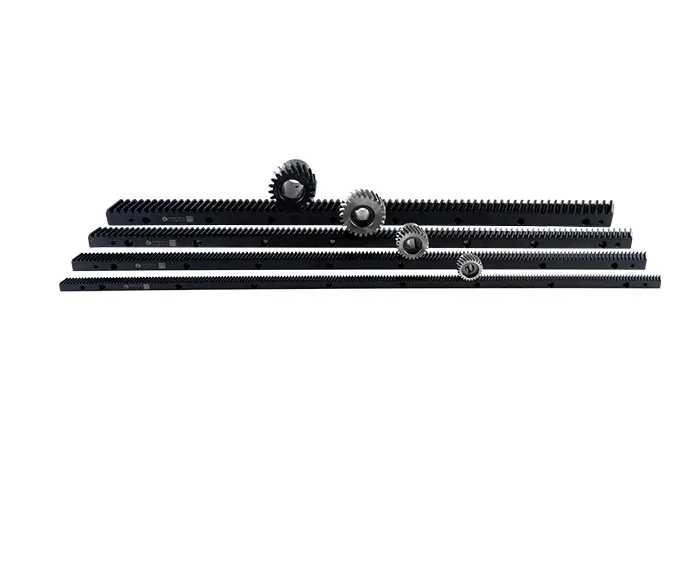
Industrial machinery often requires rotational power to produce controlled linear movement. The effectiveness of this process depends on the interaction between the driving gear and the linear transmission component. A Helical Gear Rack uses angled teeth to create progressive engagement, allowing contact to develop gradually as the mating gear rotates. This design is valuable in mechanical systems where smooth movement, stable operation, and consistent transmission behavior are important to overall equipment performance.
The angled tooth arrangement distinguishes this design from conventional straight-tooth systems. As the driving gear turns, engagement develops progressively along the tooth surface rather than occurring across the full width at the same instant. This can help reduce abrupt contact and contribute to smoother motion. In applications involving repeated movement or continuous operation, gradual engagement may also help manage vibration and mechanical noise when the complete assembly is correctly designed and installed.
The performance of a transmission component begins with its material. Industrial operating conditions can involve repeated loading, friction, and changing mechanical forces. Materials therefore need to provide suitable strength, wear resistance, and dimensional stability. Steel is commonly considered for demanding transmission applications because its properties can be adapted through material selection and heat-treatment processes. The appropriate choice depends on the expected load, operating environment, and required service life.
Manufacturing quality depends on more than the raw material itself. Preparation, cutting, machining, heat treatment, and finishing must work together to produce a component with consistent mechanical characteristics. Any variation introduced during an early production stage can influence later operations. For this reason, controlled workflows and inspection procedures are essential to maintaining reliable results.
Zhejiang Yuchen Transmission Technology Co., Ltd. focuses on mechanical transmission components for industrial applications. During production, attention to machining methods and process consistency helps support the dimensional quality required for effective assembly. Manufacturing control is particularly important for toothed components because even small variations in tooth geometry or surface condition can influence contact behavior.
Tooth profile accuracy determines how effectively the mating gear and linear component transfer force. The tooth surfaces must maintain a suitable relationship throughout engagement. Irregular geometry may cause concentrated contact, increasing friction and accelerating localized wear. Accurate machining helps create a more consistent contact pattern, while appropriate finishing can improve surface quality and reduce irregularities that interfere with movement.
The manufacturing process should also account for the relationship between tooth geometry and the intended application. Different machines may have different requirements for movement direction, positioning behavior, load distribution, and installation arrangement. A component designed for a compact automated mechanism may not be suitable for a larger industrial machine without evaluating the complete system. Understanding the operating conditions is therefore essential before selecting a transmission solution.
Installation accuracy has a direct influence on performance. The component must be mounted securely, with its working surface correctly aligned with the mating gear. If the mounting base is uneven or the assembly is misaligned, the teeth may experience inconsistent contact. This can create unnecessary stress, uneven wear, and unstable movement. A rigid supporting structure and careful installation procedure help maintain the intended engagement relationship.
Lubrication is another important consideration. Moving tooth surfaces experience friction during operation, and appropriate lubrication helps reduce direct surface interaction. The lubrication method should match the working conditions and the manufacturer's recommendations. Dust, metal particles, and other contaminants should be controlled because they can interfere with contact surfaces and contribute to premature wear. Regular maintenance helps preserve smooth movement and makes it easier to identify developing problems.
A wide range of industries uses linear transmission systems. Automated manufacturing equipment relies on controlled movement to transfer components between processing stations. Material-handling machinery uses mechanical drives to move platforms, carriers, and lifting structures. Packaging equipment may require repeatable positioning to coordinate feeding, sealing, and cutting operations. In these applications, transmission stability supports process consistency and helps maintain production efficiency.
Machine designers should evaluate several factors when choosing a transmission component. These include the working load, movement frequency, required accuracy, available installation space, environmental conditions, and compatibility with the driving gear. Maintenance access should also be considered because components that are difficult to inspect or lubricate may increase service demands. A complete system assessment helps avoid selecting parts based only on individual characteristics.
Long-term reliability depends on cooperation between design, manufacturing, installation, and maintenance. A precisely machined component cannot compensate for poor alignment, inadequate support, or unsuitable operating conditions. Similarly, correct installation cannot fully overcome inconsistent tooth geometry or unsuitable material selection. Zhejiang Yuchen Transmission Technology Co., Ltd. recognizes the importance of these connected factors in producing transmission components for industrial equipment manufacturers.
When evaluating a Helical Gear Rack, buyers should consider how the component will perform within the entire mechanical assembly. Reviewing material suitability, machining consistency, tooth contact, mounting requirements, and maintenance conditions provides a more practical basis for selection. For further information about transmission products and manufacturing solutions, visit https://www.yc-rack.com/product/spur-gear-rack/
- Technology for Students
- Admissions & Applications
- Online Courses
- Career and Jobs
- Campus Life
- Drinks
- Film
- Fitness
- Food
- Παιχνίδια
- Gardening
- Health
- Κεντρική Σελίδα
- Literature
- Music
- Networking For Students
- Insights
- Party
- Religion
- Shopping
- Sports
- Theater
- Wellness
- Education News
- Business & Finance For Students
- Security, Law & Crime Education
- Insurance
- Science & Technology For Students
 Greek
 English
 Arabic
 French
 Spanish
 Portuguese
 Deutsch
 Turkish
 Dutch
 Italiano
 Russian
 Romaian
 Portuguese (Brazil)