


Bagging Machine and Bulk Bag Unloader: Complete Guide to Efficient Material Handling
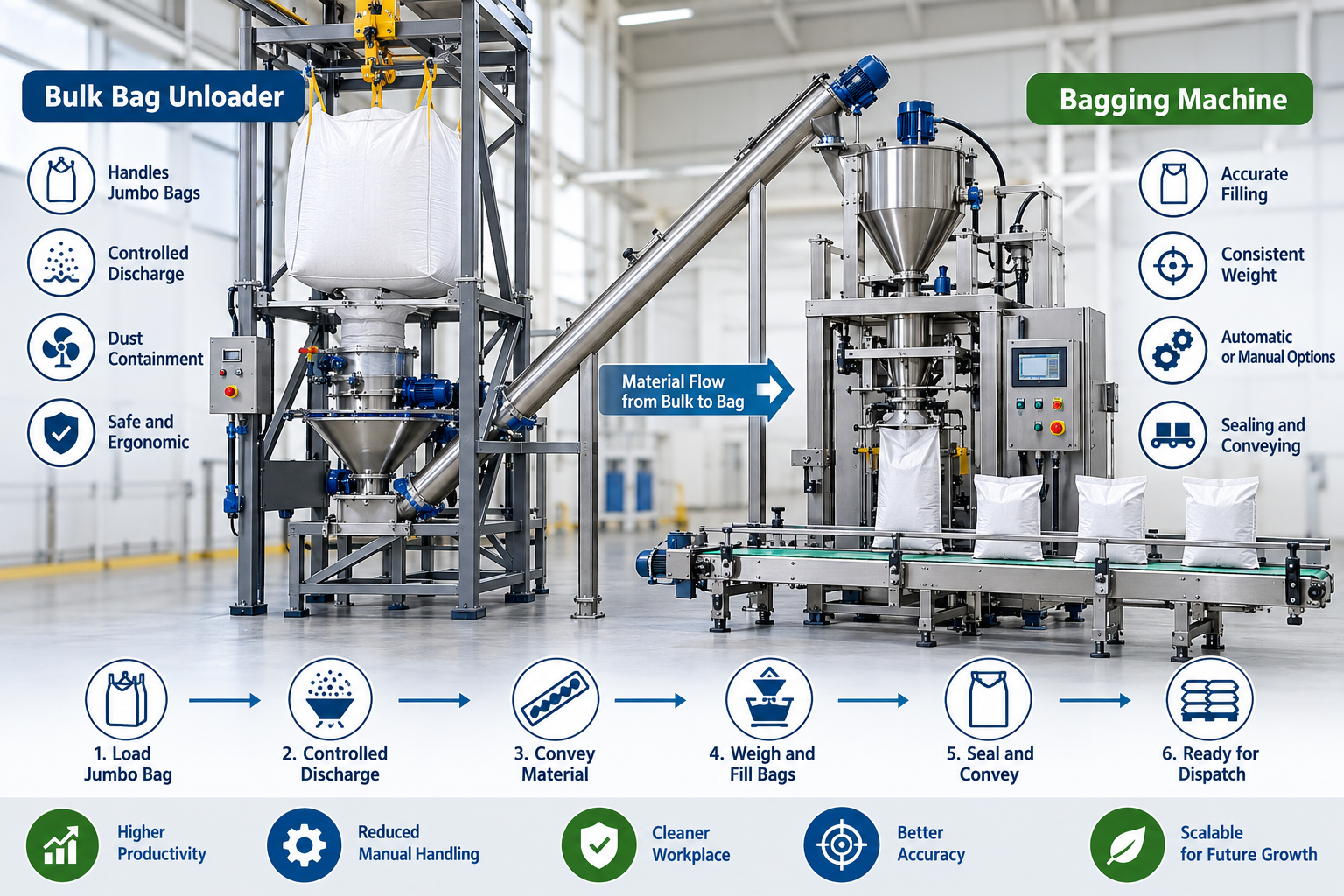
Businesses dealing with powders, granules, chemicals, fertilizers, food ingredients, cement, and other bulk materials need reliable equipment for packaging and material discharge. Two essential solutions that support these operations are the bagging machine and bulk bag unloader.
A bagging machine automates the process of filling products into bags with accuracy and consistency, while a bulk bag unloader helps discharge materials safely and efficiently from large Flexible Intermediate Bulk Containers (FIBCs), commonly known as jumbo bags.
Together, these machines help industries streamline production, minimize material wastage, and improve workplace efficiency.
What Is a Bagging Machine?
A bagging machine is industrial equipment designed to measure, fill, and package products into bags of specific weights or volumes. It is commonly used in manufacturing, agriculture, food processing, construction, and chemical industries.
Depending on the application, bagging systems can handle different materials, including:
-
Cement and construction powders
-
Rice, grains, and agricultural products
-
Fertilizers and industrial chemicals
-
Plastic granules and pellets
-
Flour, sugar, and food ingredients
-
Minerals and other powdered materials
Modern bagging equipment can operate automatically or semi-automatically, depending on production requirements.
Key Benefits of Using a Bagging Machine
Investing in a suitable bagging machine offers several operational advantages.
1. Improved Packaging Accuracy
Automated weighing and filling systems help maintain consistent bag weights, reducing underfilling and overfilling.
2. Increased Production Speed
Compared with manual packaging, automated machines can fill more bags in less time, helping manufacturers meet higher production targets.
3. Reduced Material Waste
Accurate filling mechanisms minimize product spillage and unnecessary material loss.
4. Lower Labour Requirements
Automation reduces repetitive manual activities and allows employees to focus on monitoring and quality control.
5. Better Packaging Consistency
Consistent filling improves product presentation, packaging quality, and customer satisfaction.
What Is a Bulk Bag Unloader?
A bulk bag unloader is specialized equipment used to discharge dry bulk materials from large industrial bags, typically FIBCs or jumbo bags.
These bags can contain hundreds or thousands of kilograms of material, making manual emptying difficult, time-consuming, and potentially unsafe.
A bulk bag unloading system supports controlled material discharge while reducing dust generation and manual handling.
It is widely used in industries that process powders, granules, and other dry bulk materials.
How Does a Bulk Bag Unloader Work?
A typical bulk bag unloader uses a supporting frame, bag lifting arrangement, discharge station, and controlled material outlet.
The operating process generally involves the following steps:
-
Bag Placement: A forklift, hoist, or lifting arrangement positions the jumbo bag above the unloading station.
-
Bag Connection: The operator connects the bag's discharge spout to the unloading outlet.
-
Material Discharge: The bottom spout is opened to allow material to flow into the receiving hopper.
-
Flow Control: Flow aids, vibration systems, or other mechanisms help maintain consistent material movement when required.
-
Material Transfer: The discharged product moves toward downstream equipment, such as conveyors, mixers, or a bagging machine.
The exact configuration depends on material characteristics, required capacity, and production conditions.
Major Benefits of a Bulk Bag Unloader
A properly designed bulk bag unloader can improve several aspects of industrial operations.
-
Safer Material Handling: Reduces the need for workers to manually lift or handle heavy bags.
-
Controlled Discharge: Supports consistent and predictable material flow.
-
Dust Reduction: Enclosed discharge connections can help control airborne particles.
-
Higher Productivity: Speeds up the transfer of bulk materials into production systems.
-
Reduced Material Loss: Properly designed discharge arrangements help minimize spillage.
-
Flexible Applications: Suitable for many free-flowing and difficult-to-handle dry materials when correctly configured.
Bagging Machine vs. Bulk Bag Unloader: Key Differences
Although both machines are used in material handling operations, their primary functions are different.
| Comparison | Bagging Machine | Bulk Bag Unloader |
|---|---|---|
| Main purpose | Fills products into bags | Discharges products from jumbo bags |
| Material movement | Into packaging bags | Out of bulk containers |
| Main application | Product packaging | Bulk material feeding |
| Typical equipment | Weighing and filling systems | Support frame and discharge hopper |
| Key benefit | Accurate packaging | Controlled material transfer |
| Common industries | Food, agriculture, chemicals | Cement, chemicals, food, minerals |
Both systems can work together to create a more efficient industrial material handling process.
Industries That Use These Machines
The bagging machine and bulk bag unloader are suitable for various industrial applications.
1. Food Processing Industry
Food manufacturers use these machines for handling flour, sugar, grains, starch, and other dry ingredients. Appropriate food-contact materials and hygienic designs are important.
2. Chemical Industry
Chemical manufacturers use controlled unloading and packaging systems for powders, granules, and industrial compounds.
3. Agriculture Industry
Fertilizers, seeds, animal feed, and agricultural grains require efficient filling and bulk material handling solutions.
4. Construction Industry
Cement, sand, minerals, and other construction materials can be processed using suitable industrial bagging and unloading equipment.
5. Plastic Manufacturing
Plastic resin pellets and granules can be transferred from jumbo bags and packaged using integrated material handling systems.
How to Choose the Right Equipment
Selecting the right bagging machine or bulk bag unloader requires careful evaluation of your production needs.
Consider these important factors:
-
Material Characteristics: Check particle size, density, moisture content, flowability, and dust generation.
-
Production Capacity: Determine the required filling or unloading rate.
-
Bag Size: Confirm the equipment supports your required bag dimensions and weight.
-
Automation Level: Choose manual, semi-automatic, or fully automatic operation according to your workflow.
-
Safety Requirements: Consider dust control, operator access, load capacity, and material-specific hazards.
-
Maintenance: Look for accessible components, reliable construction, and available technical support.
A detailed discussion with an equipment specialist can help identify the most suitable configuration.
Frequently Asked Questions
1. What is the main purpose of a bagging machine?
A bagging machine measures and fills products into bags accurately, helping businesses improve packaging speed and consistency.
2. What is a bulk bag unloader used for?
A bulk bag unloader safely transfers dry bulk materials from jumbo bags into hoppers, conveyors, mixers, or other processing equipment.
3. Can a bagging machine handle different materials?
Yes. Depending on its design, it can handle powders, granules, pellets, grains, fertilizers, and other suitable products.
4. Are bulk bag unloaders suitable for heavy materials?
Yes. They are designed to support specified FIBC loads. The frame and lifting arrangement must be rated for the intended bag weight.
5. Can these machines reduce material wastage?
Yes. Accurate filling and controlled discharge can reduce spillage, overfilling, and unnecessary material loss.
6. What industries require a bagging machine?
Food processing, agriculture, chemicals, construction, pharmaceuticals, and plastic manufacturing commonly use bagging equipment.
7. Is a bulk bag unloader suitable for fine powders?
Yes. With suitable enclosed connections, dust collection, and flow-assistance systems, it can handle many fine powders.
8. What is the difference between automatic and semi-automatic bagging machines?
Automatic systems perform more operations with limited manual intervention, while semi-automatic systems require operators to assist with certain activities.
9. Can a bulk bag unloader connect to a bagging machine?
Yes. A properly designed material handling arrangement can connect a bulk bag unloader to intermediate storage or conveying equipment and then feed a bagging machine.
10. How can I maintain industrial bagging equipment?
Regular inspection, cleaning, lubrication where specified, checking weighing accuracy, and replacing worn components help maintain reliable performance.
- Technology for Students
- Admissions & Applications
- Online Courses
- Career and Jobs
- Campus Life
- Drinks
- Film
- Fitness
- Food
- Jocuri
- Gardening
- Health
- Home
- Literature
- Music
- Networking For Students
- Insights
- Party
- Religion
- Shopping
- Sports
- Theater
- Wellness
- Education News
- Business & Finance For Students
- Security, Law & Crime Education
- Insurance
- Science & Technology For Students
 Romaian
 English
 Arabic
 French
 Spanish
 Portuguese
 Deutsch
 Turkish
 Dutch
 Italiano
 Russian
 Portuguese (Brazil)
 Greek