


FKM O-Ring and Pipe Seals: Choosing Reliable Sealing Solutions for Industrial Applications
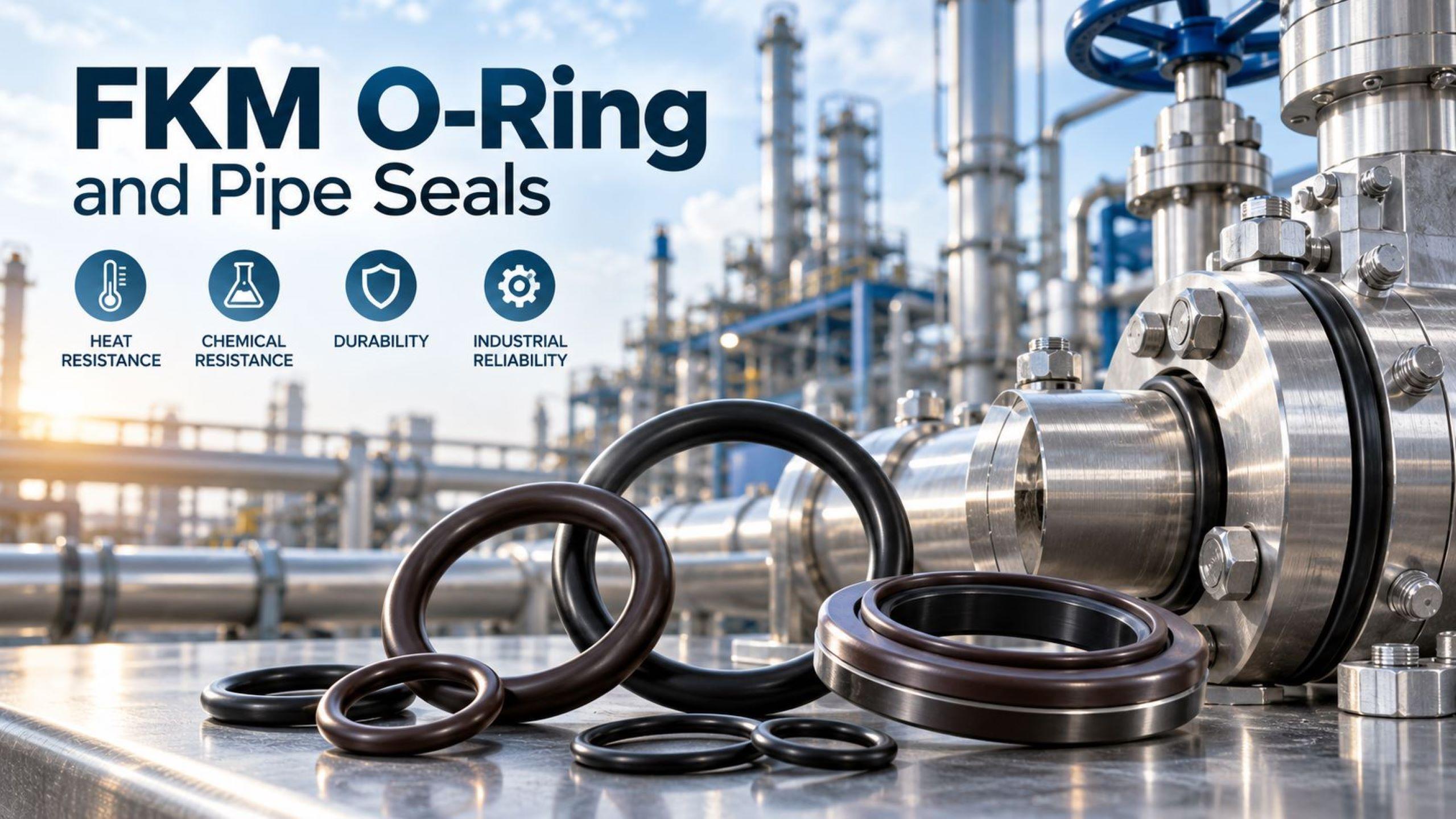
Industrial equipment depends on small components to prevent failures. A selected FKM O-Ring can protect a hydraulic connection, while Pipe Seals help keep fluid systems leak-free. Although both products create barriers against leakage, they differ in geometry, material requirements, and installation methods. Understanding these differences helps engineers, maintenance teams, and buyers make decisions.
What Is an FKM O-Ring?
An FKM O-Ring is a circular elastomer seal made from fluoroelastomer rubber. It is commonly installed in a groove and compressed between mating surfaces to create a seal. FKM is valued for resistance to many petroleum-based oils, fuels, lubricants, and elevated temperatures.
Depending on the compound and operating conditions, typical service temperatures may extend from approximately −20°C to 200°C. This is a guide, not a universal rating. Special formulations vary, and temperature alone never establishes chemical compatibility or expected lifespan.
What Are Pipe Seals?
Pipe Seals prevent fluid or gas from escaping through joints in piping systems. They can include elastomeric gaskets, bonded seals, O-rings, and other designs selected for the joint type. The correct solution depends on the pipe material, pressure, medium, movement, and applicable standards.
For example, a static flange connection may require a gasket, while a grooved connection may use a shaped rubber sealing ring. Not every pipe joint is suitable for an O-ring, and no seal should be chosen on material name alone.
Key Benefits of FKM O-Rings
The benefits of an FKM O-Ring become especially valuable where ordinary rubber may deteriorate quickly.
-
Chemical resistance: Suitable for many oils, fuels, and hydrocarbon-based fluids.
-
Heat tolerance: Often performs better than standard NBR under sustained elevated temperatures.
-
Low permeability: Can help limit certain gas and vapor losses.
-
Durability: Appropriate compounds can resist weathering, ozone, and aging.
-
Compact sealing: Simple geometry suits many static and dynamic applications when properly designed.
However, FKM is not universally compatible. Hot water, steam, certain ketones, amines, and other chemicals can damage common grades. Confirm compatibility with the compound supplier before specifying a seal.
FKM O-Ring vs. Common Pipe Seal Materials
Material selection should follow the operating environment rather than price alone.
| Material | Typical strengths | Important limitations | Common applications |
|---|---|---|---|
| FKM | Oils, fuels, high temperatures | Many steam and ketone services | Pumps, valves, fuel systems |
| NBR | Petroleum oils, economical cost | Limited ozone and high-heat resistance | Hydraulic fittings |
| EPDM | Water, weather, some steam services | Generally unsuitable for petroleum oils | Water piping, HVAC |
| PTFE | Broad chemical resistance | Limited elasticity; design-sensitive sealing | Chemical processing |
These comparisons are directional. Actual performance depends on formulation, pressure, temperature, and seal design. For drinking-water or regulated services, verify that the finished product has the necessary approvals.
Where Are These Seals Used?
Both FKM O-Ring products and Pipe Seals serve roles in industrial infrastructure. Common environments include automotive fuel assemblies, chemical-processing equipment, hydraulic power units, pumps, compressors, and industrial pipelines.
In a pump, an FKM seal may work around a stationary housing connection exposed to lubricant. In water distribution, an appropriately specified EPDM gasket may suit a pipe joint better. In aggressive chemical service, a specialized gasket or alternative elastomer might be essential. Matching the seal to service conditions prevents costly assumptions.
How to Select the Right Sealing Product
Use the following process before ordering FKM O-Ring components or Pipe Seals:
-
Identify the fluid: Record its chemical composition, concentration, and possible cleaning agents.
-
Define operating conditions: Include normal and peak temperatures, pressure, vacuum, and pressure cycling.
-
Check joint design: Confirm groove dimensions, flange style, surface finish, movement, and compression requirements.
-
Specify the compound: Compare compatibility data, hardness, compression-set performance, and relevant standards.
-
Validate dimensions: Check inside diameter, cross-section, tolerances, and installation clearance.
-
Test critical applications: Request samples and conduct leak, aging, or pressure testing before approval.
A qualified manufacturer should help confirm material selection when failure could affect safety or production continuity.
Installation and Maintenance Best Practices
Even premium Pipe Seals can fail if installed incorrectly. Clean mating surfaces, remove burrs, and inspect grooves for damage. Use only a lubricant compatible with the seal material and process fluid. Avoid twisting or stretching an O-ring excessively, and tighten fasteners according to the connection manufacturer's specified procedure.
During maintenance, look for flattening, cuts, swelling, hardening, and extrusion. These symptoms may indicate poor groove design, incompatible chemicals, excessive pressure, or heat exposure. Replacing a damaged seal without identifying the cause often leads to repeat leakage.
Frequently Asked Questions
1. What does FKM mean?
FKM identifies a family of fluoroelastomer materials commonly used for chemical-resistant rubber sealing.
2. Is an FKM O-Ring suitable for high temperatures?
Often yes, but allowable temperatures depend on the specific compound and exposure duration.
3. Can FKM seals handle water?
Some applications are possible, but common FKM grades are often poor choices for hot water or steam.
4. Are Pipe Seals and O-rings identical?
No. O-rings are one possible sealing design; pipe joints may require other gasket shapes.
5. Which material works for petroleum oils?
FKM and NBR are common candidates, subject to fluid and temperature compatibility.
6. Is EPDM suitable for fuel pipelines?
Generally not for petroleum fuels. Verify a suitable alternative with the supplier.
7. How do I measure an O-ring?
Measure its inside diameter and cross-sectional thickness using suitable tools.
8. Can damaged seals be reused?
Replacement is generally safer when seals show wear, deformation, or chemical attack.
9. Do all pipe seals withstand high pressure?
No. Pressure capability depends on the complete joint design and service conditions.
10. How can I reduce recurring leaks?
Check compatibility, dimensions, surface condition, installation practice, and operating extremes.
- Technology for Students
- Admissions & Applications
- Online Courses
- Career and Jobs
- Campus Life
- Drinks
- Film
- Fitness
- Food
- Giochi
- Gardening
- Health
- Home
- Literature
- Music
- Networking For Students
- Insights
- Party
- Religion
- Shopping
- Sports
- Theater
- Wellness
- Education News
- Business & Finance For Students
- Security, Law & Crime Education
- Insurance
- Science & Technology For Students
 Italiano
 English
 Arabic
 French
 Spanish
 Portuguese
 Deutsch
 Turkish
 Dutch
 Russian
 Romaian
 Portuguese (Brazil)
 Greek