


Forged Elements and Wrought Iron Components for Custom Metal Product Development
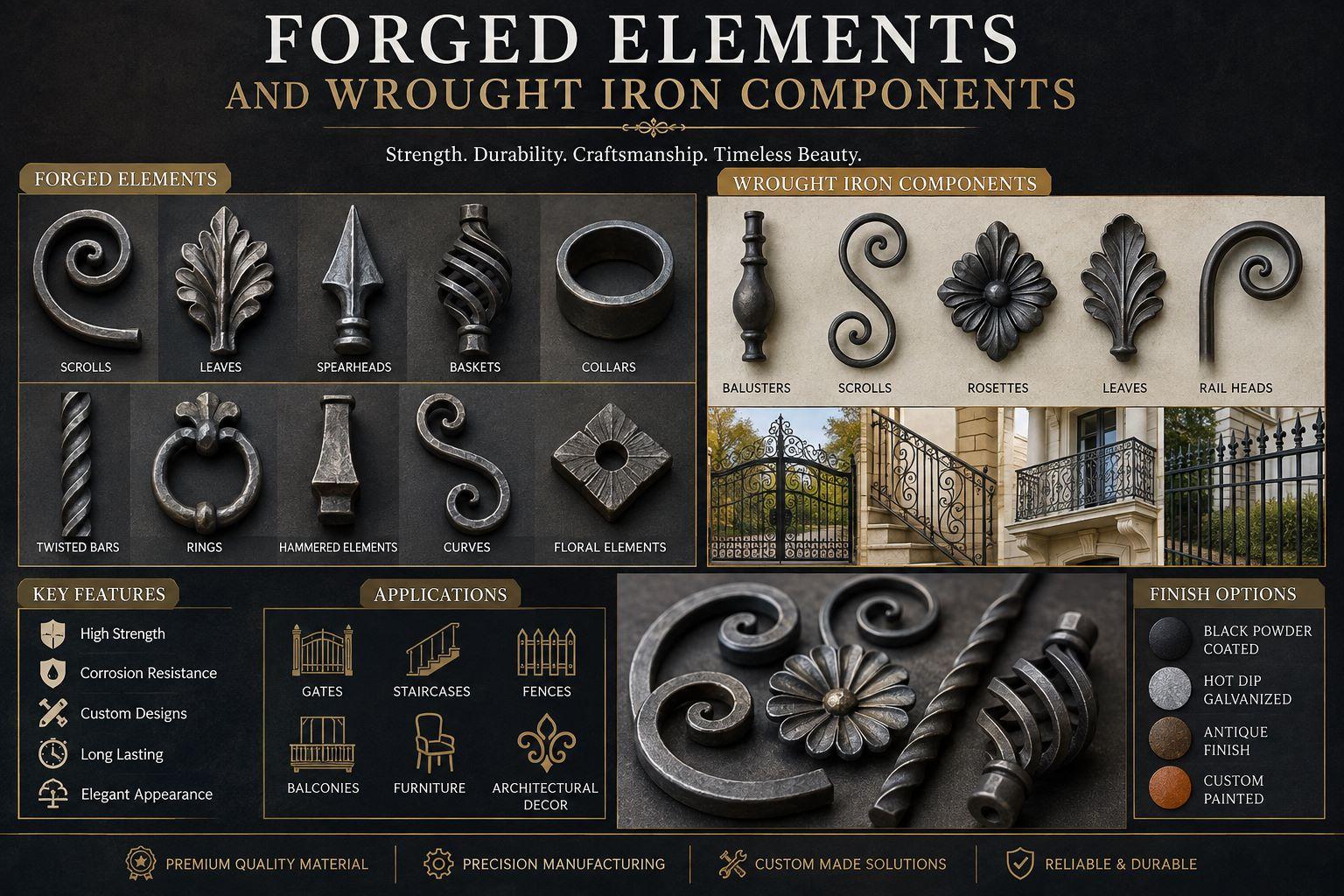
The demand for personalized metal products continues to influence how manufacturers approach design, production, and customization. Forged Elements and Wrought Iron Components provide valuable opportunities for developing distinctive products that meet individual customer preferences. From bespoke furniture accessories to decorative architectural installations, these components allow businesses to create specialized metalwork for different markets.
As customers increasingly seek unique designs rather than standard products, metal fabricators must balance creativity with practical manufacturing requirements. Understanding customization techniques, product development strategies, and design specifications can help businesses deliver attractive and functional metal solutions.
The Importance of Customization in Metal Manufacturing
Customization allows manufacturers to develop products according to specific dimensions, patterns, finishes, and functional requirements.
Instead of depending entirely on standard designs, fabrication workshops can combine different decorative parts to create personalized products.
Forged Elements support this approach because metal can be formed into various decorative shapes using suitable forging techniques.
Similarly, Wrought Iron Components are available in numerous ornamental styles, making them useful for assembling customized metal products.
The result is greater flexibility for architects, designers, manufacturers, and property owners.
Developing Unique Products with Decorative Metal Parts
Decorative components can transform ordinary metal structures into distinctive products.
Customized Entrance Systems
Manufacturers can combine ornamental scrolls, decorative panels, forged finials, and metal frames to develop entrance gates tailored to different architectural styles.
Personalized Furniture Accessories
Decorative metal components can enhance furniture legs, headboards, table supports, and ornamental furniture frames.
Designer Lighting Products
Metalworking specialists can incorporate forged patterns into chandeliers, hanging light frames, and decorative lighting accessories.
Customized Garden Accessories
Outdoor furniture, plant supports, decorative arches, and landscape ornaments can include specially shaped metal details.
Understanding the Metal Product Design Process
Successful customization requires organized planning before production begins.
Concept Development
The process starts by understanding customer preferences, intended applications, available installation space, and desired appearance.
Technical Drawings
Designers prepare measurements, component layouts, and fabrication details to communicate manufacturing requirements.
Material Selection
Suitable metals are selected according to strength requirements, formability, finishing compatibility, and environmental conditions.
Prototype Evaluation
For complex products, manufacturers may produce samples or prototypes to evaluate appearance, dimensions, and assembly methods.
Final Manufacturing
Approved designs proceed to forming, fabrication, inspection, and finishing.
Standard Components Versus Custom-Made Products
Both standardized and custom-manufactured components offer advantages depending on project requirements.
|
Factor |
Standard Components |
Custom-Made Components |
|---|---|---|
|
Design |
Existing patterns |
Customer-specific designs |
|
Tooling |
Usually established |
May require new tooling |
|
Production |
Repeatable processes |
Project-dependent |
|
Flexibility |
Limited to available options |
Greater design freedom |
|
Best Use |
Common fabrication projects |
Specialized applications |
Combining standard accessories with customized Forged Elements can provide a practical balance between design flexibility and manufacturing complexity.
How Digital Technology Supports Metal Customization
Digital tools increasingly assist manufacturers with planning and designing decorative metal products.
Computer-Aided Design
CAD software helps designers create detailed drawings, examine component arrangements, and update measurements before fabrication.
Digital Measurement
Accurate measurements help manufacturers reduce dimensional errors during product development.
CNC Manufacturing
Computer-controlled equipment supports repeatable cutting and shaping operations for compatible designs.
Production Documentation
Digital drawings and manufacturing records help maintain consistency between customer requirements and finished components.
Technology supports traditional metalworking skills rather than replacing the need for experienced fabricators.
Selecting Suitable Wrought Iron Components
Choosing Wrought Iron Components requires consideration of practical and aesthetic factors.
Important selection criteria include:
-
Component dimensions: Match the available assembly space.
-
Decorative pattern: Maintain visual consistency across the design.
-
Material type: Verify whether the product uses traditional wrought iron or modern steel.
-
Surface condition: Inspect for visible defects before fabrication.
-
Joining requirements: Confirm compatibility with the intended assembly process.
-
Protective finish: Select coatings appropriate for the installation environment.
Careful selection helps minimize unnecessary adjustments during manufacturing.
Common Challenges in Customized Metalwork
Custom fabrication may involve additional coordination compared with standard production.
Intricate patterns can require specialized tooling, additional forming operations, or skilled manual work.
Unclear drawings may create dimensional problems, while unsuitable material selection can affect joining and finishing.
Manufacturers can address these challenges through detailed specifications, realistic production planning, and effective communication with customers.
Opportunities for Small Metal Fabrication Businesses
Customized decorative metalwork offers opportunities for workshops seeking to expand their product offerings.
Businesses can develop specialized collections for furniture manufacturers, interior designers, architectural contractors, and landscaping companies.
Creating sample catalogues, documenting previous projects, and offering customization options can help customers understand available manufacturing capabilities.
Frequently Asked Questions
What are forged elements used for?
They are used to create shaped metal details for decorative and functional products.
Can wrought iron components be customized?
Yes. Manufacturers can offer customized dimensions, patterns, and finishes depending on production capabilities.
What is the first step in custom metal fabrication?
The first step is establishing clear design requirements and accurate measurements.
Are standard metal components suitable for custom projects?
Yes. Standard parts can be combined with specially manufactured accessories.
Which software is used for metal product design?
CAD software is commonly used for drawings, dimensions, and component planning.
Can decorative metal parts be used indoors?
Yes. They are suitable for furniture, partitions, lighting accessories, and decorative installations.
Are forged components suitable for outdoor products?
Yes, when appropriate materials, finishes, and maintenance practices are used.
Why is prototyping important?
Prototyping helps evaluate design accuracy, assembly suitability, and appearance before full production.
What influences custom metalwork pricing?
Design complexity, material selection, tooling, labor, order quantity, and finishing requirements influence pricing.
How can buyers find suitable components?
Buyers should compare technical specifications, product samples, customization capabilities, and supplier quality standards.
- Technology for Students
- Admissions & Applications
- Online Courses
- Career and Jobs
- Campus Life
- Drinks
- Film
- Fitness
- Food
- Spellen
- Gardening
- Health
- Home
- Literature
- Music
- Networking For Students
- Insights
- Party
- Religion
- Shopping
- Sports
- Theater
- Wellness
- Education News
- Business & Finance For Students
- Security, Law & Crime Education
- Insurance
- Science & Technology For Students
 Dutch
 English
 Arabic
 French
 Spanish
 Portuguese
 Deutsch
 Turkish
 Italiano
 Russian
 Romaian
 Portuguese (Brazil)
 Greek