


Your Extruder Is Only as Good as Its Barrel, Screw and Screw Elements
A new motor cannot fix bad mixing. Advanced controls cannot compensate for excessive wear. And a high production rating means very little if the material is not moving, melting, and mixing correctly inside the machine.
That is why the barrel and screw and every screw element deserve far more attention than they usually get.
These components control the most important part of extrusion: what actually happens to the material before it reaches the die.
They influence flow, pressure, heat generation, dispersion, residence time, output stability, and finished-product quality.
If production is becoming unstable, scrap is rising, or mixing is no longer consistent, the problem may already be hiding inside the barrel.
The Real Processing Happens Where You Cannot See It
Operators can see the control panel.
They can see temperature settings, motor load, and output.
What they cannot easily see is the material being compressed, sheared, melted, kneaded, and transported inside the extruder.
That hidden process depends heavily on the barrel and screw.
Together, they create the path through which raw material is transformed into a controlled melt.
A typical process may involve:
-
Feeding
-
Conveying
-
Compression
-
Heating
-
Melting
-
Mixing
-
Pressure generation
-
Discharge
If even one of these stages becomes unstable, the final product can suffer.
Why the Barrel Is More Than Just a Metal Housing
The barrel does far more than surround the screw.
It creates the controlled processing environment in which the material travels.
Depending on machine design, the barrel may include heating zones, cooling sections, feeding ports, venting locations, and different processing segments.
Its internal condition also matters.
If the barrel becomes excessively worn, clearance between the barrel and screw can increase. That may reduce conveying efficiency and make it harder for the machine to build stable pressure.
Possible Effects of Barrel Wear
Manufacturers may notice:
-
Lower output
-
Pressure instability
-
More material leakage
-
Higher energy consumption
-
Poor melting
-
Inconsistent product quality
Wear often develops gradually, which is why it can remain unnoticed for too long.
The Screw Is the Engine of Material Movement
The screw continuously moves material through the barrel.
But simply rotating is not enough.
Its geometry determines how the material behaves.
Important features may include:
-
Flight depth
-
Screw pitch
-
Diameter
-
Compression profile
-
Length-to-diameter ratio
-
Mixing sections
-
Surface treatment
A properly designed screw helps maintain controlled material flow.
A poorly matched design can create excess heat, unstable pressure, weak mixing, or unnecessary energy use.
This is why the barrel and screw should always be selected as part of the processing system rather than as isolated components.
What Makes a Screw Element So Important?
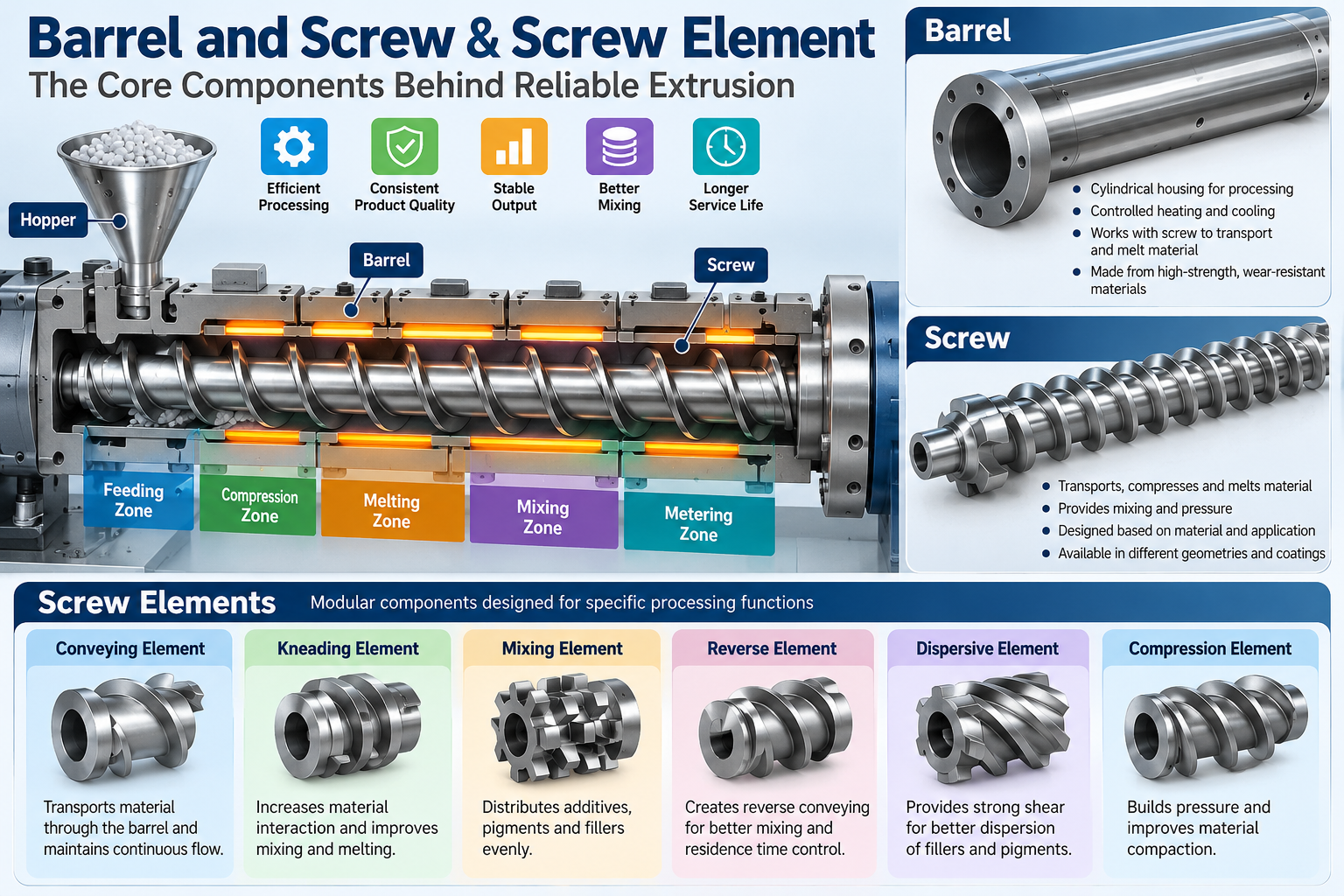
A screw element is a modular processing component used in many twin-screw extrusion systems.
Instead of using one fixed screw geometry from beginning to end, modular screws can be assembled from multiple individual elements.
Each element can perform a different task.
That changes the machine from a simple conveying system into a highly configurable processing platform.
One Screw Shaft, Multiple Jobs
Different elements can be positioned along the shaft depending on the material and desired process.
Conveying Elements
These sections help move material forward through the barrel.
Kneading Elements
Kneading elements increase material interaction and are often used to improve melting and mixing.
Mixing Elements
A mixing screw element can help distribute additives, pigments, fillers, or other ingredients more uniformly.
Reverse Elements
These can create resistance to material flow and increase residence time in a selected zone.
Compression Elements
Compression sections can help increase pressure and compact the material.
The real advantage comes from combining these functions intelligently.
Why Screw Configuration Can Change Product Quality
Two machines may use the same polymer and operate at similar temperatures.
Yet one can produce a better compound.
Why?
The difference may be inside the screw configuration.
A correctly arranged screw element sequence can improve:
-
Mixing
-
Dispersion
-
Melting
-
Pressure development
-
Residence time
-
Filler distribution
-
Additive distribution
An incorrect configuration can create the opposite result.
Too little mixing may leave pigments or fillers poorly distributed.
Too much mixing may generate excessive shear and temperature.
Good extrusion is about balance.
Barrel and Screw vs Screw Element: The Fast Comparison
| Factor | Barrel and Screw | Screw Element |
|---|---|---|
| Main Purpose | Overall material processing | Specific processing function |
| Typical Role | Conveying, melting, pressure | Mixing, kneading, conveying |
| Configuration | Core machine design | Modular |
| Flexibility | Moderate | High |
| Wear Effect | Influences overall efficiency | Influences individual zones |
| Typical Use | Most extruders | Especially twin-screw systems |
They are different components, but they work as one processing system.
The Silent Warning Signs of Internal Wear
Extruder wear does not always announce itself with a breakdown.
Often, the machine continues running.
Production simply becomes worse.
Watch for These Signs
-
Output starts dropping.
-
Melt pressure becomes unstable.
-
Motor load changes unexpectedly.
-
Product color becomes inconsistent.
-
More scrap is generated.
-
Material takes longer to process.
-
Temperature control becomes difficult.
These symptoms do not automatically mean the barrel and screw are worn, but they should trigger inspection.
Ignoring them can turn a manageable maintenance issue into a much larger production problem.
What Actually Causes Screw and Barrel Wear?
Several production conditions accelerate wear.
Abrasive Materials
Glass fiber, mineral fillers, and certain additives can create significant abrasion.
Corrosive Formulations
Some processing chemicals or additives may attack component surfaces.
Poor Material Quality
Contaminants can damage internal components and create local wear.
Incorrect Processing Conditions
Excessive temperature, pressure, or mechanical load can increase stress.
High Production Hours
Even correctly operated equipment experiences gradual wear over long production cycles.
That is why maintenance should be based on actual process conditions, not only calendar dates.
How to Make Barrel and Screw Components Last Longer
Extending service life starts with disciplined operation.
Manufacturers should focus on:
-
Proper startup procedures
-
Correct barrel temperatures
-
Clean raw materials
-
Stable feeding
-
Pressure monitoring
-
Routine inspection
-
Wear measurements
-
Preventive maintenance
-
Correct shutdown procedures
Choosing suitable metallurgy is also important.
Highly abrasive materials may require more wear-resistant component surfaces than standard polymers.
Why Cheap Replacement Parts Can Become Expensive
A low-cost replacement may look attractive.
But if its material quality, geometry, tolerances, or surface treatment are incorrect, the long-term cost can be much higher.
Poor components may lead to:
-
Faster wear
-
Unstable output
-
Higher power consumption
-
Poor mixing
-
More downtime
-
Frequent replacement
The best component is not necessarily the cheapest.
It is the one that delivers the right performance over the required service life.
How to Choose the Right Screw Element
A screw element should be selected according to the job it needs to perform.
Before choosing a configuration, consider:
-
Polymer type
-
Filler percentage
-
Fiber content
-
Pigment loading
-
Heat sensitivity
-
Mixing requirement
-
Venting requirement
-
Target output
One configuration cannot be ideal for every formulation.
That is why modular extrusion technology is so useful.
The screw can be adapted to the material rather than forcing every material through the same processing profile.
The Biggest Mistake: Chasing Maximum Mixing
More mixing is not always better.
This is one of the most important lessons in screw design.
Excessive mixing can increase:
-
Shear
-
Melt temperature
-
Energy consumption
-
Material degradation
-
Residence time
The correct goal is controlled mixing.
A properly designed screw element arrangement creates only the amount of material interaction needed for the application.
That helps maintain both product quality and process efficiency.
Why Process Data Can Reveal Hidden Component Problems
Modern extruders generate valuable operating data.
Changes in that data can reveal early signs of internal wear.
Manufacturers should monitor trends in:
-
Pressure
-
Torque
-
Motor load
-
Melt temperature
-
Output
-
Energy usage
-
Scrap levels
If output falls while motor load or temperature changes, the process may be signaling a mechanical or configuration issue.
Data does not replace inspection.
But it can tell you when inspection is needed.
Smarter Extrusion Starts Inside the Machine
Modern extrusion technology is increasingly focused on control and flexibility.
Advanced production lines may combine optimized barrel and screw systems with:
-
Automatic feeding
-
Digital temperature control
-
Torque monitoring
-
Pressure sensors
-
Energy tracking
-
Recipe storage
-
Production analytics
At the same time, modular screw element designs allow manufacturers to adapt processing conditions for different materials.
This combination of mechanical optimization and digital control is shaping the future of extrusion.
Frequently Asked Questions
1. What is the main function of the barrel and screw?
The barrel and screw transport, heat, melt, mix, compress, and pressurize material during extrusion.
2. What is a screw element?
A screw element is a modular section used to perform a specific processing function such as conveying, kneading, or mixing.
3. Where are screw elements commonly used?
They are widely used in modular twin-screw extruders.
4. Can worn screws reduce production output?
Yes. Excessive wear can reduce conveying and pressure-building efficiency.
5. What are common signs of barrel wear?
Possible signs include lower output, unstable pressure, inconsistent product quality, and higher energy use.
6. Why are kneading elements used?
They increase material interaction and can improve mixing and melting.
7. Can screw configuration affect pigment dispersion?
Yes. Screw configuration can strongly influence pigment and additive distribution.
8. What causes excessive screw wear?
Abrasive fillers, contamination, corrosive materials, poor operating conditions, and long production hours can accelerate wear.
9. Is more mixing always better?
No. Excessive mixing can generate too much heat and shear, potentially damaging the material.
10. How should extrusion components be selected?
Selection should consider material type, fillers, abrasiveness, processing temperature, mixing needs, output, and expected service life.
- Technology for Students
- Admissions & Applications
- Online Courses
- Career and Jobs
- Campus Life
- Drinks
- Film
- Fitness
- Food
- Jogos
- Gardening
- Health
- Início
- Literature
- Music
- Networking For Students
- Insights
- Party
- Religion
- Shopping
- Sports
- Theater
- Wellness
- Education News
- Business & Finance For Students
- Security, Law & Crime Education
- Insurance
- Science & Technology For Students
 Portuguese
 English
 Arabic
 French
 Spanish
 Deutsch
 Turkish
 Dutch
 Italiano
 Russian
 Romaian
 Portuguese (Brazil)
 Greek