


Twin Extruder vs Single Extruder: The Machine Choice That Can Transform Your Production Line
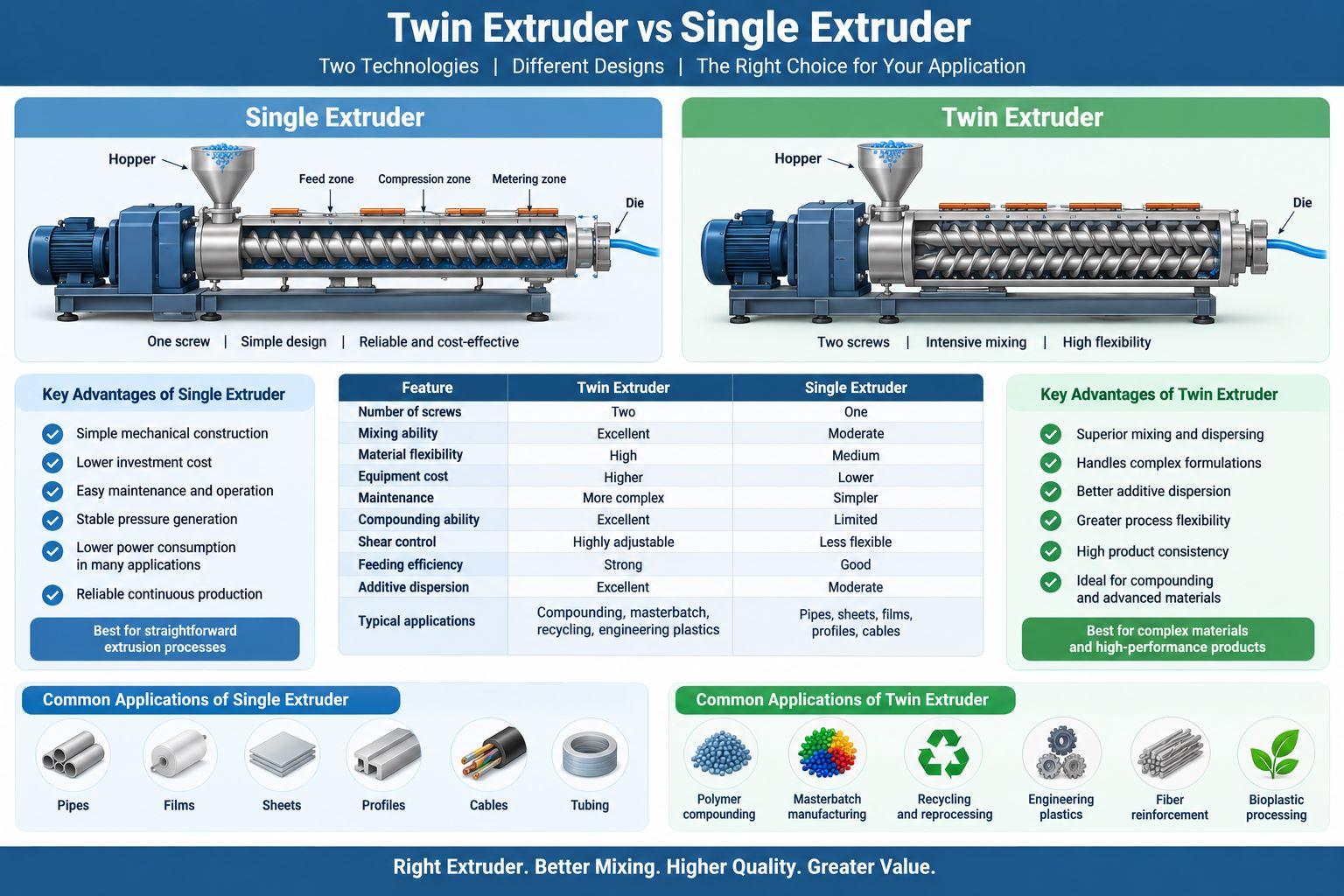
One wrong extrusion machine can slow production, increase waste, complicate maintenance, and create inconsistent product quality. One right machine can do the opposite.
That is why the debate between a twin extruder and a single extruder matters far more than it may seem.
Both machines are widely used across plastics, polymer processing, compounding, masterbatch, profiles, pipes, sheets, and specialized manufacturing. Yet they behave very differently once material enters the barrel.
A single extruder is known for simplicity, reliability, and stable continuous processing. A twin extruder is built for greater mixing, advanced formulation control, and demanding compound production.
So which one should you choose?
The answer depends on what your material actually needs.
The Biggest Mistake Manufacturers Make When Choosing an Extruder
Many buyers focus first on output capacity, machine size, or purchase price.
That can be a costly mistake.
An extrusion machine should be selected according to:
-
Material characteristics
-
Mixing requirements
-
Final product
-
Number of additives
-
Required product consistency
-
Production volume
-
Maintenance capability
-
Future product plans
A machine that looks economical at the beginning may become expensive if it causes production problems later.
The real goal is not simply to buy an extruder. It is to build a stable production process.
Why the Single Extruder Is Still a Manufacturing Workhorse
A single extruder uses one rotating screw to transport material through a heated barrel.
The process may sound simple, but that simplicity is exactly why the machine remains so valuable.
Raw material enters through the feeding section. As the screw rotates, the material moves forward, heats, compresses, melts, and becomes more uniform before passing through a die.
The result is continuous extrusion with relatively straightforward process control.
What Makes a Single Extruder So Practical?
A single extruder can be an excellent choice when complex mixing is unnecessary.
Simpler Operation
Because the machine contains one main screw, operators have fewer processing interactions to manage.
Easier Maintenance
A simpler mechanical structure can make inspections, cleaning, troubleshooting, and servicing more manageable.
Reliable Continuous Output
For established formulations and predictable materials, single-screw extrusion can provide stable production over long operating cycles.
Where It Performs Best
A single extruder is commonly suitable for:
-
Plastic pipes
-
Profiles
-
Sheets
-
Films
-
Coatings
-
Tubes
-
Standard thermoplastic products
-
Continuous shaping processes
If your material is already prepared and primarily needs melting and shaping, a single-screw system may be exactly what you need.
Why the Twin Extruder Changes the Game for Compounding
A twin extruder works with two screws inside the barrel.
That second screw changes the entire processing environment.
Instead of simply conveying material forward, the screws can create more controlled shear, mixing, kneading, and material movement.
This becomes extremely important when different ingredients must be combined evenly.
A twin extruder can handle materials containing:
-
Pigments
-
Fillers
-
Fibers
-
Stabilizers
-
Lubricants
-
Modifiers
-
Multiple polymers
-
Functional additives
When formulation complexity increases, stronger mixing control becomes a major advantage.
Why Twin Extruders Are So Popular in Masterbatch Production
Masterbatch production depends heavily on dispersion.
Color pigments and additives must be distributed consistently throughout the carrier material. If they are not, the finished product may show uneven color, inconsistent performance, or processing difficulties.
A twin extruder can create the controlled mixing action needed to improve ingredient distribution.
Better Dispersion
Two screws help break down and spread ingredients through the polymer melt.
Better Distribution
The material can be moved repeatedly across different processing zones, improving formulation uniformity.
Greater Processing Flexibility
Different screw elements may be configured for conveying, kneading, mixing, or pressure generation.
This makes twin-screw technology highly adaptable for advanced production.
Twin Extruder vs Single Extruder: The Difference at a Glance
| Factor | Twin Extruder | Single Extruder |
|---|---|---|
| Screws | Two | One |
| Mixing Strength | High | Moderate |
| Machine Complexity | Higher | Lower |
| Compounding Ability | Excellent | Basic to moderate |
| Ease of Operation | Moderate | High |
| Maintenance | More technical | Simpler |
| Material Flexibility | High | Good |
| Best Use | Compounds and complex formulations | Standard extrusion |
| Additive Dispersion | Strong | Limited |
| Process Flexibility | High | Straightforward |
The table shows why the answer is not simply "two screws are better than one."
The right machine depends on the job.
Which Machine Gives Better Production Efficiency?
This is where the comparison becomes more interesting.
Production efficiency is not only about output per hour.
True efficiency includes:
-
Stable quality
-
Low rejection rate
-
Reduced material waste
-
Consistent pressure
-
Predictable energy consumption
-
Easy changeovers
-
Controlled maintenance
-
Reliable uptime
A single extruder can be highly efficient in simple applications because it avoids unnecessary complexity.
A twin extruder, meanwhile, can be more efficient when advanced mixing is required because it can perform multiple processing functions in one continuous operation.
Efficiency therefore depends on matching the machine to the material.
When a Single Extruder Is the Smarter Choice
Manufacturers sometimes assume a more advanced machine automatically means better production.
That is not always true.
A single extruder may be the smarter option when:
-
The material is already compounded.
-
Intensive mixing is unnecessary.
-
The finished product is a simple continuous shape.
-
Production runs are stable and repetitive.
-
Lower machine complexity is preferred.
-
Maintenance resources are limited.
For standard extrusion, simplicity can be a competitive advantage.
When a Twin Extruder Becomes the Better Investment
A twin extruder becomes more valuable as formulation complexity increases.
It may be the better choice when production involves:
-
Multiple raw materials
-
High filler loading
-
Pigments or masterbatch
-
Fiber reinforcement
-
Reactive processing
-
Degassing requirements
-
Frequent formulation changes
-
High mixing demands
In such applications, the extra processing control can directly influence product quality.
Five Questions That Reveal Which Extruder You Actually Need
Before requesting a machine quotation, ask these questions:
1. Does My Material Need Intensive Mixing?
If yes, twin-screw technology may have a clear advantage.
2. Am I Processing Ready-Made Material?
If the material is already compounded, a single extruder may be enough.
3. How Many Ingredients Are in the Formula?
The more complex the formulation, the more important mixing capability becomes.
4. Will Products Change Frequently?
Frequent formulation changes may require greater processing flexibility.
5. What Matters More: Simplicity or Compounding Power?
This question often reveals the correct direction immediately.
The Hidden Factors That Control Extruder Performance
Even the best extruder can perform poorly if operating conditions are unstable.
Extrusion quality depends on several connected variables.
Screw Speed
Screw speed affects material movement, residence time, mixing, pressure, and output.
Barrel Temperature
Incorrect temperatures can cause incomplete melting or material degradation.
Feeding Accuracy
Inconsistent feeding produces inconsistent extrusion.
Screw Design
Screw geometry determines how material is conveyed, mixed, compressed, and processed.
Other Critical Variables
Manufacturers should also monitor:
-
Raw-material moisture
-
Melt temperature
-
Die pressure
-
Cooling conditions
-
Barrel wear
-
Screw wear
-
Material consistency
-
Process stability
Machine selection is important, but process control determines whether that machine performs at its best.
Twin Extruder and Single Extruder: What About Energy Consumption?
Energy use varies widely depending on machine design, material, output, screw speed, heating system, and process conditions.
A single extruder may offer an advantage in straightforward production because the process is mechanically simpler.
A twin extruder may justify additional processing complexity when it combines several operations that would otherwise require separate steps.
Manufacturers should therefore compare energy consumption against actual production value rather than focusing only on motor size.
Why Modern Extrusion Lines Are Getting Smarter
Today's extrusion systems are increasingly connected to automation and digital process control.
Modern machines may include:
-
Automated raw-material feeding
-
Digital temperature control
-
Recipe management
-
Real-time pressure monitoring
-
Production data recording
-
Energy monitoring
-
Automatic alarms
-
Speed synchronization
These tools can improve consistency across both twin extruder and single extruder production lines.
The future of extrusion is not only about stronger machines. It is about smarter machines that give operators better control over every stage of production.
Which Extruder Wins?
There is no universal winner.
That may sound less dramatic, but it is the most important truth in extrusion technology.
A single extruder wins when simplicity, continuous shaping, easy operation, and reliable processing are the priorities.
A twin extruder wins when intensive mixing, complex formulations, advanced compounding, and material flexibility matter more.
The wrong question is:
"Which machine is better?"
The right question is:
"Which machine is better for my material and my product?"
Frequently Asked Questions
1. What is a twin extruder?
A twin extruder is an extrusion machine that uses two screws to process material, providing strong mixing and compounding capability.
2. What is a single extruder?
A single extruder uses one rotating screw to melt, convey, compress, and shape material continuously.
3. Which extruder is better for masterbatch?
A twin-screw system is generally more suitable because masterbatch requires strong pigment and additive dispersion.
4. Is a single extruder good for plastic pipes?
Yes. A single extruder is widely suitable for many pipe and profile production applications.
5. Why does a twin extruder mix better?
Two interacting screws create more material movement, shear, and mixing opportunities inside the barrel.
6. Is a twin extruder more complicated to operate?
Usually, yes. It offers greater control but can involve more processing variables and mechanical complexity.
7. Which extruder is easier to maintain?
A single extruder generally has a simpler design, which can make maintenance easier.
8. Can a twin extruder handle fillers and fibers?
Yes. Twin-screw systems are widely used for compounds containing fillers, reinforcing fibers, pigments, and additives.
9. Does screw design affect extrusion output?
Yes. Screw geometry influences feeding, melting, mixing, pressure, residence time, and final product consistency.
10. How do I choose between twin and single extrusion?
Start with your raw material, formulation, mixing requirement, finished product, output target, maintenance capability, and future production needs.
- Technology for Students
- Admissions & Applications
- Online Courses
- Career and Jobs
- Campus Life
- Drinks
- Film
- Fitness
- Food
- Παιχνίδια
- Gardening
- Health
- Κεντρική Σελίδα
- Literature
- Music
- Networking For Students
- Insights
- Party
- Religion
- Shopping
- Sports
- Theater
- Wellness
- Education News
- Business & Finance For Students
- Security, Law & Crime Education
- Insurance
- Science & Technology For Students
 Greek
 English
 Arabic
 French
 Spanish
 Portuguese
 Deutsch
 Turkish
 Dutch
 Italiano
 Russian
 Romaian
 Portuguese (Brazil)