


Why Flanging Machines and Small Press Brakes Are Becoming Essential in Modern Metal Shops
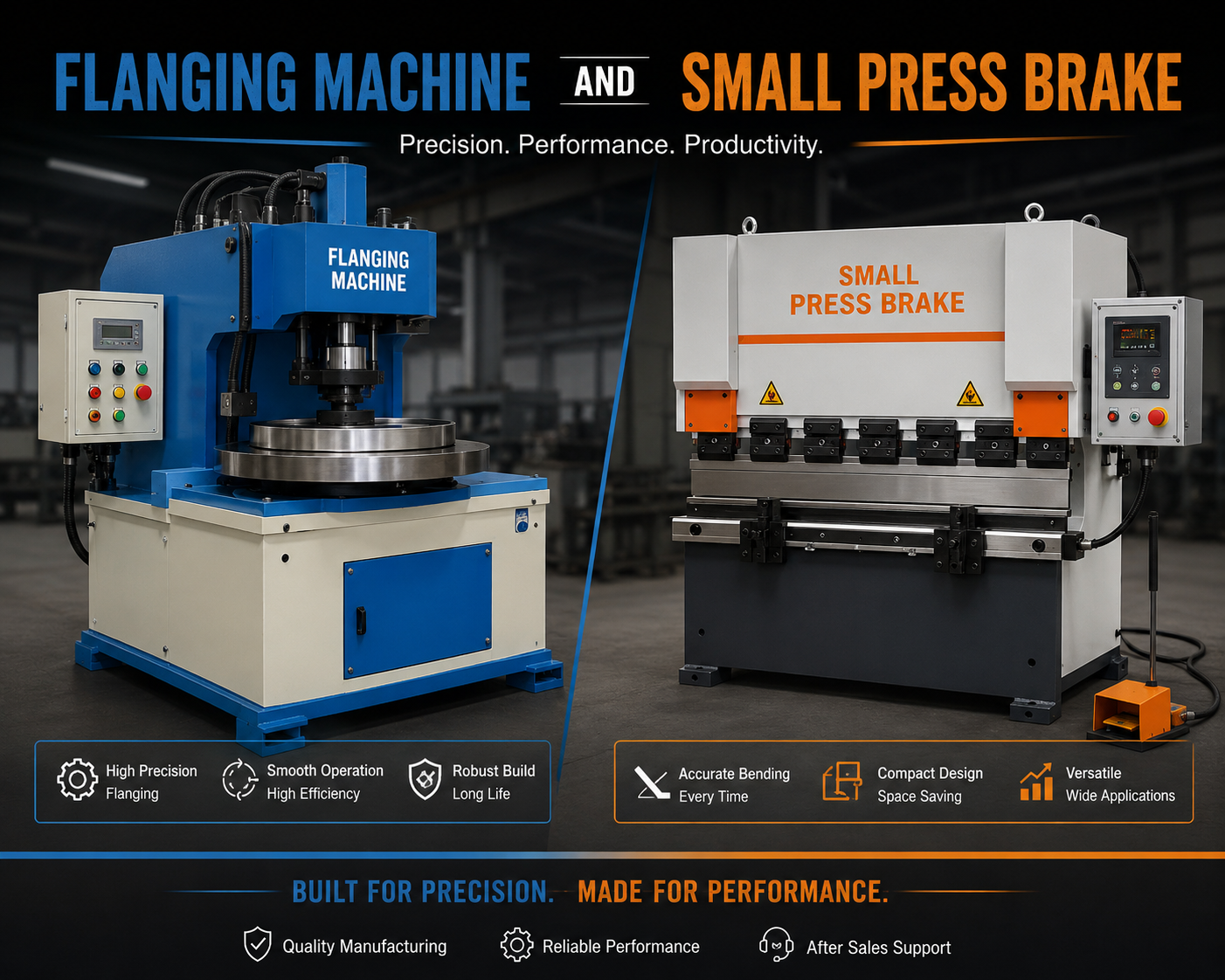
Customers want cleaner finishes, tighter tolerances, shorter lead times, and smaller production batches without paying the cost of large-scale tooling. This shift is pushing manufacturers toward compact, flexible equipment that can perform precise forming without slowing down production.
Two machines are becoming increasingly important in this environment: the Flanging machine and the small press brake.
They may look like ordinary forming equipment, but their real value lies in how efficiently they solve everyday production challenges. From strengthening metal edges to creating accurate bends for prototypes, brackets, housings, ducts, and custom components, these machines help fabrication shops work faster with less waste and greater control.
The Real Reason Flanging Machines Matter
A Flanging machine does more than bend the outer edge of a metal component. It transforms a simple sheet or formed part into a stronger, more functional, and assembly-ready component.
Flanges are often added to improve:
-
Structural rigidity
-
Connection strength
-
Joining accuracy
-
Edge safety
-
Component appearance
-
Sealing performance
This is especially useful in products where flat edges are not strong enough or where two metal parts need to connect precisely.
Industries such as HVAC, automotive fabrication, appliance manufacturing, tank production, ducting, enclosure manufacturing, and general engineering regularly depend on flange-forming operations.
What Makes a Flanging Machine Different?
The biggest advantage of a Flanging machine is specialization.
Instead of forcing a general-purpose bending machine to perform edge-forming work, flanging equipment is designed specifically to shape edges accurately and consistently.
This becomes important when manufacturers need to produce repeated parts with similar dimensions.
A properly configured machine can help reduce:
-
Edge deformation
-
Uneven flange heights
-
Cracking
-
Manual finishing
-
Rejected components
-
Production variation
Better Edge Forming Means Better Assembly
A small dimensional error in a flange can create major assembly problems later.
Poorly formed edges may affect welding, riveting, bolting, sealing, or alignment. That is why manufacturers often view flanging as a critical production step rather than a simple secondary operation.
Why Small Press Brakes Are Gaining Attention
Large press brakes are powerful, but not every job requires a large machine.
A small press brake is often a smarter choice for workshops that handle smaller components, prototypes, short production runs, repair jobs, or custom metalwork.
Its strength lies in flexibility.
A compact press brake can form:
-
Mounting brackets
-
Electrical boxes
-
Sheet metal covers
-
Channels
-
Frames
-
Small panels
-
Machine guards
-
Prototype parts
-
Custom fabricated components
Because the machine occupies less floor space, it can fit easily into small and medium-sized manufacturing environments.
Small Machine, Big Manufacturing Advantage
The word “small” can be misleading.
A small press brake may have a compact footprint, but modern models can provide impressive bending accuracy and production control.
Many fabrication companies prefer smaller machines because operators can manage short jobs quickly without tying up a large production press.
This becomes especially valuable when a customer requests a small quantity of customized parts.
Instead of interrupting high-volume production, the job can be handled separately and efficiently.
Flanging Machine and Small Press Brake: Different Jobs, Same Goal
The two machines are not competitors. In many workshops, they work together.
| Production Need | Flanging Machine | Small Press Brake |
|---|---|---|
| Form metal edges | Excellent | Limited |
| Create straight bends | Limited | Excellent |
| Produce brackets | Possible in selected cases | Highly suitable |
| Create reinforced rims | Highly suitable | Not primary use |
| Prototype fabrication | Useful | Excellent |
| Small batch production | Very effective | Very effective |
| Complex edge preparation | Strong capability | Depends on tooling |
The right machine depends on the geometry of the component and the required forming process.
Why Modern Fabricators Prefer Flexible Equipment
Manufacturing has moved away from one-size-fits-all production.
Today, buyers often request customized dimensions, smaller orders, faster deliveries, and frequent design changes.
Flexible forming equipment helps manufacturers respond without rebuilding their entire process.
A small press brake is particularly useful in this environment because tooling can often be changed quickly.
A Flanging machine, meanwhile, can simplify repetitive edge-forming tasks that would otherwise require significant manual work.
Together, these machines can help manufacturers maintain speed without sacrificing consistency.
Where These Machines Deliver the Most Value
Prototype Development
During product development, engineers frequently modify component dimensions.
Compact forming equipment makes these revisions easier because new parts can be produced without expensive dedicated tooling.
Low-Volume Manufacturing
For short production runs, flexibility is often more important than extreme automation.
These machines allow manufacturers to produce different components efficiently in smaller quantities.
Custom Fabrication
Custom fabrication rarely follows one repetitive design.
A workshop may produce a bracket in the morning, an enclosure in the afternoon, and a custom panel later the same day.
A small press brake is ideal for this type of changing workload.
Repetitive Edge Production
When the same flange must be created across many components, a Flanging machine can improve consistency and reduce dependence on manual skill.
What Should Buyers Check Before Choosing a Machine?
Buying metal-forming equipment based only on price can create problems later.
Manufacturers should evaluate the actual work the machine will perform.
Important factors include:
-
Material type
-
Maximum metal thickness
-
Required bend length
-
Flange dimensions
-
Production volume
-
Tooling options
-
Accuracy requirements
-
Available floor space
-
Control system
-
Maintenance support
Material Strength Changes Everything
Two sheets with the same thickness may behave differently if they are made from different materials.
Stainless steel, mild steel, aluminum, and copper have different forming characteristics. The machine must provide enough force while keeping the material within safe forming limits.
Accuracy Is More Important Than Speed Alone
Fast production is valuable only when the parts remain accurate.
In sheet metal fabrication, small errors can create major downstream issues.
Incorrect bends or uneven flanges can cause:
-
Poor assembly
-
Welding gaps
-
Misaligned components
-
Increased finishing time
-
Material rejection
-
Customer complaints
Modern controls, accurate tooling, proper setup, and trained operators help reduce these problems.
The Role of Tooling in Better Results
Tooling is one of the most important parts of any forming process.
Even a high-quality machine cannot produce accurate components with damaged or unsuitable tooling.
Manufacturers should regularly inspect:
-
Punches
-
Dies
-
Forming rollers
-
Alignment systems
-
Contact surfaces
-
Tool wear
Correct tooling selection also helps protect the sheet metal from unnecessary marks and deformation.
Safety Cannot Be Treated as an Afterthought
Metal-forming equipment generates significant force.
Operators should never rely only on experience when working near moving tooling.
Important safety practices include:
-
Using guards where provided
-
Keeping hands away from forming zones
-
Following machine load limits
-
Checking emergency stop functions
-
Wearing suitable protective equipment
-
Maintaining a clean work area
-
Training operators before production
Safety systems should support productivity, not be bypassed for faster output.
Automation Is Changing Compact Fabrication
Modern forming equipment is becoming more intelligent.
Programmable controls, digital positioning, automated backgauges, servo systems, and production monitoring are making compact machines more capable than ever before.
This trend is especially important for small and medium manufacturers.
Previously, advanced forming technology was often associated with large factories. Today, compact machines can offer features that improve repeatability and simplify setup.
Why These Machines Fit the Future of Manufacturing
The future of fabrication is not only about producing more parts.
It is about producing the right parts faster, with fewer errors and greater flexibility.
A Flanging machine supports this shift by improving edge-forming consistency.
A small press brake supports it by making short-run bending practical and efficient.
For manufacturers working with changing designs, customized orders, or low-volume production, this combination can significantly improve workflow.
Frequently Asked Questions
1. What is the main purpose of a Flanging machine?
It is mainly used to form controlled edges or flanges on metal components for strength, joining, assembly, or finishing.
2. Why choose a small press brake instead of a large one?
A compact press brake is easier to install and often more efficient for smaller parts, prototypes, and short production runs.
3. Can both machines be used in the same workshop?
Yes. Many fabrication businesses use both because they perform different forming operations.
4. Is a small press brake suitable for custom fabrication?
Yes. It is especially useful for customized parts and frequently changing production requirements.
5. Can a Flanging machine improve part strength?
Yes. Properly designed flanges can increase rigidity and improve edge strength.
6. What materials can these machines process?
Depending on capacity, they can work with mild steel, stainless steel, aluminum, copper, and other formable metals.
7. Are these machines suitable for prototype production?
Yes. Both can support prototype development, especially when designs require repeated adjustment.
8. Does machine size affect accuracy?
Not necessarily. A properly built and calibrated compact machine can provide excellent accuracy within its operating capacity.
9. How important is tooling?
Tooling is critical because it directly affects bend quality, flange shape, surface finish, and repeatability.
10. What is the biggest benefit of using both machines?
Using both provides greater forming flexibility, allowing a workshop to handle straight bends, edge forming, prototypes, and short production runs more efficiently.
- Technology for Students
- Admissions & Applications
- Online Courses
- Career and Jobs
- Campus Life
- Drinks
- Film
- Fitness
- Food
- Jogos
- Gardening
- Health
- Início
- Literature
- Music
- Networking For Students
- Insights
- Party
- Religion
- Shopping
- Sports
- Theater
- Wellness
- Education News
- Business & Finance For Students
- Security, Law & Crime Education
- Insurance
- Science & Technology For Students
 Portuguese
 English
 Arabic
 French
 Spanish
 Deutsch
 Turkish
 Dutch
Dutch
 Italiano
 Russian
 Romaian
 Portuguese (Brazil)
 Greek
Greek