


Caprylyl Glycol and Dicumene: Properties, Applications, Benefits and Industrial Uses Explained
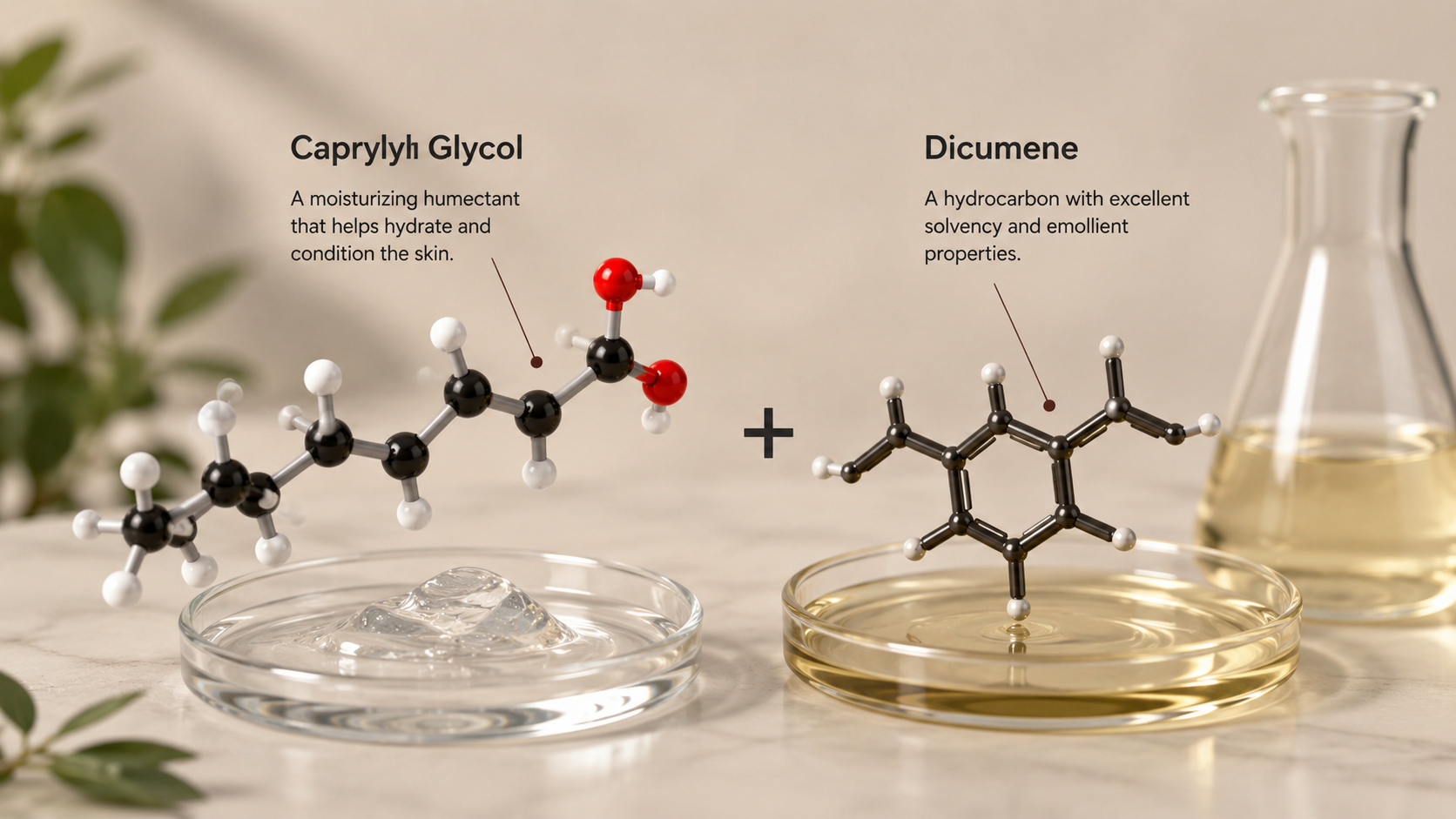
Modern chemical manufacturing depends on specialized ingredients that improve product performance, stability, safety, and processing efficiency. Caprylyl Glycol and Dicumene are two distinctive compounds used for very different industrial purposes. While Caprylyl Glycol is widely associated with personal care, cosmetic, and formulation applications, Dicumene is primarily connected with specialty polymer and flame-retardant systems.
Understanding their chemical characteristics, functional benefits, and suitable applications helps formulators, manufacturers, and procurement professionals select the right material for specific production requirements.
What Is Caprylyl Glycol?
Caprylyl Glycol is a multifunctional ingredient commonly known chemically as 1,2-octanediol. It belongs to the glycol family and combines moisturizing properties with formulation-support functions.
Its molecular structure contains both water-attracting and oil-compatible characteristics, allowing it to perform effectively in many cosmetic and personal care formulations.
Manufacturers commonly consider Caprylyl Glycol when developing products that require:
-
Improved skin feel
-
Moisture retention
-
Better formulation stability
-
Support for preservation systems
-
Smooth ingredient dispersion
-
Enhanced sensory performance
Because one ingredient can perform several functions, Caprylyl Glycol can help formulators create efficient and streamlined product compositions.
Key Benefits of Caprylyl Glycol
The popularity of Caprylyl Glycol comes from its versatility rather than a single functional property.
Moisturizing Performance
Caprylyl Glycol functions as a humectant and conditioning ingredient. It can help maintain moisture within cosmetic formulations while contributing to a softer and smoother application experience.
Preservation Support
It is frequently incorporated into modern preservation strategies because it can complement selected preservative ingredients. This may allow formulators to build more balanced preservation systems depending on product composition and regulatory requirements.
Sensory Improvement
Caprylyl Glycol can improve spreadability and overall texture. This property is particularly valuable in products such as creams, lotions, serums, deodorants, and cleansing formulations.
Typical Caprylyl Glycol Applications
Common product categories include:
-
Skin creams and moisturizers
-
Facial serums
-
Hair conditioners
-
Shampoos
-
Body lotions
-
Facial cleansers
-
Deodorants
-
Makeup formulations
-
Sunscreen products
-
Personal hygiene products
What Is Dicumene?
Dicumene, also called 2,3-dimethyl-2,3-diphenylbutane, is an organic specialty chemical with the molecular formula C18H22. Its CAS number is 1889-67-4.
Unlike Caprylyl Glycol, Dicumene is not primarily a cosmetic conditioning ingredient. It is associated with specialized industrial formulations, particularly polymer-processing and flame-retardant applications.
Its chemical structure makes it useful where controlled radical activity and performance enhancement are required in compatible polymer systems.
Major Applications of Dicumene
Dicumene can be used as a synergistic component within selected flame-retardant formulations. Depending on the polymer system and formulation design, it may be evaluated alongside other additives to improve overall fire-performance efficiency.
Common areas of application may include:
-
Polypropylene materials
-
Polystyrene formulations
-
Expanded polystyrene
-
Extruded polystyrene
-
Specialty plastic compounds
-
Flame-retardant masterbatches
-
Industrial polymer additives
Actual usage levels should always be established through formulation testing, technical specifications, and applicable safety standards.
Caprylyl Glycol vs. Dicumene
Although both are specialty chemicals, their functions differ significantly.
| Feature | Caprylyl Glycol | Dicumene |
|---|---|---|
| Primary Market | Cosmetics and personal care | Plastics and polymers |
| Main Function | Humectant and formulation enhancer | Specialty polymer additive |
| Typical Form | Liquid or low-melting material | Solid chemical material |
| Key Benefit | Moisturizing and preservation support | Flame-retardant formulation synergy |
| Application Focus | Skin, hair and hygiene products | Polymer and industrial compounds |
| Formulation Role | Multifunctional cosmetic ingredient | Functional industrial additive |
Understanding this difference is essential when sourcing either material because specifications, purity requirements, packaging, and regulatory documentation can vary substantially.
Important Quality Considerations
Chemical buyers should evaluate more than price when purchasing Caprylyl Glycol or Dicumene.
Check Product Purity
Higher and consistent purity can support predictable formulation performance. Buyers should verify specifications through a current Certificate of Analysis.
Review Technical Documentation
Professional suppliers should be able to provide documents such as:
-
Certificate of Analysis
-
Safety Data Sheet
-
Technical Data Sheet
-
Storage recommendations
-
Packaging specifications
-
Regulatory documentation where applicable
Confirm Application Compatibility
A chemical that performs well in one formulation may behave differently in another. Small-scale testing should therefore be conducted before commercial production.
Storage and Handling
Both materials should be stored according to supplier recommendations. Containers should generally remain properly sealed and protected from unsuitable temperatures, contamination, moisture, and incompatible substances.
Industrial users should follow the applicable SDS and workplace safety procedures rather than relying on general handling assumptions.
How to Select a Reliable Supplier
Choosing a dependable Caprylyl Glycol or Dicumene supplier can influence production consistency as much as selecting the chemical itself.
Look for suppliers offering:
-
Stable product specifications
-
Batch-level quality documentation
-
Traceable manufacturing information
-
Reliable packaging
-
Technical support
-
Consistent supply capacity
-
Regulatory documentation
-
Responsive customer service
For long-term manufacturing programs, requesting a sample before placing a bulk order can also help confirm compatibility.
Frequently Asked Questions
1. What is Caprylyl Glycol mainly used for?
Caprylyl Glycol is mainly used in cosmetics and personal care products as a moisturizing, conditioning, and formulation-support ingredient.
2. Is Caprylyl Glycol a preservative?
It is more accurately considered a multifunctional ingredient that can support certain preservation systems rather than automatically replacing every primary preservative.
3. Where is Caprylyl Glycol commonly found?
It may be found in creams, lotions, serums, shampoos, conditioners, cleansers, deodorants, and other personal care formulations.
4. What is Dicumene?
Dicumene is an organic chemical also known as 2,3-dimethyl-2,3-diphenylbutane and has CAS number 1889-67-4.
5. What is the molecular formula of Dicumene?
The molecular formula of Dicumene is C18H22.
6. What industries use Dicumene?
Dicumene is primarily relevant to specialty chemical, plastics, polymer-compounding, and flame-retardant formulation industries.
7. Are Caprylyl Glycol and Dicumene interchangeable?
No. They perform entirely different functions and are intended for different formulation environments.
8. How should buyers evaluate chemical quality?
Buyers should review purity, technical specifications, batch consistency, COA, SDS, packaging, and supplier reliability.
9. Can Dicumene be used in every polymer?
No. Compatibility depends on the polymer, additive package, processing conditions, and required performance. Laboratory testing is essential.
10. Why is Caprylyl Glycol considered multifunctional?
It can contribute to moisturization, sensory properties, ingredient compatibility, and preservation-support strategies within properly designed formulations.
- Technology for Students
- Admissions & Applications
- Online Courses
- Career and Jobs
- Campus Life
- Drinks
- Film
- Fitness
- Food
- Giochi
- Gardening
- Health
- Home
- Literature
- Music
- Networking For Students
- Insights
- Party
- Religion
- Shopping
- Sports
- Theater
- Wellness
- Education News
- Business & Finance For Students
- Security, Law & Crime Education
- Insurance
- Science & Technology For Students
 Italiano
 English
 Arabic
 French
 Spanish
 Portuguese
 Deutsch
 Turkish
 Dutch
Dutch
 Russian
 Romaian
 Portuguese (Brazil)
 Greek
Greek