


Zinc Die Casting and Die Casting Mold: Precision Manufacturing for Strong, Complex Metal Components
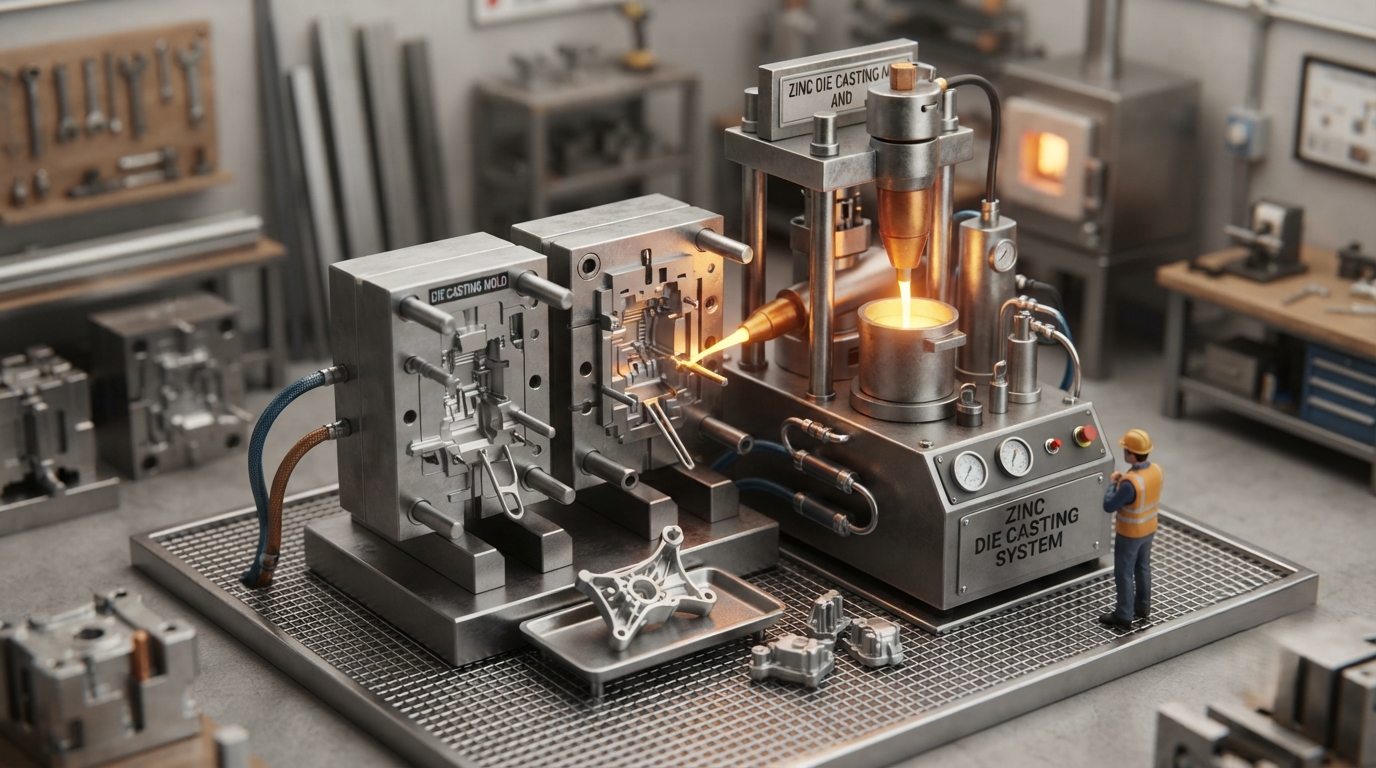
At the center of the process is the Die Casting Mold, a precisely engineered tool that determines the shape, dimensions, surface condition, and consistency of every manufactured component. When zinc alloy selection, mold engineering, temperature control, and production parameters work together effectively, manufacturers can produce reliable parts with repeatable quality.
What Is Zinc Die Casting?
Zinc Die Casting is a metal manufacturing process in which molten zinc alloy is injected under controlled pressure into a reusable steel mold. After the metal fills the mold cavity, it cools and solidifies into the required component shape.
Zinc alloys are particularly suitable for die casting because of their excellent fluidity and relatively low melting temperatures. These characteristics enable molten zinc to enter narrow sections and reproduce fine mold details accurately.
The process is commonly selected for components requiring:
-
Tight dimensional tolerances
-
Thin wall sections
-
Fine surface details
-
Complex geometries
-
High production consistency
-
Good mechanical strength
-
Decorative or functional finishing
Industries using zinc cast components include automotive manufacturing, electronics, electrical equipment, hardware, industrial machinery, household products, telecommunications, and consumer products.
Why Zinc Is Suitable for Die Casting
Zinc provides a valuable combination of manufacturing flexibility and mechanical performance. Its casting characteristics allow designers to create complicated components that could otherwise require several manufacturing and assembly operations.
Excellent Casting Fluidity
Molten zinc flows effectively through detailed cavities, allowing a properly designed Die Casting Mold to incorporate thin walls, lettering, ribs, bosses, holes, and complex surface features.
High Dimensional Accuracy
Stable casting behavior makes zinc suitable for applications where component dimensions must remain consistent throughout large production quantities.
Better Design Integration
Manufacturers can sometimes integrate several functions into one zinc casting. Mounting points, strengthening ribs, external details, and structural features can potentially be incorporated directly into the part design, reducing secondary assembly requirements.
Understanding the Die Casting Mold
A Die Casting Mold, often called a die, is a specially manufactured steel tool containing the negative geometry of the final component. Molten metal enters its cavity and takes the desired shape during solidification.
The quality of the mold directly influences component accuracy, surface finish, productivity, and manufacturing cost.
Important mold elements may include:
-
Fixed die half
-
Moving die half
-
Mold cavity
-
Core sections
-
Runner system
-
Gates
-
Ejector pins
-
Cooling channels
-
Overflow areas
-
Venting features
Every element must be carefully designed because poor metal flow, inadequate cooling, or insufficient venting can contribute to defects.
Zinc Die Casting Process Explained
Producing a quality zinc component requires much more than simply filling a cavity with molten metal.
The manufacturing cycle generally follows these stages:
1. Mold preparation: The die is prepared and maintained at an appropriate operating condition.
2. Metal injection: Molten zinc alloy is injected into the cavity rapidly under controlled pressure.
3. Filling and pressure control: Metal travels through runners and gates until the cavity is completely filled.
4. Cooling: Heat transfers from the casting into the mold until the component becomes sufficiently solid.
5. Mold opening: The two mold sections separate after solidification.
6. Component ejection: Ejector mechanisms release the casting safely.
7. Trimming: Runners, gates, flash, and unnecessary material are removed.
8. Finishing and inspection: Components may undergo machining, polishing, coating, plating, or dimensional inspection depending on application requirements.
Zinc Die Casting vs Other Metal Casting Options
| Feature | Zinc Die Casting | Aluminum Die Casting | Conventional Sand Casting |
|---|---|---|---|
| Fine Details | Excellent | Very Good | Moderate |
| Thin Walls | Excellent | Very Good | Limited |
| Surface Finish | Excellent | Good | Rougher |
| High-Volume Production | Excellent | Excellent | Lower |
| Dimensional Consistency | High | High | Moderate |
| Complex Geometry | Excellent | Very Good | Good |
| Reusable Metal Mold | Yes | Yes | No |
The correct manufacturing process should always depend on component size, operating conditions, production quantity, mechanical requirements, weight targets, and overall project economics.
Important Factors in Die Casting Mold Design
A successful Die Casting Mold requires careful engineering before production starts. Mold development should consider both component geometry and manufacturing behavior.
Key considerations include:
-
Correct gate position for balanced filling
-
Smooth runner geometry
-
Effective air venting
-
Uniform cooling distribution
-
Proper draft angles
-
Suitable wall thickness
-
Adequate ejector placement
-
Appropriate parting-line position
-
Allowance for shrinkage
-
Easy mold maintenance
A well-designed mold improves production stability while helping reduce defects, material waste, cycle interruptions, and unnecessary finishing operations.
Common Zinc Die Casting Quality Issues
Even a capable manufacturing process can develop defects when design or production controls are unsuitable.
Potential issues include porosity, incomplete filling, flash, surface imperfections, dimensional variation, and flow-related marks.
These problems can often be reduced through careful control of:
-
Molten metal temperature
-
Mold temperature
-
Injection pressure
-
Injection speed
-
Gate dimensions
-
Venting
-
Cooling balance
-
Alloy condition
-
Mold cleanliness
Quality management should therefore begin during product and mold design rather than only after production starts.
Benefits of Zinc Die Casting for High-Volume Manufacturing
Manufacturers often choose Zinc Die Casting because the process offers strong repeatability once tooling and production settings have been optimized.
Major benefits include:
-
Fast production cycles
-
Excellent repeatability
-
Reduced material waste
-
Complex one-piece component designs
-
Good surface quality
-
Accurate dimensions
-
Efficient large-volume manufacturing
-
Compatibility with several finishing processes
Although initial tooling represents an important investment, high-volume production can distribute mold costs across a large number of components.
How to Select a Zinc Die Casting Manufacturer
Choosing a capable manufacturing partner can influence product performance, delivery reliability, and long-term production costs.
Evaluate a supplier based on:
-
Die casting engineering experience
-
Mold design capabilities
-
Tool manufacturing standards
-
Quality inspection systems
-
Production equipment
-
Alloy knowledge
-
Secondary machining capabilities
-
Surface finishing support
-
Capacity for required production volumes
-
Communication and technical support
A strong supplier should understand not only casting production but also design-for-manufacturing principles.
Frequently Asked Questions About Zinc Die Casting and Die Casting Mold
1. What is Zinc Die Casting?
Zinc Die Casting is a manufacturing process that injects molten zinc alloy into a precision steel mold to create accurately shaped metal components.
2. What is a Die Casting Mold?
A Die Casting Mold is a reusable steel tool containing cavities, runners, gates, cooling channels, and related features that form the final casting.
3. Why is zinc suitable for complex components?
Zinc has excellent molten-metal fluidity, allowing it to reproduce detailed geometries and relatively thin sections efficiently.
4. Can zinc die casting produce thin walls?
Yes. Proper component and mold design can allow zinc alloys to produce relatively thin sections with good detail.
5. Is zinc die casting suitable for mass production?
Yes. Its rapid production cycles and reusable molds make it highly suitable for medium- and high-volume manufacturing.
6. How important is mold design?
Mold design is extremely important because it influences filling behavior, cooling, dimensional accuracy, surface finish, cycle time, and defect control.
7. Can zinc castings receive surface finishes?
Yes. Depending on the alloy and application, parts may be polished, plated, painted, powder coated, or treated with other suitable finishes.
8. What causes porosity in die cast components?
Porosity can be related to trapped gases, filling behavior, pressure conditions, mold design, temperature control, or solidification characteristics.
9. How long can a Die Casting Mold last?
Tool life varies considerably according to mold steel, casting alloy, component design, production conditions, maintenance practices, and cycle requirements.
10. How can production costs be reduced?
Design simplification, optimized wall thickness, efficient tooling, stable process parameters, reduced secondary machining, and larger production volumes can help improve manufacturing economics.
- Technology for Students
- Admissions & Applications
- Online Courses
- Career and Jobs
- Campus Life
- Drinks
- Film
- Fitness
- Food
- Spiele
- Gardening
- Health
- Startseite
- Literature
- Music
- Networking For Students
- Insights
- Party
- Religion
- Shopping
- Sports
- Theater
- Wellness
- Education News
- Business & Finance For Students
- Security, Law & Crime Education
- Insurance
- Science & Technology For Students
 Deutsch
 English
 Arabic
 French
 Spanish
 Portuguese
 Turkish
 Dutch
Dutch
 Italiano
 Russian
 Romaian
 Portuguese (Brazil)
 Greek
Greek