


How Big Is 5mm? Understanding Its Size With Everyday Examples
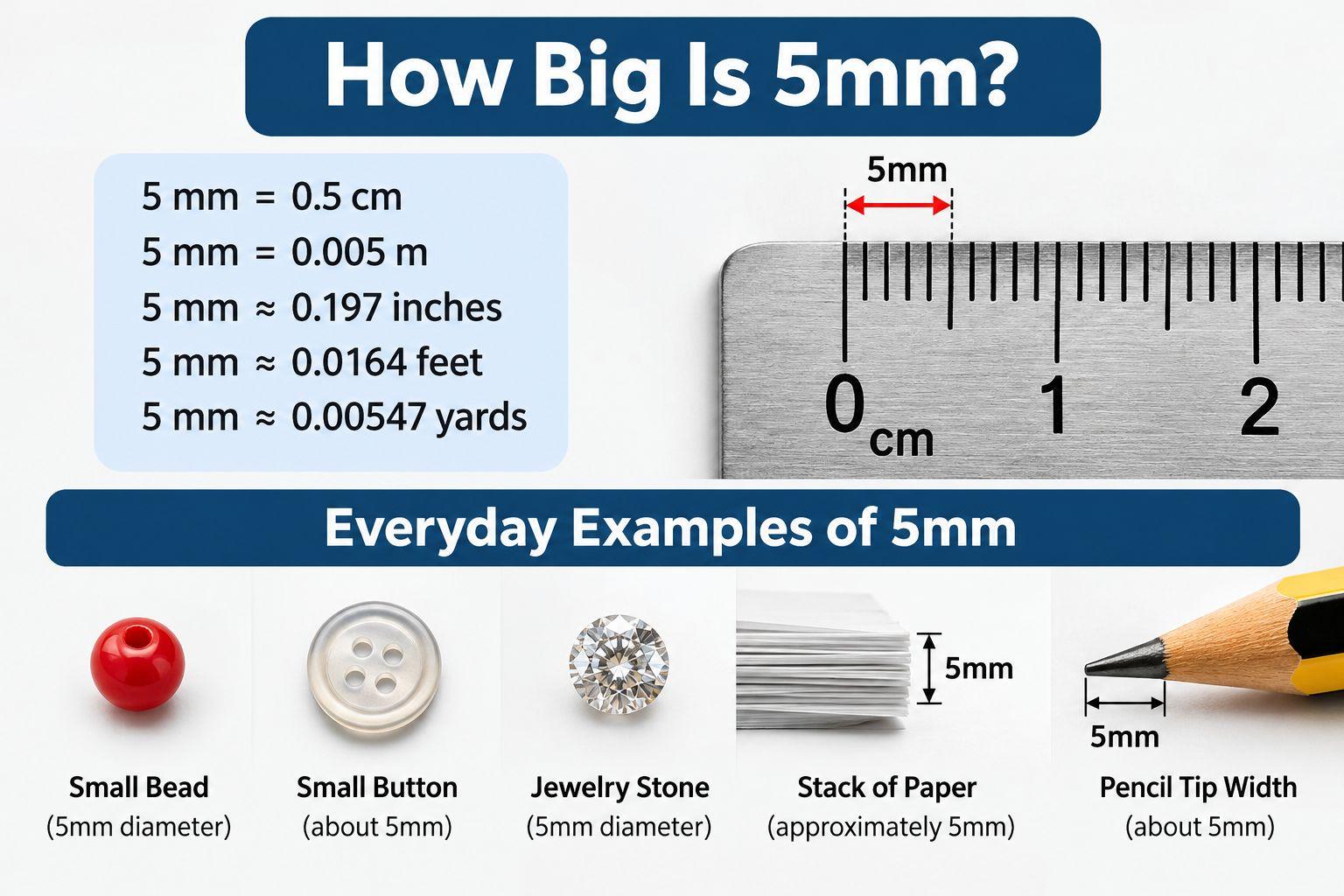
Have you ever wondered how big 5mm actually is? Millimeters are small units of measurement that are commonly used to describe the size of tiny objects, thickness, jewelry, and other everyday items. Although 5mm may sound extremely small, comparing it with familiar objects makes it much easier to understand.
5 millimeters (5mm) equals 0.5 centimeters, 0.005 meters, or approximately 0.197 inches. It is slightly less than one-quarter of an inch. You can visualize this measurement by looking at the thickness of a few stacked coins, the width of a small button, or the size of a tiny bead.
In this guide, we will explore how big 5mm is, its conversions into other units, and several everyday examples that make this small measurement easier to picture.
How Big Is 5mm in Different Units?
Before comparing 5mm with everyday objects, it helps to understand how this measurement relates to other units.
| Measurement Unit | Equivalent of 5mm |
|---|---|
| Millimeters | 5 mm |
| Centimeters | 0.5 cm |
| Meters | 0.005 m |
| Inches | 0.197 inches |
| Feet | 0.0164 feet |
| Yards | 0.00547 yards |
The most useful conversion to remember is that 10mm equals 1cm. Therefore, 5mm is exactly half a centimeter.
In inches, 5mm is approximately 0.197 inches, which is close to one-fifth of an inch. This helps explain why the measurement can be difficult to judge without a ruler.\
Visit: The Size Frame
What Does 5mm Look Like?
A measurement of 5mm is small enough to fit easily between your fingertips. However, it is still visible when you look closely.
Imagine a line drawn on paper that measures half a centimeter from one end to the other. That line represents 5mm.
You can also use the following comparisons to understand its size:
| Comparison | How It Helps You Visualize 5mm |
|---|---|
| Half a centimeter | 5mm is exactly half the distance between two centimeter marks on a ruler |
| One-fifth of an inch | It is slightly less than 1/4 inch |
| Small bead | A bead with a diameter of 5mm is tiny but visible |
| Short line on a ruler | The distance covers five individual millimeter intervals |
| Small button | Some small buttons measure approximately 5mm across |
These examples provide a useful starting point for understanding the measurement. Actual object sizes vary, so a ruler is the most reliable way to confirm an exact 5mm dimension.
Everyday Objects That Are Approximately 5mm
Several small everyday objects can help you picture 5mm. The following examples are useful because they relate an unfamiliar measurement to things you might already recognize.
A Small Bead
A small craft bead measuring 5mm in diameter is a good example of this size. Such beads are commonly used in bracelets, necklaces, and decorative projects.
A 5mm bead is small enough to fit comfortably between your fingertips, but its shape makes it relatively easy to see.
Half a Centimeter on a Ruler
One of the easiest ways to visualize 5mm is to look at a ruler. Find the zero mark and move to the halfway point between 0 and 1 centimeter.
That distance is exactly 5mm.
If your ruler includes millimeter markings, count five small intervals from the starting point. You will reach the 5mm mark.
A Small Craft Button
Some small craft buttons measure around 5mm across. These buttons are often used for miniature clothing, doll accessories, and decorative projects.
However, many standard shirt buttons are larger, so it is important not to assume that every button is 5mm wide.
A Small Jewelry Stone
A gemstone or decorative stone with a diameter of 5mm is a useful example for understanding the size. Small stones of this dimension are often used in earrings, rings, and other jewelry designs.
The actual appearance depends on the stone's cut, shape, and setting.
A Short Stack of Thin Materials
Stacking several thin sheets or pieces of material can help you understand thickness measurements. For example, ten sheets that are each exactly 0.5mm thick would have a combined thickness of 5mm.
This example illustrates how small individual measurements can add up to a larger dimension.
How Big Is 5mm Compared With an Inch?
To understand 5mm in the imperial measurement system, it helps to compare it with common fractions of an inch.
| Inch Measurement | Equivalent in Millimeters |
|---|---|
| 1/8 inch | 3.175mm |
| 1/5 inch | 5.08mm |
| 1/4 inch | 6.35mm |
| 1/2 inch | 12.7mm |
| 1 inch | 25.4mm |
As the table shows, 5mm is very close to one-fifth of an inch and smaller than one-quarter of an inch.
This comparison can be particularly useful when reading product descriptions from countries that use inches instead of millimeters. If a product specification lists a thickness of 5mm, you can think of it as approximately 0.2 inches.
How Big Is 5mm on a Ruler?
A ruler is one of the most practical tools for measuring 5mm accurately.
Most metric rulers display centimeters, with smaller divisions representing millimeters. Each centimeter contains ten millimeters.
To find 5mm on a ruler:
-
Locate the zero mark.
-
Find the first centimeter mark, labeled 1cm.
-
Identify the fifth small division between zero and 1cm.
-
The fifth division represents 5mm.
The halfway point between zero and one centimeter is therefore the exact location of the 5mm mark.
If you are measuring an object, align one edge with zero and check where the opposite edge falls. Make sure the object is positioned straight against the ruler to avoid inaccurate readings.
How Big Is 5mm in Jewelry and Accessories?
The measurement 5mm is frequently used in jewelry and accessory specifications. It can describe the diameter of a bead, the width of a decorative stone, or the thickness of a small component.
| Jewelry Item | Example of a 5mm Measurement |
|---|---|
| Bead | A bead measuring 5mm in diameter |
| Gemstone | A round stone measuring 5mm across |
| Earring stud | A decorative front measuring 5mm wide |
| Bracelet accessory | A small decorative element measuring 5mm |
| Pendant detail | A narrow component measuring 5mm across |
A 5mm stone may appear modest when viewed individually, but several stones arranged together can create a noticeable pattern.
Remember that diameter, width, and thickness describe different dimensions. A round bead with a 5mm diameter is not necessarily 5mm thick in every part of its design, particularly if it has an unusual shape.
How Big Is 5mm in Construction and DIY Projects?
In construction, manufacturing, and DIY projects, a few millimeters can make a significant difference. A measurement of 5mm may describe a gap, a material's thickness, a drill bit diameter, or the dimensions of a small component.
For example, a 5mm gap between two pieces of material may be important when assembling furniture or installing a fitting. Similarly, a component with a 5mm diameter needs a suitable opening or connector.
| Application | How 5mm May Be Used |
|---|---|
| Furniture assembly | Measuring a small gap or component |
| Woodworking | Checking a narrow space or thickness |
| Metalworking | Specifying a small part's diameter |
| Craft projects | Measuring beads and decorative elements |
| Product design | Defining the dimensions of small components |
When accuracy matters, use a ruler, caliper, or other suitable measuring instrument. Visual estimation alone may not be precise enough for engineering or construction work.
Is 5mm Considered Small?
Yes, 5mm is generally considered a small measurement. It is only half a centimeter, which makes it much smaller than most familiar household objects.
However, whether 5mm is small depends on what you are measuring. For a large table, 5mm is almost negligible. For a small electronic component, jewelry stone, or precision fitting, it can be an important dimension.
For example, a 5mm difference in the length of a large shelf may not be noticeable from a distance. In contrast, a 5mm difference in the diameter of a small screw or connector could affect whether the parts fit together properly.
The context determines how significant this measurement is.
How to Measure 5mm Without a Ruler
If you do not have a ruler nearby, you can estimate 5mm by comparing the object with something of a known size. However, these methods are only approximate.
Use a familiar object: A small bead or button may provide a rough visual reference if you know its dimensions.
Use a paper measurement: Fold or mark a piece of paper using a ruler beforehand to create a reusable 5mm reference.
Compare with a centimeter: If you can identify a 1cm distance, half of that distance equals 5mm.
For accurate work, it is always better to use a metric ruler or caliper. Everyday objects vary in size, and estimating a few millimeters by eye can lead to errors.
Final Thoughts
So, how big is 5mm? It is exactly half a centimeter, equivalent to 0.005 meters and approximately 0.197 inches. Although it is a small measurement, it is commonly used in jewelry, crafts, manufacturing, construction, and everyday product specifications.
The easiest way to visualize 5mm is to find the halfway point between zero and one centimeter on a metric ruler. You can also picture a small bead or decorative stone measuring 5mm across.
Once you become familiar with this measurement, it becomes easier to understand product dimensions, compare object sizes, and estimate small distances in everyday life.
- Technology for Students
- Admissions & Applications
- Online Courses
- Career and Jobs
- Campus Life
- Drinks
- Film
- Fitness
- Food
- Spellen
- Gardening
- Health
- Home
- Literature
- Music
- Networking For Students
- Insights
- Party
- Religion
- Shopping
- Sports
- Theater
- Wellness
- Education News
- Business & Finance For Students
- Security, Law & Crime Education
- Insurance
- Science & Technology For Students
 Dutch
Dutch
 English
 Arabic
 French
 Spanish
 Portuguese
 Deutsch
 Turkish
 Italiano
 Russian
 Romaian
 Portuguese (Brazil)
 Greek
Greek