


Dumbwaiter Lift and Passenger Lift: Smart Vertical Mobility Solutions for Modern Buildings
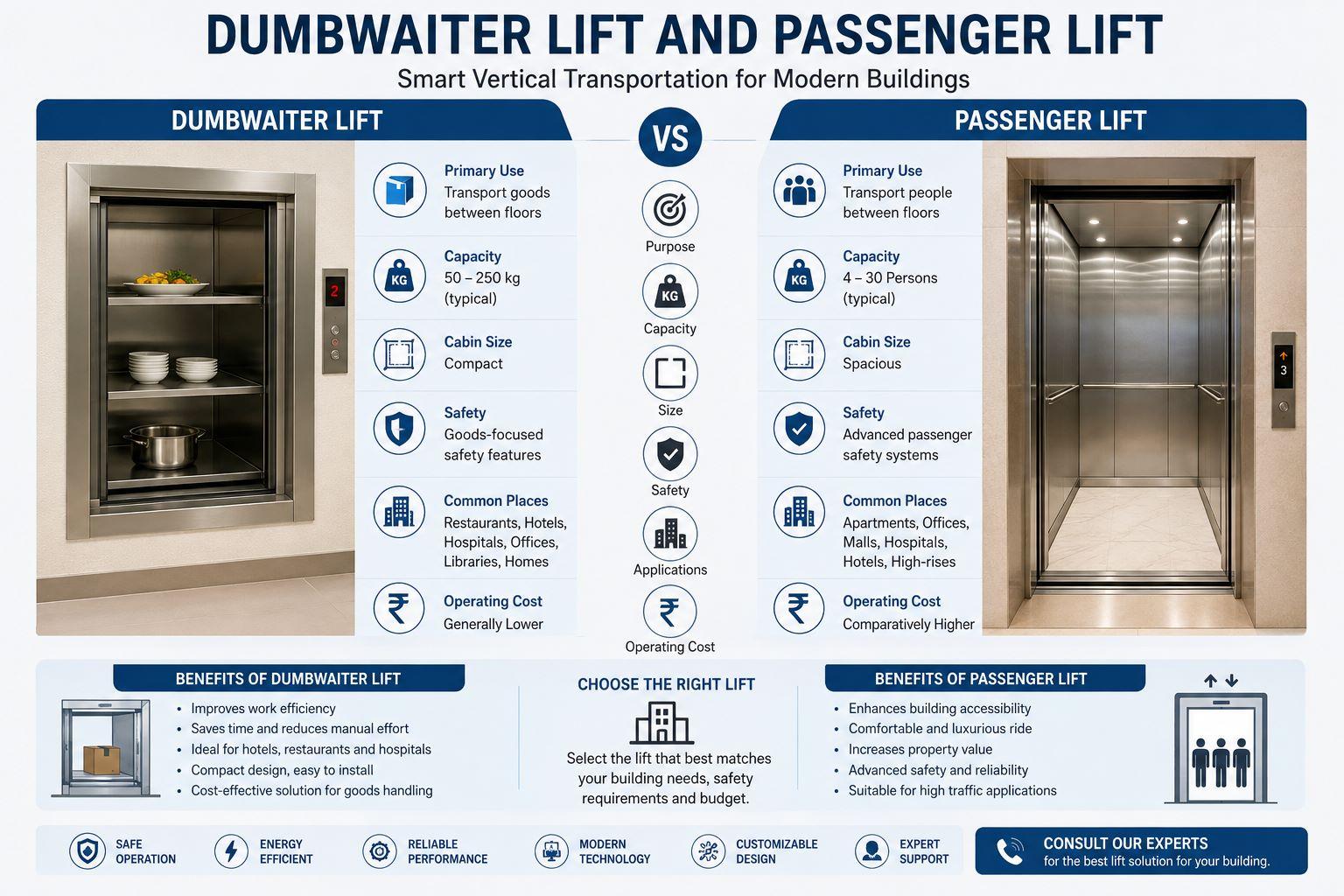
Whether it is a restaurant, hotel, hospital, residential apartment, office building, or commercial facility, selecting the right lift can significantly improve convenience and daily operations. Two widely used solutions are the dumbwaiter lift and passenger lift.
Although both systems provide vertical transportation, they serve completely different purposes. A dumbwaiter lift is designed primarily for transporting lightweight goods and materials, while a passenger lift safely carries people between different floors. Understanding their applications, features, benefits, and differences helps building owners select the most suitable lift system.
What Is a Dumbwaiter Lift?
A dumbwaiter lift is a compact material-handling lift designed to transport items instead of passengers. It is commonly installed in restaurants, hotels, hospitals, libraries, offices, villas, warehouses, and commercial kitchens.
These lifts help businesses move food trays, utensils, documents, medicines, laundry, small packages, and other materials without requiring employees to repeatedly use stairs.
Common Applications of Dumbwaiter Lifts
A modern dumbwaiter system can be installed in several environments, including:
-
Restaurants and commercial kitchens
-
Hotels and hospitality facilities
-
Hospitals and healthcare buildings
-
Offices and corporate buildings
-
Libraries and educational institutions
-
Residential villas and large homes
-
Retail stores and warehouses
-
Laboratories and industrial facilities
By automating small material movement, a dumbwaiter lift can improve productivity while reducing unnecessary manual handling.
Key Features of a Dumbwaiter Lift
Depending on the model and application, dumbwaiter lifts may include stainless-steel cabins, automatic doors, floor-level controls, safety interlocks, durable guide rails, efficient motors, and customizable cabin dimensions.
Their compact structure also allows installation in buildings where a large elevator may not be practical.
Benefits of Installing a Dumbwaiter Lift
The primary advantage of a dumbwaiter lift is operational efficiency. Businesses can transport materials between floors faster while allowing staff to concentrate on more productive activities.
Other important benefits include:
-
Reduced manual carrying of goods between floors.
-
Improved workflow in restaurants and commercial facilities.
-
Better handling of fragile or sensitive items.
-
Space-efficient installation.
-
Convenient floor-to-floor material movement.
-
Reduced dependency on stairs for transporting goods.
-
Customizable load capacities and cabin sizes.
For restaurants in particular, dumbwaiters can create a smoother connection between kitchens, preparation areas, dining floors, and storage spaces.
What Is a Passenger Lift?
A passenger lift is an elevator specifically engineered to transport people safely and comfortably between floors. Passenger elevators are widely used in residential apartments, shopping centres, corporate offices, hospitals, hotels, educational buildings, and other multi-storey properties.
Modern passenger elevators combine functionality with advanced control technology, attractive cabin interiors, comfortable operation, and essential safety systems.
Where Are Passenger Lifts Used?
Passenger elevators are suitable for:
-
Residential apartment buildings
-
Commercial complexes
-
Hotels and resorts
-
Corporate offices
-
Hospitals
-
Shopping centres
-
Educational institutions
-
Public buildings
A properly selected passenger lift enhances accessibility and makes movement within multi-storey buildings much more convenient.
Important Passenger Lift Features
Common features can include automatic doors, emergency alarms, overload protection, floor indicators, smooth acceleration, emergency communication systems, backup operation, advanced controllers, and customizable cabin interiors.
The exact specifications should be selected according to building height, expected passenger traffic, available space, capacity requirements, and applicable safety standards.
Dumbwaiter Lift vs Passenger Lift
Understanding the difference between both systems is important before making an investment.
| Feature | Dumbwaiter Lift | Passenger Lift |
|---|---|---|
| Main Purpose | Transporting goods | Transporting people |
| Cabin Size | Compact | Larger |
| Typical Usage | Food, documents, materials | Passenger transportation |
| Installation Area | Restaurants, hotels, offices | Residential and commercial buildings |
| Load Requirement | Generally smaller | Higher capacity options |
| Human Transportation | Not permitted | Specifically designed for passengers |
| Space Requirement | Relatively low | Larger shaft requirement |
A dumbwaiter lift should never be used for carrying people. Passenger transportation requires equipment specifically designed and approved for human use.
How to Choose the Right Lift
Selecting the right vertical transportation system requires more than comparing prices.
Evaluate Your Requirements
Before installation, determine what will be transported. If the requirement is moving meals, documents, laundry, medicines, or small goods, a dumbwaiter lift may be suitable.
If people need regular floor-to-floor transportation, a passenger lift is the appropriate solution.
Consider Capacity and Building Structure
Evaluate:
-
Number of floors
-
Required load capacity
-
Available shaft space
-
Expected usage frequency
-
Door configuration
-
Power requirements
-
Safety provisions
-
Maintenance accessibility
Professional technical assessment helps ensure that the selected lift matches the building and operational requirements.
Why Quality Lift Installation Matters
Lift performance depends heavily on design, manufacturing quality, installation accuracy, and regular maintenance. Choosing reliable components and experienced lift professionals can contribute to smooth performance and long-term reliability.
Routine inspection also helps identify worn components before they create larger problems. Businesses should follow the recommended maintenance schedule and applicable local elevator safety requirements.
Frequently Asked Questions
1. What is a dumbwaiter lift used for?
A dumbwaiter lift is used for transporting food, documents, utensils, medicines, laundry, packages, and other small goods between floors.
2. Can people travel inside a dumbwaiter lift?
No. Dumbwaiters are designed for goods and should not be used to transport people.
3. What is a passenger lift?
A passenger lift is an elevator designed and equipped specifically for safe transportation of people between different floors.
4. Where can dumbwaiter lifts be installed?
They are commonly installed in restaurants, hotels, hospitals, offices, villas, libraries, warehouses, and commercial kitchens.
5. Are dumbwaiter lifts customizable?
Yes. Cabin dimensions, capacity, door position, finish, and control configuration can often be customized according to project requirements.
6. How do I select passenger lift capacity?
Capacity should be selected according to expected passenger traffic, building type, number of floors, available space, and technical requirements.
7. Do lifts require regular maintenance?
Yes. Preventive inspection and scheduled servicing are important for reliable operation, safety, and equipment longevity.
8. Can a passenger lift be installed in a residential building?
Yes. Passenger elevators are widely installed in apartments, villas, residential towers, and other multi-storey residential properties.
9. Which lift is suitable for restaurants?
A dumbwaiter lift is often suitable for transporting food, dishes, and kitchen supplies between different restaurant floors.
10. What should I check before buying a lift?
Check capacity, dimensions, safety systems, installation requirements, controls, manufacturer quality, maintenance support, warranty, and applicable regulations.
- Technology for Students
- Admissions & Applications
- Online Courses
- Career and Jobs
- Campus Life
- Drinks
- Film
- Fitness
- Food
- Jocuri
- Gardening
- Health
- Home
- Literature
- Music
- Networking For Students
- Insights
- Party
- Religion
- Shopping
- Sports
- Theater
- Wellness
- Education News
- Business & Finance For Students
- Security, Law & Crime Education
- Insurance
- Science & Technology For Students
 Romaian
 English
 Arabic
 French
 Spanish
 Portuguese
 Deutsch
 Turkish
 Dutch
Dutch
 Italiano
 Russian
 Portuguese (Brazil)
 Greek
Greek