


Glass Sandblasting Machine and Glass Drilling Machine: Modern Solutions for Precision Glass Processing
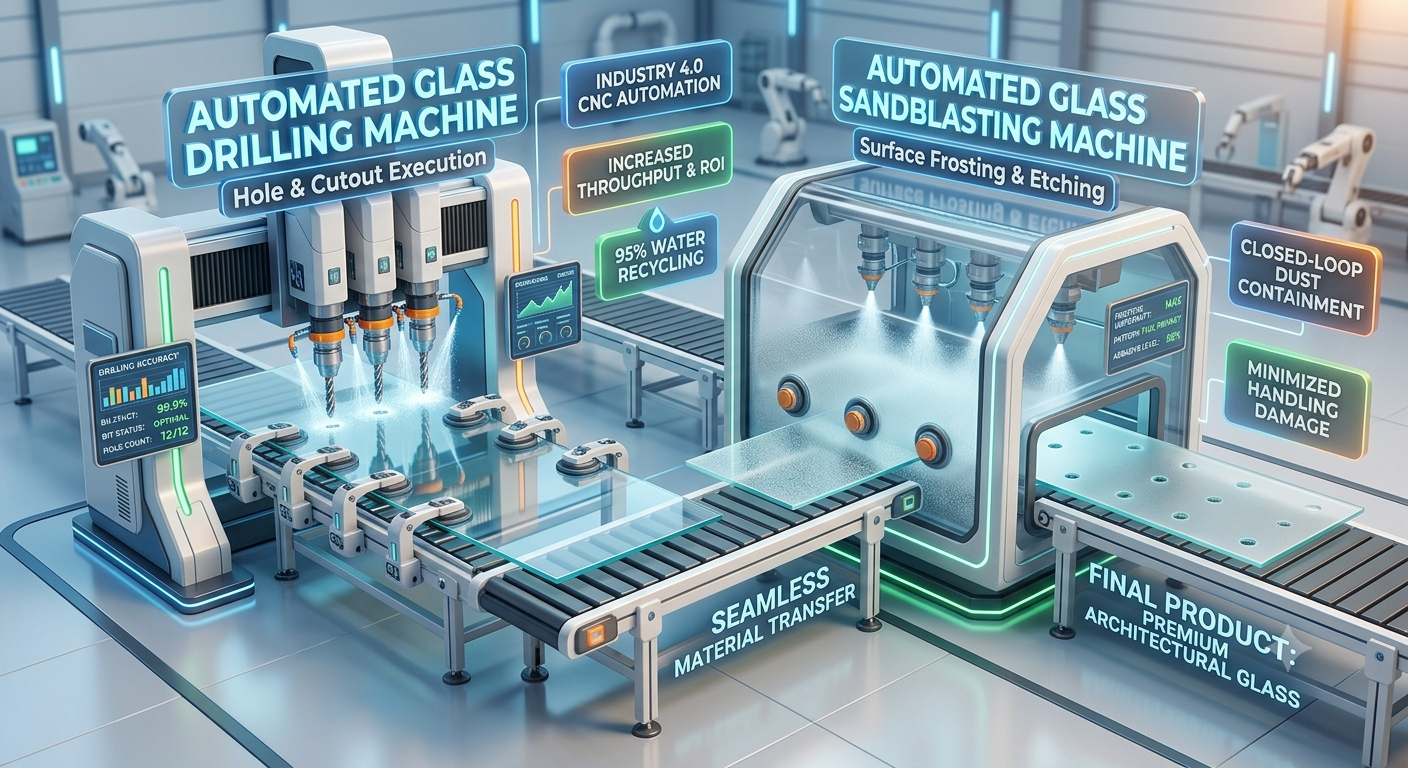
Architectural projects, interior decoration, furniture manufacturing, shower enclosures, partitions, mirrors, and customized glass products increasingly demand accurate surface treatment and precise hole-making. Two important technologies supporting these requirements are the Glass Sandblasting Machine and Glass Drilling Machine.
Although these machines perform different tasks, both help glass processors improve accuracy, productivity, design flexibility, and finishing quality. Selecting suitable equipment can also reduce manual effort, minimize glass waste, and create more consistent finished products.
What Is a Glass Sandblasting Machine?
A Glass Sandblasting Machine is designed to create frosted, matte, decorative, textured, or partially opaque effects on glass surfaces. The machine directs abrasive material toward the glass under controlled pressure, modifying the surface without requiring conventional painting or chemical frosting.
Sandblasted glass is commonly found in commercial offices, hotels, restaurants, homes, retail interiors, decorative doors, shower cabins, partitions, and customized signage.
Modern sandblasting equipment allows manufacturers to control the treated area and produce consistent surface finishes. Templates or masking materials may also be used when logos, patterns, lettering, borders, or other decorative designs are required.
The major benefits include:
-
Consistent matte and frosted finishes
-
Flexible decorative glass production
-
Controlled surface processing
-
Reduced dependence on manual frosting
-
Support for custom patterns and designs
-
Improved productivity for repetitive projects
For glass processors handling decorative applications regularly, automated or semi-automated sandblasting can significantly simplify production.
How Does Glass Sandblasting Improve Decorative Glass Production?
Decorative glass must combine visual quality with repeatable manufacturing results. Manual surface processing can create inconsistent textures, particularly when several identical panels are required.
A Glass Sandblasting Machine offers better control over blasting pressure, movement, processing speed, and surface coverage. This helps operators achieve a more uniform appearance across multiple glass panels.
Typical applications include:
-
Office privacy partitions
-
Frosted glass doors
-
Decorative mirrors
-
Hotel interior glass
-
Customized logos
-
Architectural panels
-
Shower enclosure glass
-
Furniture and cabinet glass
The ability to process both simple frosted sections and complex decorative patterns gives manufacturers greater freedom when serving architects, interior designers, contractors, and customized glass buyers.
What Is a Glass Drilling Machine?
A Glass Drilling Machine is specialized equipment used to create accurate holes in glass panels. Holes may be required for handles, hinges, connectors, plumbing accessories, mounting hardware, fittings, locks, and other installation components.
Drilling glass requires considerably more care than drilling materials such as wood or conventional metal. Glass is brittle, meaning incorrect pressure, poor alignment, vibration, unsuitable tooling, or excessive heat can cause cracks, edge damage, or complete breakage.
A properly configured Glass Drilling Machine provides controlled drilling conditions that help achieve smooth and precise holes while reducing the possibility of damage.
Important Features of a Glass Drilling Machine
The effectiveness of glass drilling equipment depends on machine construction, tooling, positioning accuracy, cooling arrangements, and operator control.
Important characteristics may include:
-
Accurate drilling position
-
Stable glass support
-
Adjustable operating parameters
-
Reliable spindle performance
-
Suitable diamond drilling tools
-
Effective water cooling
-
Smooth machine movement
-
Easy operation and maintenance
Cooling is especially important because drilling generates heat around the contact area. Proper cooling helps control temperature while assisting with the removal of glass particles during processing.
Glass Sandblasting Machine vs Glass Drilling Machine
While both machines are used in glass processing, their purposes are completely different.
| Feature | Glass Sandblasting Machine | Glass Drilling Machine |
|---|---|---|
| Main Purpose | Surface finishing and decoration | Creating accurate holes |
| Processing Area | Glass surface | Specific drilling points |
| Typical Result | Frosted, matte or decorative finish | Smooth circular holes |
| Main Applications | Partitions, doors, mirrors, décor | Hinges, handles, fittings, hardware |
| Processing Focus | Appearance and privacy | Installation and assembly |
| Customization | Patterns, logos and textures | Hole size and position |
A modern glass fabrication workshop may require both machines because decorative finishing and mechanical preparation are often needed during the same manufacturing process.
Why Precision Matters in Glass Processing
Precision directly influences product quality, installation accuracy, material utilization, and manufacturing efficiency.
For example, incorrectly positioned holes can prevent hardware from fitting properly. Similarly, inconsistent sandblasting can make decorative panels appear uneven when installed alongside one another.
Quality machinery helps manufacturers maintain repeatable production standards while reducing unnecessary glass rejection.
Accurate processing can provide several advantages:
-
Less material waste
-
Better finished appearance
-
Easier installation
-
Improved production consistency
-
Lower reworking requirements
-
Greater customer satisfaction
Precision becomes particularly important when processing expensive, customized, or large-format glass panels.
How to Choose the Right Glass Processing Machine
Before purchasing equipment, manufacturers should evaluate their production requirements instead of selecting machinery only according to price.
Consider the following factors:
-
Production volume: Determine how many glass sheets must be processed daily.
-
Glass dimensions: Confirm that the machine supports required panel sizes.
-
Glass thickness: Ensure compatibility with commonly processed thickness ranges.
-
Automation level: Choose manual, semi-automatic, or automated equipment according to production needs.
-
Processing accuracy: Evaluate consistency for repetitive production.
-
Maintenance requirements: Select equipment with convenient access to serviceable components.
-
Operator safety: Proper shielding, controls, dust management, cooling, and emergency functions are important.
-
Technical support: Reliable installation guidance and after-sales support can reduce operational interruptions.
The most suitable machine is one that matches actual production conditions while providing room for future business growth.
Safety Considerations During Glass Processing
Glass fabrication requires disciplined operating procedures. Operators should receive proper training before using either a Glass Sandblasting Machine or Glass Drilling Machine.
Protective eyewear, gloves, appropriate clothing, machine guards, ventilation, dust collection, and correct handling procedures should be incorporated into workplace practices.
Machines should also be inspected regularly. Worn drilling tools, damaged components, blocked cooling lines, leaking systems, or improper abrasive delivery can affect both safety and processing quality.
Frequently Asked Questions
1. What is a Glass Sandblasting Machine used for?
It is mainly used to create frosted, matte, textured, decorative, or privacy finishes on glass surfaces.
2. Can sandblasting create custom designs on glass?
Yes. Masking and templates can be used to create patterns, logos, borders, letters, and customized decorative areas.
3. What is a Glass Drilling Machine used for?
It creates precise holes for handles, hinges, fittings, connectors, locks, and other glass hardware.
4. Can ordinary drills be used for professional glass production?
Dedicated glass drilling equipment is generally more suitable because it provides better positioning, stability, cooling, and process control.
5. Why is water used during glass drilling?
Water helps control heat, cool the drilling area, and remove debris generated during processing.
6. Which machine is better for decorative glass?
A Glass Sandblasting Machine is the appropriate choice when the objective is frosting, texturing, privacy, or decorative surface treatment.
7. Can thick glass be drilled?
Yes, provided the machine, drilling tool, operating parameters, and glass specifications are compatible.
8. Does sandblasting weaken glass?
Correctly controlled processing is designed for surface treatment, but operators must always use suitable pressure and procedures for the particular glass.
9. Can both machines be used in one production line?
Yes. Many glass fabrication businesses use both because they perform complementary operations.
10. What should buyers check before purchasing glass machinery?
They should consider glass size, thickness, production capacity, accuracy, automation, maintenance, safety features, operating costs, and technical support.
- Technology for Students
- Admissions & Applications
- Online Courses
- Career and Jobs
- Campus Life
- Drinks
- Film
- Fitness
- Food
- Jeux
- Gardening
- Health
- Domicile
- Literature
- Music
- Networking For Students
- Insights
- Party
- Religion
- Shopping
- Sports
- Theater
- Wellness
- Education News
- Business & Finance For Students
- Security, Law & Crime Education
- Insurance
- Science & Technology For Students
 French
 English
 Arabic
 Spanish
 Portuguese
 Deutsch
 Turkish
 Dutch
Dutch
 Italiano
 Russian
 Romaian
 Portuguese (Brazil)
 Greek
Greek