


Aluminum Die Casting and China Die Casting Manufacturer: Quality, Benefits, Process and Sourcing Guide
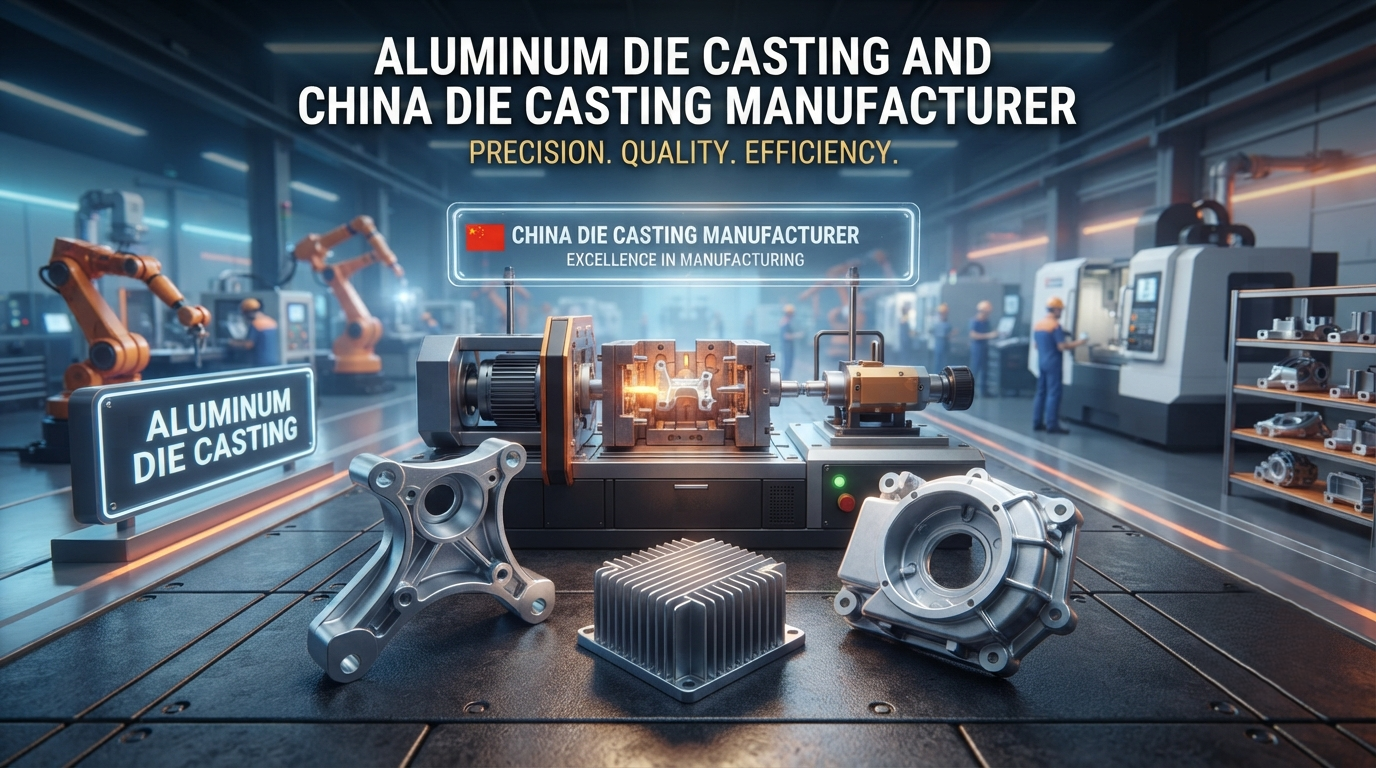
From automotive housings and electronic enclosures to machinery and consumer products, the process supports efficient production with consistent quality. Choosing an experienced China die casting manufacturer can also help buyers combine engineering support, tooling, machining, finishing, and scalable production within one supply chain.
Successful sourcing involves more than comparing prices. Buyers should understand casting technology, alloy selection, tooling quality, inspection methods, finishing options, and supplier capabilities. This guide explains how aluminum die casting works, its benefits, applications, quality considerations, and important factors when selecting a manufacturing partner.
What Is Aluminum Die Casting?
Aluminum die casting is a manufacturing process in which molten aluminum alloy is injected into a precision steel mold under high pressure. The material fills the mold cavity, cools rapidly, and solidifies into the required component shape.
After solidification, the casting is removed, trimmed, inspected, and prepared for additional machining or finishing when required.
The process is particularly suitable for parts containing thin walls, ribs, bosses, mounting points, detailed surfaces, and complex shapes.
How the Aluminum Die Casting Process Works
A typical production cycle includes:
-
Preparing and lubricating the die.
-
Melting the selected aluminum alloy.
-
Injecting molten metal into the mold.
-
Maintaining pressure during solidification.
-
Opening the die and ejecting the component.
-
Removing gates, runners, and excess material.
-
Performing machining, finishing, and quality inspection.
Importance of Process Control
Temperature, injection pressure, filling speed, cooling time, alloy composition, and tooling condition can directly affect component quality.
An experienced China die casting manufacturer carefully manages these parameters to minimize defects such as porosity, flash, warpage, incomplete filling, and dimensional variation.
Key Benefits of Aluminum Die Casting
Manufacturers choose aluminum because it offers an excellent combination of strength, low weight, thermal performance, corrosion resistance, and design flexibility.
Important advantages include:
-
Lightweight components
-
High production efficiency
-
Consistent dimensional accuracy
-
Excellent repeatability
-
Complex component geometries
-
Good surface appearance
-
Strong thermal conductivity
-
Reduced assembly requirements
-
Compatibility with CNC machining
-
Multiple finishing possibilities
Another important benefit of aluminum die casting is part consolidation. Engineers can often combine several separate components into one casting, reducing fasteners, assembly operations, and production complexity.
Common Applications of Aluminum Die Casting
Automotive and Transportation
Automotive manufacturers use die-cast aluminum for motor housings, transmission housings, brackets, covers, structural supports, electronic housings, and thermal-management components.
Its lightweight properties make aluminum particularly useful where weight reduction and structural performance are important.
Electronics and Electrical Equipment
Common applications include LED housings, electrical enclosures, communication equipment, heat sinks, power-tool bodies, and control-system components.
Aluminum's thermal conductivity can also help transfer heat away from sensitive electronic systems.
Industrial and Consumer Products
Industrial applications include pump housings, machinery covers, frames, handles, appliance components, and hardware.
A capable China die casting manufacturer may provide casting together with machining, polishing, coating, inspection, and assembly.
Aluminum Die Casting vs Other Manufacturing Methods
| Factor | Aluminum Die Casting | CNC Machining | Sand Casting |
|---|---|---|---|
| Production volume | Medium to high | Low to medium | Low to medium |
| Initial tooling cost | Higher | Low | Moderate |
| Complex geometry | Excellent | Excellent | Moderate |
| Surface quality | Good | Very good | Moderate |
| Production speed | Fast | Slower | Slower |
| Repeatability | Very high | Very high | Moderate |
| Material efficiency | Good | Lower due to chips | Moderate |
The best manufacturing method depends on order quantity, component geometry, tolerance requirements, tooling budget, materials, and expected production life.
How to Choose a China Die Casting Manufacturer
Selecting the right production partner should involve more than choosing the lowest quotation. Technical expertise, manufacturing capability, quality management, and communication are equally important.
Engineering and Tooling Capability
A professional supplier should be able to review component drawings, evaluate manufacturability, develop tooling, optimize gating, and recommend practical design improvements.
Early technical discussion can prevent expensive mold changes after production begins.
Quality Management
A dependable China die casting manufacturer should control:
-
Raw material quality
-
Casting parameters
-
Mold condition
-
Dimensional accuracy
-
Machining operations
-
Surface appearance
-
Final inspection
Depending on the application, inspection can involve measuring gauges, coordinate measuring systems, material verification, leak testing, or X-ray inspection.
Secondary Manufacturing Services
Buyers should also evaluate whether the supplier provides:
-
CNC machining
-
Drilling
-
Tapping
-
Deburring
-
Polishing
-
Shot blasting
-
Powder coating
-
Painting
-
Plating
-
Assembly
Integrated production can simplify procurement and improve consistency between manufacturing stages.
Communication and Production Planning
Before starting mass production, both parties should confirm drawings, tolerances, surface requirements, inspection criteria, approved samples, packaging standards, quantities, and delivery expectations.
Good communication reduces the possibility of costly misunderstandings.
Common Quality Challenges
Like any manufacturing process, aluminum die casting has technical challenges. Possible defects include:
-
Gas porosity
-
Shrinkage
-
Cold shuts
-
Flash
-
Warpage
-
Flow marks
-
Dimensional variation
Manufacturers can reduce these problems through optimized gating, proper venting, stable molten-metal temperature, controlled injection parameters, balanced cooling, regular die maintenance, and systematic inspection.
Buyers should clearly identify critical dimensions instead of demanding extremely tight tolerances throughout the entire component.
Sustainability and Future of Aluminum Die Casting
Modern manufacturing is increasingly focused on improving material utilization, energy efficiency, automation, and waste reduction.
Advanced simulation can help engineers optimize tooling before physical production begins. Automated inspection and real-time process monitoring can also improve consistency.
Recycled aluminum is another important consideration because aluminum can be recovered and reused within suitable manufacturing systems.
Future aluminum die casting facilities are expected to use more intelligent production monitoring, automated quality inspection, digital traceability, robotics, and data-driven process control.
For a competitive China die casting manufacturer, these technologies can improve productivity while supporting more consistent manufacturing results.
Frequently Asked Questions
1. What is aluminum die casting used for?
It is used to manufacture lightweight and accurate components for automotive, electronics, machinery, lighting, appliances, and industrial products.
2. Why is aluminum suitable for die casting?
Aluminum provides low weight, good strength, corrosion resistance, thermal conductivity, and excellent design flexibility.
3. Is aluminum die casting suitable for mass production?
Yes. Once tooling is developed and validated, aluminum die casting is highly suitable for repeated medium- and high-volume production.
4. What should I send to a die casting manufacturer?
Provide 2D drawings, 3D models, alloy requirements, quantities, tolerances, surface-finishing requirements, and inspection expectations.
5. Can aluminum die-cast components be CNC machined?
Yes. Holes, threads, sealing surfaces, and precision features are frequently CNC machined after casting.
6. What surface finishes can be used?
Common options include painting, powder coating, polishing, shot blasting, plating, and specialized protective finishes.
7. How should I evaluate a China die casting manufacturer?
Evaluate engineering knowledge, tooling capability, production equipment, quality systems, inspection methods, communication, and relevant project experience.
8. What causes porosity in die casting?
Porosity can result from trapped gases, shrinkage, insufficient venting, unsuitable process parameters, or improper gating design.
9. Is aluminum die casting economical for small orders?
It may be less economical for very small quantities because precision tooling requires an upfront investment.
10. How can buyers improve casting quality?
Involve the supplier early, specify critical requirements clearly, review tooling designs, approve samples, and define inspection procedures before mass production.
- Technology for Students
- Admissions & Applications
- Online Courses
- Career and Jobs
- Campus Life
- Drinks
- Film
- Fitness
- Food
- Jeux
- Gardening
- Health
- Domicile
- Literature
- Music
- Networking For Students
- Insights
- Party
- Religion
- Shopping
- Sports
- Theater
- Wellness
- Education News
- Business & Finance For Students
- Security, Law & Crime Education
- Insurance
- Science & Technology For Students
 French
 English
 Arabic
 Spanish
 Portuguese
 Deutsch
 Turkish
 Dutch
Dutch
 Italiano
 Russian
 Romaian
 Portuguese (Brazil)
 Greek
Greek