


How does Laminar Airflow System Manufacturers help control VOCs and airborne pollutants?
INTRODUCTION
Laminar Airflow System Manufacturers play an important role in designing controlled environments that help reduce airborne particles and manage contamination risks across healthcare facilities, pharmaceutical production, laboratories, electronics manufacturing, and other sensitive industries. Volatile organic compounds (VOCs), dust, aerosols, and other airborne pollutants can affect indoor air quality and product or process integrity. By combining appropriate airflow design, HEPA filtration, compatible chemical filtration, and effective ventilation engineering, manufacturers help organizations establish cleaner and more controlled working environments.
However, controlling airborne contamination requires more than installing a laminar airflow unit. Laminar airflow primarily directs filtered air across a designated area to reduce particulate contamination. VOCs are gaseous chemical pollutants and generally require source control, adequate ventilation, and suitable gas-phase filtration. The Centers for Disease Control and Prevention (CDC) explains that HEPA filtration is used to remove airborne particles, while proper HVAC design and maintenance are essential to reliable air-cleaning performance.
Understanding how these technologies work together helps businesses choose a solution that matches their contamination-control requirements.
Understanding VOCs and Airborne Pollutants
Before selecting a laminar airflow system, it is important to understand the contaminants that may be present in a facility.
What Are VOCs?
Volatile organic compounds are chemicals that can evaporate into the air under normal environmental conditions. Common sources include paints, adhesives, solvents, cleaning agents, coatings, furnishings, and certain industrial processes.
Depending on the chemical and exposure level, VOCs may contribute to odors, irritation, or other health concerns. In sensitive manufacturing and laboratory environments, they may also interfere with specific processes or affect product quality.
What Are Airborne Pollutants?
Airborne pollutants include a variety of particles and contaminants suspended in the air, such as:
-
Dust and fine particulate matter
-
Fibres and construction debris
-
Aerosol droplets
-
Pollen and other environmental particles
-
Certain microorganisms carried by particles
-
Chemical vapours and gases
-
Smoke and process-generated contaminants
These pollutants require different control methods. HEPA filtration is effective for capturing suitable airborne particles, but it does not remove all gases or VOCs. Therefore, manufacturers must assess the contamination source before recommending a complete air-cleaning solution.
1. Designing Controlled Airflow Patterns
One of the main contributions of Laminar Airflow System Manufacturers is the design of a consistent airflow pattern that carries filtered air through a designated work area.
Laminar airflow systems are commonly designed for vertical downflow or horizontal airflow, depending on the application. Their purpose is to minimize uncontrolled air movement and help sweep particles away from critical work surfaces.
Manufacturers consider factors such as:
-
Room dimensions and layout
-
Required cleanliness level
-
Airflow direction and velocity
-
Position of workstations and equipment
-
Location of supply and return openings
-
Potential sources of contamination
-
Staff movement and operational activities
A properly designed airflow pattern can help reduce the accumulation of airborne particles in the protected area. However, its performance depends on installation quality, operating conditions, and the way the workspace is used.
2. Using HEPA Filtration to Capture Particles
High-efficiency particulate air (HEPA) filtration is a major component of many laminar airflow systems. HEPA filters capture airborne particles as air passes through the filter media.
The filter specification should match the application, required cleanliness level, and applicable standards. Manufacturers also need to consider filter installation, sealing, airflow resistance, and replacement requirements.
Important features include:
-
Appropriate HEPA filter efficiency
-
Secure filter housing and gasket arrangements
-
Proper sealing to prevent air bypass
-
Uniform airflow across the filter face
-
Accessible inspection and maintenance points
-
Filter integrity testing where required
A filter cannot deliver its intended performance if air leaks around its edges or if the system has inadequate airflow. The CDC recommends proper installation and maintenance of HVAC filters to prevent leakage and preserve particulate-removal performance.
Important distinction: HEPA filters capture particles, not all gaseous pollutants. Facilities dealing with VOCs need additional controls appropriate to the chemicals involved.
3. Controlling VOCs Through Gas-Phase Filtration
Because VOCs exist as gases or vapours, controlling them usually requires a different filtration method from particle removal.
Depending on the chemical contaminants and operating conditions, Laminar Airflow System Manufacturers may coordinate the integration of gas-phase filtration into the wider air-treatment system.
Potential technologies include:
-
Activated carbon filtration
-
Application-specific chemical adsorbents
-
Other engineered gas-phase filtration media
-
Exhaust ventilation for contaminants generated by processes
Activated carbon can adsorb certain gaseous compounds, but its effectiveness varies with the type of VOC, concentration, humidity, airflow, and the amount and condition of the filter media. No single carbon filter removes every chemical equally well.
A suitable system should therefore be designed around the actual contaminant profile. Manufacturers and HVAC engineers should evaluate filter compatibility, expected service life, pressure drop, and the method for determining when replacement is necessary.
For higher-risk chemical processes, local exhaust ventilation or dedicated extraction may be more appropriate than relying on room air filtration alone.
4. Combining Source Control with Ventilation
The most effective approach to VOC management often begins by reducing the amount of pollution released into the environment.
Manufacturers and project engineers can help identify how the airflow system should work alongside other contamination-control measures.
These may include:
-
Selecting low-emission construction and finishing materials
-
Storing solvents and chemicals in suitable closed containers
-
Using less-polluting cleaning products where feasible
-
Installing local exhaust near contaminant-generating equipment
-
Separating chemical processes from clean work areas
-
Positioning outdoor-air intakes away from exhaust outlets and pollution sources
-
Establishing appropriate cleaning and maintenance procedures
Ventilation can dilute and remove contaminants when it is designed to provide suitable airflow and exhaust. However, dilution alone may not be sufficient for hazardous or highly concentrated chemical emissions.
The CDC recommends suitable air-intake and exhaust placement, routine ventilation maintenance, and monitoring of systems with special filtration or pressure requirements.
5. Maintaining Uniform Air Distribution
Uneven airflow can create stagnant areas where airborne particles accumulate or allow contamination to move into critical work zones.
To reduce these risks, manufacturers evaluate the airflow distribution across the protected area. They may consider filter-face velocity, diffuser design, equipment placement, room geometry, and obstructions caused by machinery or storage.
A good airflow design aims to provide:
-
Consistent delivery of filtered air
-
Reduced turbulence in critical work areas
-
Suitable coverage of the intended protection zone
-
Appropriate return-air or exhaust pathways
-
Minimal obstruction from equipment and personnel
The design should be verified under realistic operating conditions. Placing equipment or materials in front of supply openings can disturb the intended airflow, so operating procedures should maintain the required clearances.
Laminar airflow can reduce particle contamination in a designated zone, but it should not be assumed to remove every pollutant from the entire room. Whole-room ventilation and suitable exhaust arrangements may still be necessary.
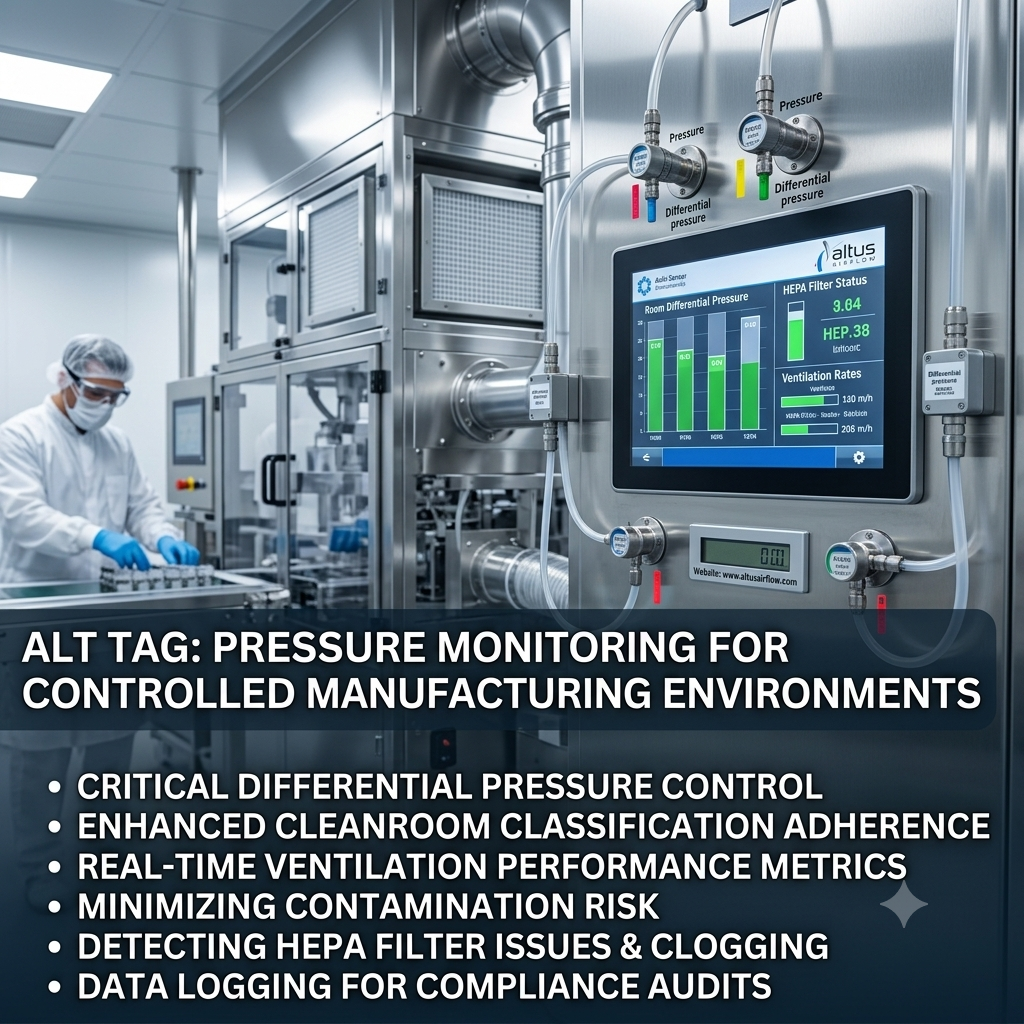
6. Supporting Pressure Control and Contamination Separation
Some cleanrooms and controlled laboratories use pressure differentials to manage the movement of air between adjoining spaces.
Positive pressure may help protect a cleaner room from the entry of less-clean air. Conversely, negative pressure may be appropriate in areas where hazardous contaminants must be contained and exhausted safely.
The correct pressure strategy depends on the activity being performed. A clean manufacturing area and a room containing hazardous chemical vapours may require different approaches.
A complete design may include:
-
Differential-pressure gauges or sensors
-
Suitable door and room-sealing arrangements
-
Defined supply and exhaust airflow rates
-
Alarm limits for significant pressure deviations
-
Appropriate exhaust treatment, where required
-
Commissioning and routine pressure checks
Pressure control does not directly eliminate VOCs. It helps manage air movement and contamination transfer between spaces and must be combined with the correct filtration or exhaust method.
7. Choosing Materials That Minimize Contamination
Air-cleaning equipment can only address part of the contamination problem. Materials used in the surrounding room may themselves release particles or VOCs.
Manufacturers involved in cleanroom and laminar airflow projects should coordinate with designers to select materials suitable for the intended environment.
Depending on the application, considerations may include:
-
Low-emission coatings and sealants
-
Smooth, cleanable surfaces
-
Suitable wall and ceiling finishes
-
Properly sealed joints
-
Durable materials compatible with cleaning agents
-
Equipment finishes that resist corrosion and degradation
Newly installed materials may release VOCs during an initial period, depending on their composition and installation conditions. Project planning should account for appropriate curing, ventilation, and air-quality verification before sensitive operations begin.
Material selection is especially important in pharmaceutical, healthcare, and laboratory environments where both particulate and chemical contamination need to be managed.
8. Applying Laminar Airflow Technology Across Industries
Different industries face different contamination risks. Laminar Airflow System Manufacturers should therefore adapt system specifications to the facility's intended use.
Pharmaceutical Manufacturing
Pharmaceutical operations may require controlled particulate levels, defined airflow patterns, and application-specific containment or pressure arrangements. VOC control may be needed where solvents or other volatile chemicals are used.
Healthcare Facilities
Selected healthcare applications use filtered airflow to support a controlled environment. System requirements depend on the room's clinical purpose, infection-control assessment, and applicable healthcare ventilation guidance.
Laminar airflow should not automatically be treated as a replacement for a complete healthcare ventilation strategy. The CDC notes that laminar airflow has not conclusively been shown to reduce overall surgical-site infection risk in operating rooms.
Biotechnology and Research Laboratories
Laboratories may need to manage particles, chemical vapours, and other process-specific contaminants. The appropriate solution depends on the substances handled, the required protection, and the laboratory's containment strategy.
Electronics Manufacturing
Electronic components can be sensitive to particulate contamination. Laminar airflow may help protect specific assembly areas, while VOC management may require separate controls for solvents, adhesives, and process emissions.
Food and Other Precision Manufacturing
Controlled airflow can support cleanliness around selected production activities. However, the required filtration, hygiene practices, and exhaust arrangements must reflect the actual process and applicable requirements.
9. Monitoring System Performance
A well-designed system needs regular inspection to ensure that it continues to perform as intended.
Depending on the facility's requirements, monitoring and testing may include:
-
Airflow velocity and distribution measurements
-
HEPA filter integrity testing
-
Differential-pressure monitoring
-
Particle-count testing
-
Inspection for filter damage or air leakage
-
VOC measurements where appropriate
-
Review of gas-phase filter condition
-
Verification of exhaust and alarm performance
VOC monitoring methods should be selected according to the chemicals of concern. A general VOC reading may indicate a change in air quality, but it does not necessarily identify individual compounds or establish that every exposure limit is met.
The CDC recommends ventilation monitoring and preventive maintenance to support particulate removal and reliable operation.
Testing should be performed at commissioning and repeated according to the risk assessment, manufacturer recommendations, and facility quality plan.
10. Preventive Maintenance and Filter Replacement
Even advanced filtration systems can become less effective if maintenance is neglected. Dust loading, damaged seals, worn components, and exhausted gas-phase media can reduce performance.
A preventive maintenance programme should include:
-
Inspecting filters and housings for damage or leakage.
-
Checking airflow and pressure readings.
-
Replacing HEPA filters according to condition and approved procedures.
-
Replacing gas-phase media according to contaminant loading and service-life criteria.
-
Cleaning suitable surfaces and air pathways.
-
Checking sensors, controls, and alarms.
-
Recording maintenance activities and test results.
Gas-phase media may become saturated, meaning it can no longer effectively adsorb the target compounds. Replacement schedules should account for the actual contaminants and operating conditions rather than relying solely on a fixed calendar interval.
The CDC emphasizes that HVAC filters must be properly installed and maintained and that ventilation systems should be monitored according to engineering and manufacturer recommendations.
How to Choose the Right Manufacturer
When comparing providers, businesses should evaluate more than the equipment's initial price or stated filter efficiency.
Consider whether the manufacturer can provide:
-
Application-specific airflow design
-
Appropriate HEPA filtration specifications
-
VOC-control options based on the contaminants involved
-
Coordination with HVAC and exhaust systems
-
Airflow and filter testing
-
Installation and commissioning support
-
Clear maintenance instructions
-
Technical documentation and after-sales assistance
Ask the provider to explain which contaminants the proposed system is designed to control and which require separate source-control or exhaust measures. This helps prevent a common mistake: assuming that a laminar airflow unit alone can remove both airborne particles and all gaseous pollutants.
Conclusion
Laminar airflow systems help control airborne particles by directing filtered air through a designated work area, while effective VOC management generally requires source reduction, suitable ventilation, and compatible gas-phase filtration. A complete contamination-control strategy should combine the right filtration technologies with well-designed airflow, appropriate pressure relationships, suitable materials, regular monitoring, and preventive maintenance. The exact configuration depends on the industry, contaminants, room layout, and applicable standards. For organizations planning integrated cleanroom and airflow solutions, Altus Airflow can support project planning and engineering coordination to help meet application-specific environmental-control requirements.
Frequently Asked Questions
1. How do Laminar Airflow System Manufacturers help control VOCs?
Laminar Airflow System Manufacturers can help address VOCs by coordinating appropriate ventilation, source-control measures, and compatible gas-phase filtration, such as activated carbon where suitable. HEPA filtration alone does not remove most gaseous VOCs.
2. Can Laminar Airflow System Manufacturers remove all airborne pollutants?
No. Laminar Airflow System Manufacturers design systems that can reduce airborne particulate contamination, but different pollutants require different control methods. VOCs and other gases may need chemical filtration or dedicated exhaust ventilation.
3. Why is HEPA filtration important when selecting Laminar Airflow System Manufacturers?
Laminar Airflow System Manufacturers commonly incorporate HEPA filtration to capture airborne particles and help provide cleaner air in designated work zones. Correct installation, sealing, testing, and maintenance are essential for reliable performance.
4. Which industries benefit from Laminar Airflow System Manufacturers?
Laminar Airflow System Manufacturers serve applications in pharmaceutical production, healthcare, biotechnology, electronics, research laboratories, and other precision industries where controlled airborne particle levels are important.
5. How often should filters be replaced in systems supplied by Laminar Airflow System Manufacturers?
Filter replacement depends on filter condition, pressure drop, contamination loading, system performance, and manufacturer guidance. Laminar Airflow System Manufacturers should provide a documented maintenance plan that covers both particulate filters and gas-phase media where installed.
Read Our Previous Blog------>What ventilation systems are recommended for IVF Lab Design?
- Technology for Students
- Admissions & Applications
- Online Courses
- Career and Jobs
- Campus Life
- Drinks
- Film
- Fitness
- Food
- Παιχνίδια
- Gardening
- Health
- Κεντρική Σελίδα
- Literature
- Music
- Networking For Students
- Insights
- Party
- Religion
- Shopping
- Sports
- Theater
- Wellness
- Education News
- Business & Finance For Students
- Security, Law & Crime Education
- Insurance
- Science & Technology For Students
 Greek
Greek
 English
 Arabic
 French
 Spanish
 Portuguese
 Deutsch
 Turkish
 Dutch
Dutch
 Italiano
 Russian
 Romaian
 Portuguese (Brazil)