


Why Motorcycle Gear Can Fit Your Measurements but Still Fit Wrong on Your Body
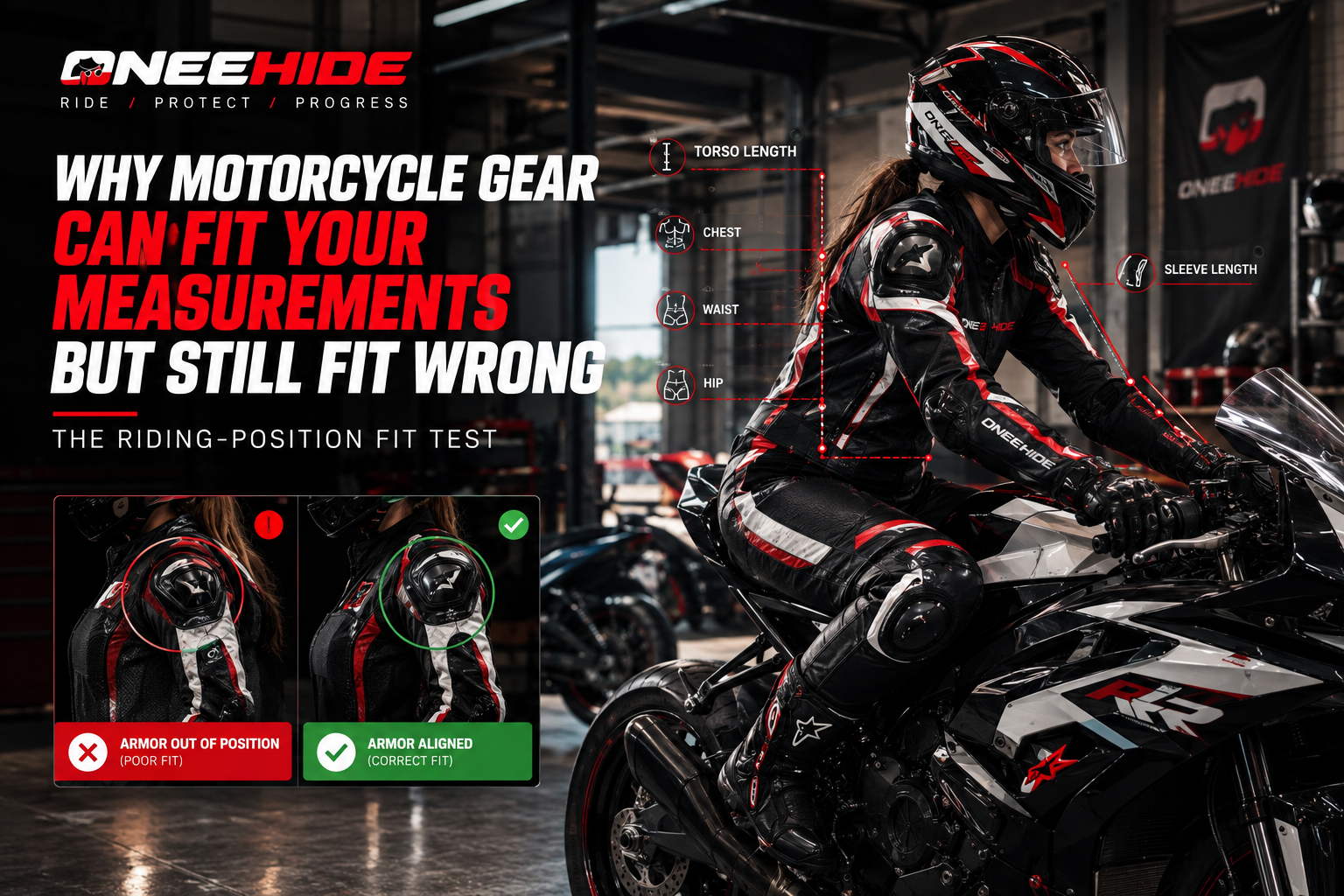
A motorcycle jacket can match your chest, waist, and sleeve measurements perfectly and still feel wrong once you are actually riding. The problem is that motorcycle gear is not ordinary clothing. It has to work around a moving body, a riding posture, protective armor, and the controls of the motorcycle at the same time.
This becomes especially noticeable with women’s riding gear because a few basic measurements cannot describe every combination of torso length, shoulder width, bust, waist, hip shape, arm length, and riding posture.
A size chart can tell you which garment is supposed to accommodate your measurements. It cannot guarantee that the armor will sit correctly, that the sleeves will stay in the right position, or that the garment will remain comfortable when you lean forward over the tank.
The real test is not whether the gear fits your measurements. It is whether the gear still fits your body when your body is in the position it uses to ride.
Why matching measurements does not guarantee a correct fit
Most motorcycle apparel sizing starts with basic body measurements. Chest, waist, hips, height, inseam, and sleeve length are useful because they establish the general dimensions of the rider.
But two riders can share the same chest measurement and have very different proportions.
One might have a longer torso and shorter arms. Another could have broader shoulders, a shorter torso, and longer arms. A third might have similar chest and waist measurements but a substantially different hip-to-waist ratio.
Those differences become important once protective gear is added.
A motorcycle jacket is not simply covering the body. It has armor pockets, seams, reinforcement panels, sleeves, cuffs, closures, and sometimes adjustments that all have to interact with the rider's movement. A measurement can be technically correct while the resulting garment still pulls in one area or leaves too much movement in another.
That is why dedicated women's motorcycle gear can be useful when a rider's proportions do not work well with a generic unisex pattern. The goal is not simply to make the garment smaller or larger. It is to create a shape that works with the rider's actual proportions and intended use.
The most important fit test happens on the motorcycle
Standing upright is a poor test of motorcycle gear fit by itself.
When riding, the shoulders usually move forward, the elbows bend, the wrists rotate toward the controls, and the torso changes angle. On some motorcycles, the rider leans considerably farther forward than on an upright commuter or touring bike.
A useful fitting sequence is:
-
Put on the complete riding outfit.
-
Close the jacket or suit exactly as you would before riding.
-
Sit on the motorcycle.
-
Put your hands and feet into their normal riding positions.
-
Hold that posture for several minutes.
-
Move naturally and check what happens to the garment and armor.
The objective is not to eliminate every wrinkle. Motorcycle gear has to move with you. The question is whether that movement causes protective components to migrate away from the areas they are intended to cover.
Research on motorcycle riders supports the importance of fitted protective clothing. In a study of 212 crashed motorcyclists, wearing motorcycle jackets, pants, and gloves was associated with lower risks of hospital admission, while fitted body armor was associated with reduced upper-body injury risk. The study was observational, so it does not establish that fit alone caused the differences, but it provides useful evidence for treating protective fit as more than a comfort issue.
Which measurements matter beyond chest and waist?
Chest and waist measurements are important, but they should not be treated as the complete picture.
Torso length changes how the jacket sits
A jacket that is correct around the chest can still be too short or too long through the torso.
A shorter torso can cause the waist portion of the jacket to sit higher than intended. A longer torso can create tension when the rider leans forward. Both situations can affect how the jacket interacts with the motorcycle and how the protective panels sit.
Back length deserves particular attention because a jacket can appear correctly sized from the front while providing a very different fit when the rider is seated.
Shoulder width affects sleeve and armor alignment
Shoulder width is another measurement that is easy to overlook.
If a jacket is too narrow through the shoulders, the sleeves may pull inward when the rider reaches for the handlebars. That can create tension across the upper back and restrict natural arm movement.
If the shoulder area is too wide, the garment may move more than intended, potentially affecting the position of shoulder armor.
The correct fit is therefore not simply the smallest size that closes comfortably. It is the size and cut that maintain usable movement while keeping the protective construction appropriately positioned.
Arm and leg proportions can expose sizing compromises
Sleeve length is particularly important because a rider's hands are extended toward the handlebars rather than hanging naturally at the sides.
The same principle applies to motorcycle pants. In a standing position, the knee armor may appear perfectly placed. Once the rider bends the knees and adopts the riding posture, the armor can move relative to the knee.
This is why a sizing chart should be treated as a starting point rather than a final fit test.
Women's body proportions can expose generic sizing problems
The difficulty is not that women's measurements are inherently complicated. The problem is that a few circumference measurements cannot represent three-dimensional body shape.
A 1996 anthropometric study of 140 UK motorcyclists found substantial variation in body dimensions relevant to motorcycle design. It also measured knee position on a motorcycle test rig and found a range of 228 mm in forward knee position. The study included both male and female riders, illustrating how rider geometry can vary significantly even before protective clothing is added.
That finding has an important practical implication: motorcycle apparel cannot be judged entirely by static body measurements.
The rider and motorcycle form a moving system. The garment has to accommodate that system.
For women in particular, areas such as the bust, waist, hips, shoulders, and torso length can make a simple size increase a poor solution. Going one size larger may create enough room at the chest while making the sleeves, shoulders, or waist excessively loose.
That is often how a garment can technically "fit" but still feel wrong.
Armor creates another layer of fit problems
Protective armor makes motorcycle gear fundamentally different from regular clothing.
An elbow protector needs to remain around the elbow. A shoulder protector needs to remain around the shoulder. A back protector needs to stay appropriately positioned along the back. The exact design varies between garments and protectors, but the general principle is consistent: the protective component needs to remain where the garment was designed to place it.
BS EN 17092 addresses motorcycle protective garments through requirements and test methods covering areas such as zoning, ergonomics, mechanical properties, and impact and abrasion resistance. BSI also describes protective risk zones within the standard.BSI Knowledge
That makes armor placement part of fit, not an issue separate from it.
A jacket that fits your bust measurement but allows the shoulder armor to sit too far toward the upper arm is not necessarily giving you the same fit that the size chart suggests.
How to check armor position while riding
The armor check should be performed with the rider seated on the actual motorcycle.
For the shoulders, place both hands on the controls and see whether the protectors remain centered around the shoulder area.
For the elbows, bend your arms into your normal riding position. Check whether the elbow armor follows the joint or slides noticeably toward the forearm or upper arm.
For the back, lean forward naturally. A removable back protector should remain appropriately centered rather than folding or moving significantly sideways or upward.
Do not judge these areas only by appearance. Move.
Reach forward, rotate your shoulders, bend your elbows, stand briefly on the footpegs if that is normal for your riding, and then return to your normal seated position.
The point is to identify movement that would not be obvious in a mirror.
A jacket can be too tight even when the armor fits
The opposite problem also occurs.
A rider may choose a very snug jacket because they know motorcycle gear should not be loose. But excessive tightness can create its own problems.
If the jacket restricts shoulder movement, pulls heavily across the chest, interferes with breathing, or makes it difficult to reach the controls naturally, the fit is not successful.
Protective clothing must also allow sufficient movement for motorcycle control. BSI's description of EN 17092 specifically connects protective garment requirements with ergonomics and the rider's ability to control the motorcycle.
A useful distinction is secure versus restrictive.
Secure means the garment stays appropriately positioned while you move.
Restrictive means the garment prevents natural movement or creates pressure that becomes uncomfortable during riding.
The target is the first, not the second.
How motorcycle type changes the fit you need
A rider's motorcycle can change the ideal garment shape.
An upright commuter or standard motorcycle generally places the torso differently from a sportbike. A touring motorcycle can require a different reach to the bars again. Even within the same category, handlebar height, seat position, footpeg placement, and individual riding style can change posture.
This is why "fits motorcycles" is not a sufficiently precise description of protective apparel.
The better question is: How does the rider sit on the specific motorcycle?
A jacket that works beautifully for an upright position may pull across the back when the same rider moves onto a sportbike. Pants that feel correct while standing may place the knee armor differently after the knees bend.
For riders who switch between very different motorcycles, testing the garment in the position used most often is particularly important.
When standard sizing keeps missing the same areas
Repeated fit problems are useful information.
If a rider consistently has enough room in the chest but excess material around the waist, that is not necessarily solved by sizing down. If the waist becomes comfortable but the shoulders become restrictive, the problem may be the garment's shape rather than the rider choosing the wrong size.
The same logic applies to race suits. A rider who needs a precise fit through the shoulders, torso, hips, arms, and legs may have a stronger case for a custom motorcycle racing suit rather than trying to force a standard size to cover every proportion.
A custom process can take more measurements and account for the intended riding type. OneeHide's current custom suit process asks for measurements, suit fit, gender, leather type, perforation, hump configuration, rider type, and motorcycle details.
Customization is not a guarantee of perfect fit, though. Accurate measurements and clear information about how the gear will be used remain essential.
The difference between body measurements and garment measurements
Another common source of confusion is comparing body measurements directly with garment dimensions.
A body measurement describes the rider. A garment measurement describes the finished piece of clothing. They are not supposed to be identical.
For example, the jacket needs enough construction room to allow movement, closures, layers, armor, and the riding posture. A garment that measures the same circumference as the body would often be too restrictive.
This is why the size chart should be read according to the manufacturer's instructions.
Do not assume that a numerical size has the same meaning between brands. Even among women's motorcycle jackets, sizing systems and proportions can vary significantly. Measurements can overlap while the garment shape changes.
A practical fit checklist before buying
Use this checklist when evaluating motorcycle gear:
-
Chest: Does the garment close without excessive pressure?
-
Shoulders: Do the seams and armor sit correctly without restricting arm movement?
-
Bust: Is there enough room without creating excessive looseness elsewhere?
-
Waist: Does the jacket remain secure without digging into the body?
-
Hips: Can the rider sit naturally without the lower garment pulling upward?
-
Sleeves: Do the cuffs and armor remain correctly positioned with hands on the bars?
-
Back: Does the garment remain long and stable enough in the riding position?
-
Armor: Do the protectors stay over their intended body areas?
-
Movement: Can the rider operate the motorcycle without restriction?
-
Layers: Does the fit still work with the clothing normally worn underneath?
If the garment passes these checks while standing but fails them on the motorcycle, the riding-position fit should take priority.
A better way to think about fit
The strongest motorcycle gear fit is not necessarily the one that looks best in a dressing room.
It is the one that remains stable, comfortable, and functional when the rider is using the motorcycle as intended.
That means measurements are the beginning of the process, not the end. Chest, waist, hips, height, sleeve length, inseam, and other dimensions help select or create a garment, but riding posture determines whether those dimensions translate into a functional fit.
Protective clothing research also makes the distinction worth taking seriously. In studies of motorcycle crashes, fitted protective clothing has been associated with reduced injury risk, while motorcycle clothing standards explicitly consider ergonomics alongside protective performance.
Before deciding that a jacket or suit is the right size, sit on the motorcycle wearing it. Put your hands on the controls, bend your elbows, lean forward, and check the armor. Look for what moves, not just what feels comfortable.
A motorcycle garment fits correctly when its measurements, construction, protective components, and riding position all work together. That is the difference between gear that merely fits a size chart and gear that actually fits the rider.
- Technology for Students
- Admissions & Applications
- Online Courses
- Career and Jobs
- Campus Life
- Drinks
- Film
- Fitness
- Food
- Giochi
- Gardening
- Health
- Home
- Literature
- Music
- Networking For Students
- Insights
- Party
- Religion
- Shopping
- Sports
- Theater
- Wellness
- Education News
- Business & Finance For Students
- Security, Law & Crime Education
- Insurance
- Science & Technology For Students
 Italiano
 English
 Arabic
 French
 Spanish
 Portuguese
 Deutsch
 Turkish
 Dutch
Dutch
 Russian
 Romaian
 Portuguese (Brazil)
 Greek
Greek