


Disc Cap and Flip Top Cap: Smart Closure Solutions for Modern Packaging
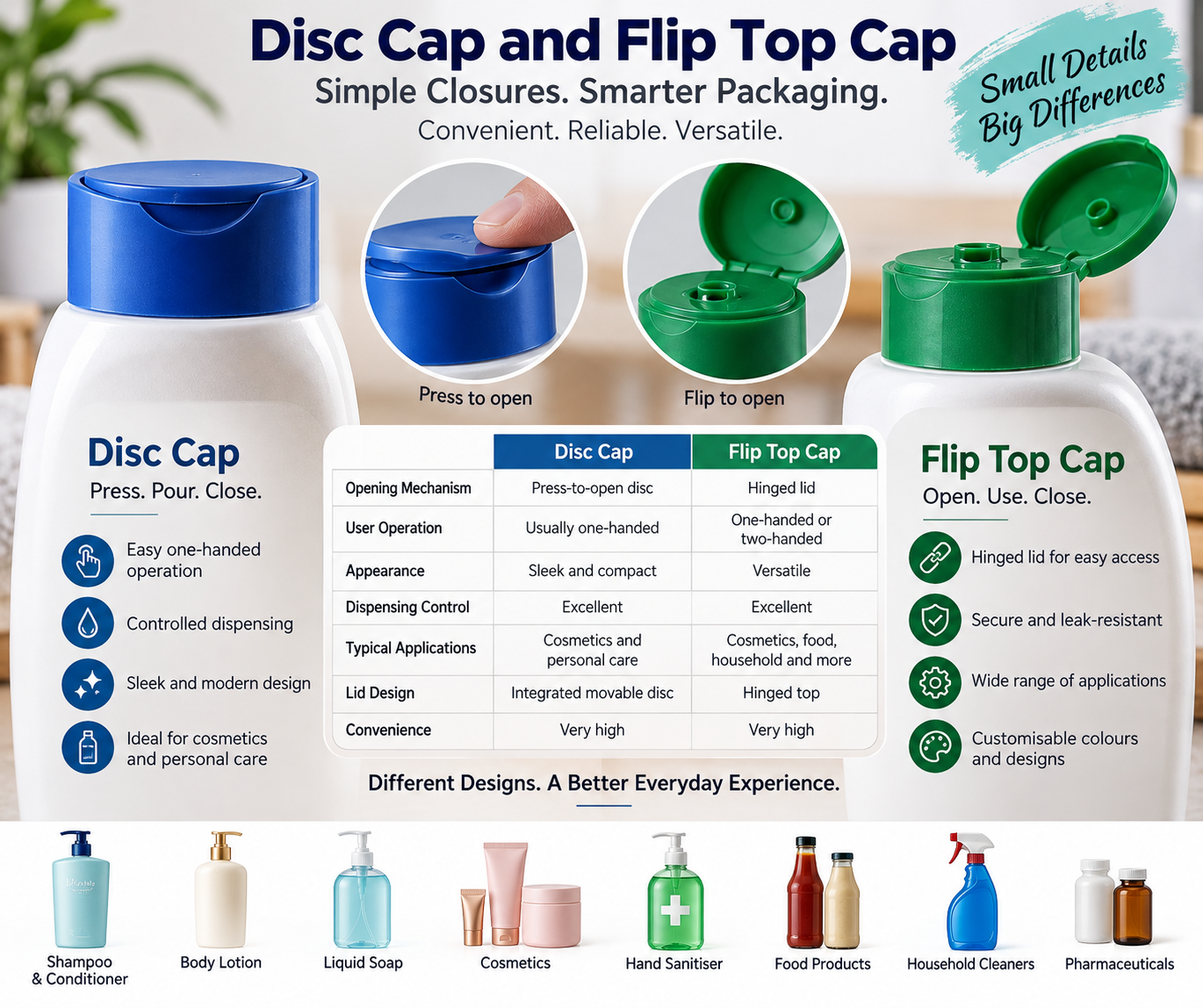
Packaging is no longer only about protecting a product. It also influences convenience, brand perception, hygiene, dosing, storage, and the overall customer experience. Among the most widely used closure options for bottles and containers are the disc cap and flip top cap.
Both closures are designed to make dispensing easier, but they serve slightly different purposes. A disc cap generally uses a press-to-open mechanism that reveals a dispensing hole, while a flip top cap opens through a hinged lid that can be lifted and closed repeatedly. These closures are frequently used in personal care, cosmetics, household products, food packaging, pharmaceuticals, and other consumer goods.
Choosing the right closure can improve usability, reduce leakage risks, support efficient filling operations, and strengthen the visual appeal of the final package.
Understanding the Disc Cap
A disc cap, sometimes called a disc-top closure, is designed with a top surface that opens when one side of the disc is pressed. Pressing one section causes the opposite side to rise, exposing a dispensing opening.
This simple mechanism makes the closure suitable for products that need controlled dispensing without completely removing a lid.
How a Disc Cap Works
The closure usually contains a rotating or pivoting top section. When the user presses one side, the dispensing area opens. After use, the raised section can be pushed down again to close the package.
Because the mechanism is compact, a disc cap can create a clean and modern bottle appearance.
Common Applications
Disc closures are commonly used for:
-
Shampoos and conditioners
-
Body lotions
-
Liquid soaps
-
Hand sanitizers
-
Cosmetic creams
-
Hair care products
-
Cleaning liquids
-
Automotive care products
-
Personal hygiene formulations
Their suitability depends on product viscosity, bottle neck dimensions, dispensing requirements, and closure design.
Understanding the Flip Top Cap
A flip top cap contains a hinged upper section that flips open while remaining attached to the main closure body. The design allows consumers to open and close the package without unscrewing or removing the cap.
This closure style is particularly useful for products that are used frequently.
How a Flip Top Cap Functions
The hinged lid normally covers a dispensing orifice. Users lift the top, dispense the required amount, and press it closed after use.
A properly engineered flip top cap should provide smooth opening, secure closing, reliable hinge performance, and compatibility with the bottle neck.
Typical Uses of Flip Top Closures
A flip closure is frequently found on:
-
Face washes
-
Shower gels
-
Lotions
-
Sauces and condiments
-
Honey containers
-
Pharmaceutical liquids
-
Cleaning formulations
-
Hair oils
-
Cosmetic products
-
Travel-size packaging
Disc Cap and Flip Top Cap Comparison
Although both closures support convenient dispensing, their operating mechanisms differ.
| Feature | Disc Cap | Flip Top Cap |
|---|---|---|
| Opening Method | Press-to-open disc | Hinged lid |
| Lid Removal | Not required | Not required |
| Appearance | Compact and streamlined | Functional and familiar |
| Dispensing | Controlled through top opening | Controlled through hinged opening |
| Common Products | Shampoo, lotion, cosmetics | Toiletries, sauces, cleaners |
| User Convenience | High | High |
| Repeated Use | Suitable | Highly suitable |
The final selection should always be based on actual packaging requirements rather than appearance alone.
Why Closure Selection Matters in Packaging
A bottle closure forms an important interface between the consumer and the product. Even a well-designed container can create a poor customer experience if its closure leaks, becomes difficult to open, or dispenses too much product.
Product Compatibility
The closure material must be compatible with the packaged formulation. Oils, chemicals, alcohol-based products, thick creams, and food formulations may behave differently when exposed to specific plastics.
Dispensing Control
The size and shape of the dispensing hole influence how quickly the product leaves the package.
A thick lotion may require a different opening design than a thin cleansing liquid.
Leak Resistance
Both the disc cap and flip top cap should form an effective seal when properly matched with the container.
Neck Finish Accuracy
Closure performance depends heavily on bottle neck dimensions, thread design, sealing surfaces, and manufacturing tolerances. Small dimensional differences can influence fitting and leakage performance.
Benefits of Disc Cap Packaging
A well-designed disc cap provides several practical advantages.
First, it allows consumers to operate the bottle without removing a separate component. This can reduce the chance of losing the closure.
Second, the compact top can support a clean package profile, which is useful for cosmetic and personal care branding.
Other advantages may include:
-
Convenient one-hand operation
-
Controlled product dispensing
-
Reclosable design
-
Compact construction
-
Compatibility with different bottle shapes
-
Easy integration into many packaging concepts
For brands seeking a minimal and modern closure style, disc-top packaging can be particularly effective.
Benefits of Flip Top Cap Packaging
A flip top cap is popular because of its familiar opening mechanism and repeated-use convenience.
Its attached lid helps consumers quickly access the product while keeping the closure connected to the bottle.
Key benefits include:
-
Fast opening and closing
-
Convenient repeated dispensing
-
Reduced risk of losing the lid
-
Flexible design possibilities
-
Suitable use across multiple industries
-
Potential for different dispensing hole sizes
-
Good branding opportunities through custom shapes and colors
These qualities make flip closures useful for products used every day.
Materials Used for Packaging Caps
Plastic closures are commonly manufactured using materials selected for durability, molding performance, chemical resistance, and hinge flexibility.
Polypropylene is frequently associated with hinged closure designs because it can support repeated flexing when correctly engineered. Other polymers may also be used depending on the application.
Material selection should consider:
-
Product formulation
-
Storage temperature
-
Transportation conditions
-
Required stiffness
-
Hinge performance
-
Recycling goals
-
Manufacturing method
Manufacturing and Quality Control
Injection molding is commonly used to manufacture both disc cap and flip top cap components.
High-quality production requires control over mold design, polymer flow, cooling, dimensional consistency, hinge formation, and sealing areas.
Important Quality Checks
Manufacturers may evaluate:
-
Opening and closing performance
-
Closure torque
-
Leakage resistance
-
Hinge durability
-
Dimensional consistency
-
Surface finish
-
Fit with the bottle neck
-
Dispensing behavior
Why Prototype Testing Matters
Before large-scale production, packaging prototypes should be tested with the actual bottle and product formulation whenever possible. A closure that performs well with one container may not perform identically with another.
Sustainability in Closure Design
Packaging companies are increasingly focusing on reducing unnecessary material and simplifying packaging structures.
Lightweight closure designs can help reduce plastic consumption when performance is maintained. Brands may also consider mono-material packaging systems that support easier recycling within suitable waste streams.
The sustainability of a closure depends on much more than its weight. Manufacturing efficiency, transport requirements, durability, recyclability, and product protection should all be considered.
Future Trends in Packaging Closures
Future closure development is likely to focus on convenience, material efficiency, improved sealing, automation compatibility, and more sustainable packaging structures.
Brands are also paying greater attention to ergonomic opening mechanisms and differentiation through surface finish, shape, color, and customized dispensing features.
Both the disc cap and flip top cap are likely to remain relevant because they combine practical dispensing with familiar consumer interaction.
Frequently Asked Questions
1. What is a disc cap?
A disc cap is a bottle closure that opens when one side of its top disc is pressed, revealing a dispensing opening.
2. What is a flip top cap?
A flip top cap is a closure with a hinged lid that flips open while remaining attached to the main cap body.
3. Which products commonly use disc caps?
They are often used for shampoo, conditioner, lotion, liquid soap, cosmetics, and cleaning products.
4. Where are flip top caps commonly used?
They are widely used for toiletries, cosmetics, food products, cleaners, and personal care packaging.
5. Which closure is easier to use?
Both offer convenient dispensing. The better option depends on the product, bottle design, opening mechanism, and consumer preference.
6. Can disc caps be customized?
Yes. Depending on manufacturing capability, they can be customized in color, size, finish, dispensing opening, and closure design.
7. Are flip top caps suitable for thick liquids?
They can be, provided the dispensing opening and bottle design are suitable for the viscosity of the product.
8. Can these closures prevent leakage?
Properly designed and matched closures can provide good sealing, but leakage performance should always be tested with the final bottle and formulation.
9. What material is commonly used for flip closures?
Polypropylene is commonly used because of its useful molding and hinge properties, although material choice depends on the application.
10. How do I choose between a disc cap and flip top cap?
Consider product viscosity, bottle neck design, target market, dispensing requirements, user experience, sealing performance, and manufacturing cost.
- Technology for Students
- Admissions & Applications
- Online Courses
- Career and Jobs
- Campus Life
- Drinks
- Film
- Fitness
- Food
- Oyunlar
- Gardening
- Health
- Home
- Literature
- Music
- Networking For Students
- Insights
- Party
- Religion
- Shopping
- Sports
- Theater
- Wellness
- Education News
- Business & Finance For Students
- Security, Law & Crime Education
- Insurance
- Science & Technology For Students
 Turkish
 English
 Arabic
 French
 Spanish
 Portuguese
 Deutsch
 Dutch
Dutch
 Italiano
 Russian
 Romaian
 Portuguese (Brazil)
 Greek
Greek