


CUET Exam Guide: Full Form of CUET, Eligibility, Pattern, Preparation and Admission Process
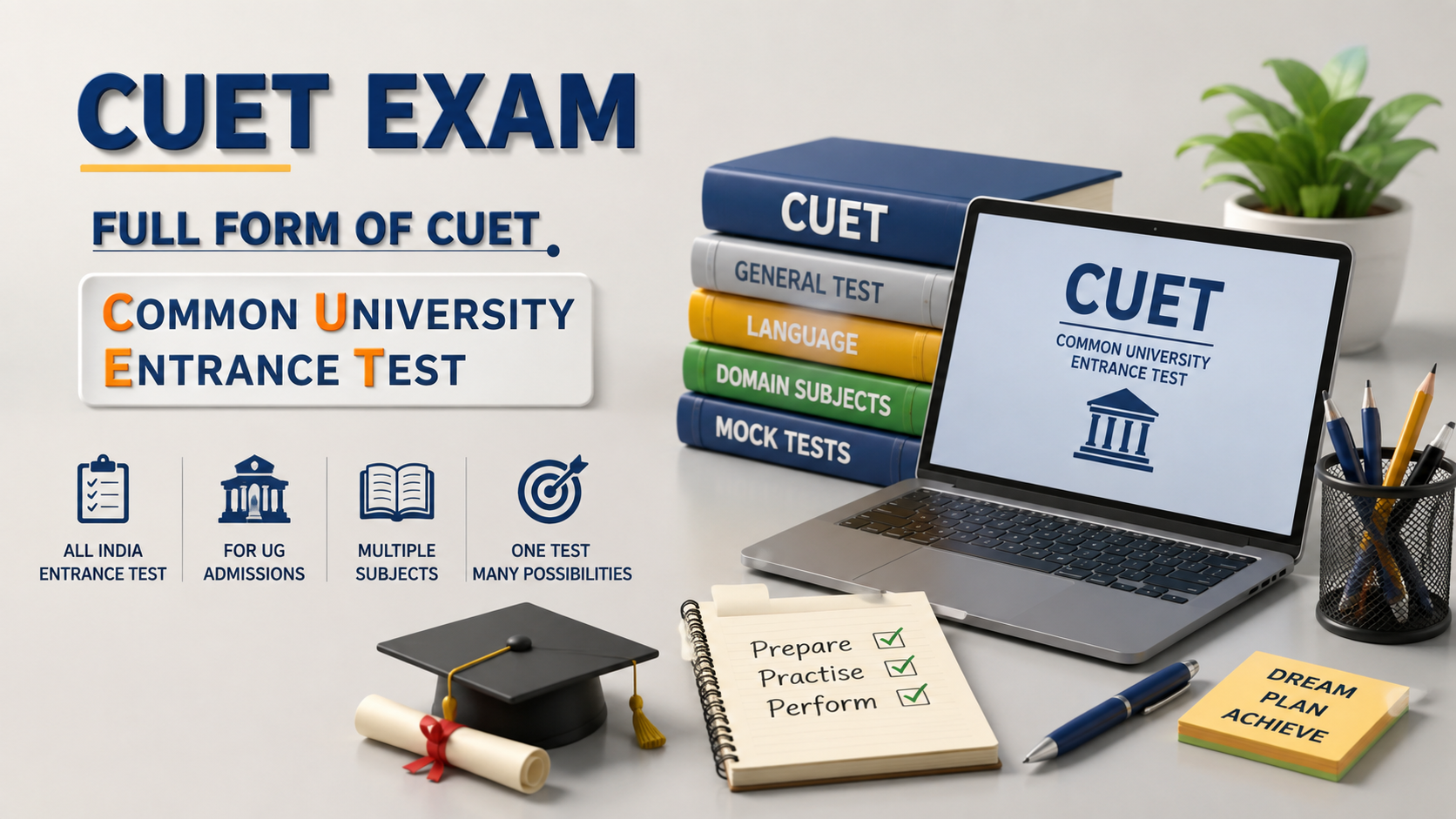
The CUET exam has become an important entrance route for students seeking admission to undergraduate programmes in participating universities across India. For students preparing after Class 12, understanding the full form of CUET, exam structure, eligibility, subjects, and preparation strategy can make the admission journey much easier. CUET provides a common platform where students can compete for university admission through a standardized entrance process rather than depending only on board examination marks. However, successful preparation requires more than simply studying textbooks. Students need to understand the syllabus, question format, subject selection, time management, and university-specific admission rules. This guide explains the CUET exam in a simple, practical, and student-focused way.
What Is the Full Form of CUET?
The full form of CUET is Common University Entrance Test.
CUET is an entrance examination designed for admission to undergraduate and other eligible programmes offered by participating universities and institutions.
The main purpose of the examination is to create a common assessment platform for students from different education boards.
Why Was CUET Introduced?
Students across India study under different state boards, national boards, and academic systems. Marking patterns may vary significantly.
A common entrance examination can provide universities with an additional standardized method for evaluating applicants.
CUET Focuses on Common Assessment
The examination aims to evaluate students through subject knowledge, language ability, reasoning, and other relevant areas depending on the chosen programme and university requirements.
What Is the CUET Exam?
The CUET exam is a competitive entrance test through which students can apply to participating universities.
Students usually select subjects according to:
-
Their Class 12 academic background
-
Desired undergraduate course
-
University eligibility requirements
-
Programme-specific subject combinations
Students should always check the latest official admission requirements before selecting their subjects.
CUET Exam Structure Explained
The examination generally includes different areas based on languages, domain subjects, and aptitude-related sections.
| Section | Main Focus | Student Requirement |
|---|---|---|
| Language | Reading and language ability | Based on programme requirements |
| Domain Subjects | Academic subject knowledge | Choose relevant subjects |
| General/Aptitude Area | Reasoning and general ability | Required for selected programmes |
| Admission Stage | Score-based university process | Depends on university rules |
The exact combination required can vary by course and university.
Why Is the CUET Exam Important?
The growing importance of the CUET exam comes from its role in simplifying admission applications for students targeting multiple participating institutions.
Instead of preparing independently for several different entrance patterns, students may be able to use CUET scores for multiple eligible universities.
Major Benefits of CUET
Key advantages include:
-
A common entrance platform.
-
Wider university choices.
-
Standardized academic assessment.
-
Opportunity to demonstrate subject knowledge.
-
Greater focus on entrance performance.
-
Easier application planning for multiple institutions.
CUET does not remove the importance of Class 12 studies. Strong school-level understanding remains valuable because many domain questions are based on academic subjects studied during senior secondary education.
CUET Eligibility: What Students Should Know
Eligibility for the CUET exam and eligibility for university admission are related but not always identical.
A student may be eligible to appear for the examination but still need to satisfy programme-specific requirements of a university.
Important Eligibility Factors
Students should verify:
-
Required Class 12 qualification
-
Mandatory subjects
-
Minimum marks, if applicable
-
Course-specific criteria
-
University-specific requirements
-
Category-related admission provisions
University Rules Matter
Students should not assume that one subject combination works for every university.
Before submitting an application, compare the requirements of all preferred institutions carefully.
How to Choose CUET Subjects
Choosing the right subjects is one of the most important decisions in CUET preparation.
A student interested in a commerce programme may need a different combination from someone applying for science, humanities, management, or language-based courses.
A practical selection process is:
-
Shortlist preferred courses.
-
Identify target universities.
-
Check subject requirements.
-
Compare requirements across universities.
-
Select subjects that keep maximum suitable options available.
Correct subject selection can prevent admission problems later.
How to Prepare for the CUET Exam
Preparation for the CUET exam should begin with understanding the syllabus rather than immediately solving random questions.
Students need a structured plan that balances conceptual learning and practice.
Build Strong Subject Knowledge
Start with the core concepts of your selected domain subjects.
Focus on:
-
Important chapters
-
Definitions
-
Concepts and formulas
-
Application-based questions
-
Frequently confused topics
-
Revision notes
Practice Questions Regularly
Practice improves both accuracy and speed.
Use mock tests and topic-wise questions to identify weak areas.
Analyze Mistakes
After every practice session, ask:
-
Why was the answer incorrect?
-
Was the concept unclear?
-
Did I misread the question?
-
Did I spend too much time?
-
Was it a calculation error?
Mistake analysis can be more useful than simply attempting more questions.
Effective CUET Study Strategy
A balanced study routine should include learning, revision, testing, and performance analysis.
A simple daily structure can include:
-
Concept learning
-
Short revision
-
Practice questions
-
Language or reasoning practice
-
Error review
-
Mock-test analysis
Avoid studying only your strongest subjects. Improvement usually comes from consistently addressing weaker areas.
Common CUET Preparation Mistakes
Students preparing for the CUET exam often lose marks because of planning mistakes rather than lack of knowledge.
Common mistakes include:
-
Ignoring official requirements
-
Selecting incorrect subject combinations
-
Starting mock tests too late
-
Memorizing without understanding
-
Neglecting revision
-
Spending excessive time on one subject
-
Ignoring time management
-
Applying to too few universities
A clear admission plan should run alongside exam preparation.
CUET Exam vs Board Exams
| Factor | CUET Exam | Board Examination |
|---|---|---|
| Purpose | University entrance | School qualification |
| Competition | National applicant pool | School-board assessment |
| Preparation | Speed and objective practice | Detailed academic study |
| Outcome | Admission score | Class 12 result |
| Focus | Entrance performance | Academic performance |
Both are important, but their preparation approaches can differ.
Frequently Asked Questions About CUET
1. What is the full form of CUET?
The full form of CUET is Common University Entrance Test.
2. What is the CUET exam used for?
It is used for admission to eligible programmes at participating universities and institutions.
3. Who can appear for CUET?
Students who meet the applicable examination and university eligibility requirements can apply.
4. Is CUET only for undergraduate admission?
CUET is commonly associated with undergraduate admissions, although candidates should check the relevant official examination category.
5. Is Class 12 preparation useful for CUET?
Yes. Strong understanding of senior secondary subjects can support preparation for domain-based sections.
6. Is CUET difficult?
Difficulty depends on preparation, subject knowledge, competition, and time management.
7. How should I start CUET preparation?
Start by understanding your target course requirements, syllabus, exam structure, and required subjects.
8. Are mock tests important for CUET?
Yes. Mock tests help improve speed, accuracy, confidence, and exam strategy.
9. Can one CUET score be used for multiple universities?
Students can use their score for eligible participating universities according to their respective admission processes.
10. How can I improve my CUET score?
Focus on conceptual clarity, regular revision, practice questions, timed tests, and careful analysis of mistakes.
- Technology for Students
- Admissions & Applications
- Online Courses
- Career and Jobs
- Campus Life
- Drinks
- Film
- Fitness
- Food
- Игры
- Gardening
- Health
- Главная
- Literature
- Music
- Networking For Students
- Insights
- Party
- Religion
- Shopping
- Sports
- Theater
- Wellness
- Education News
- Business & Finance For Students
- Security, Law & Crime Education
- Insurance
- Science & Technology For Students
 Russian
 English
 Arabic
 French
 Spanish
 Portuguese
 Deutsch
 Turkish
 Dutch
Dutch
 Italiano
 Romaian
 Portuguese (Brazil)
 Greek
Greek