


Precipitated Barium Sulfate and Barium Sulfate Powder: Uses, Benefits, and Selection Guide
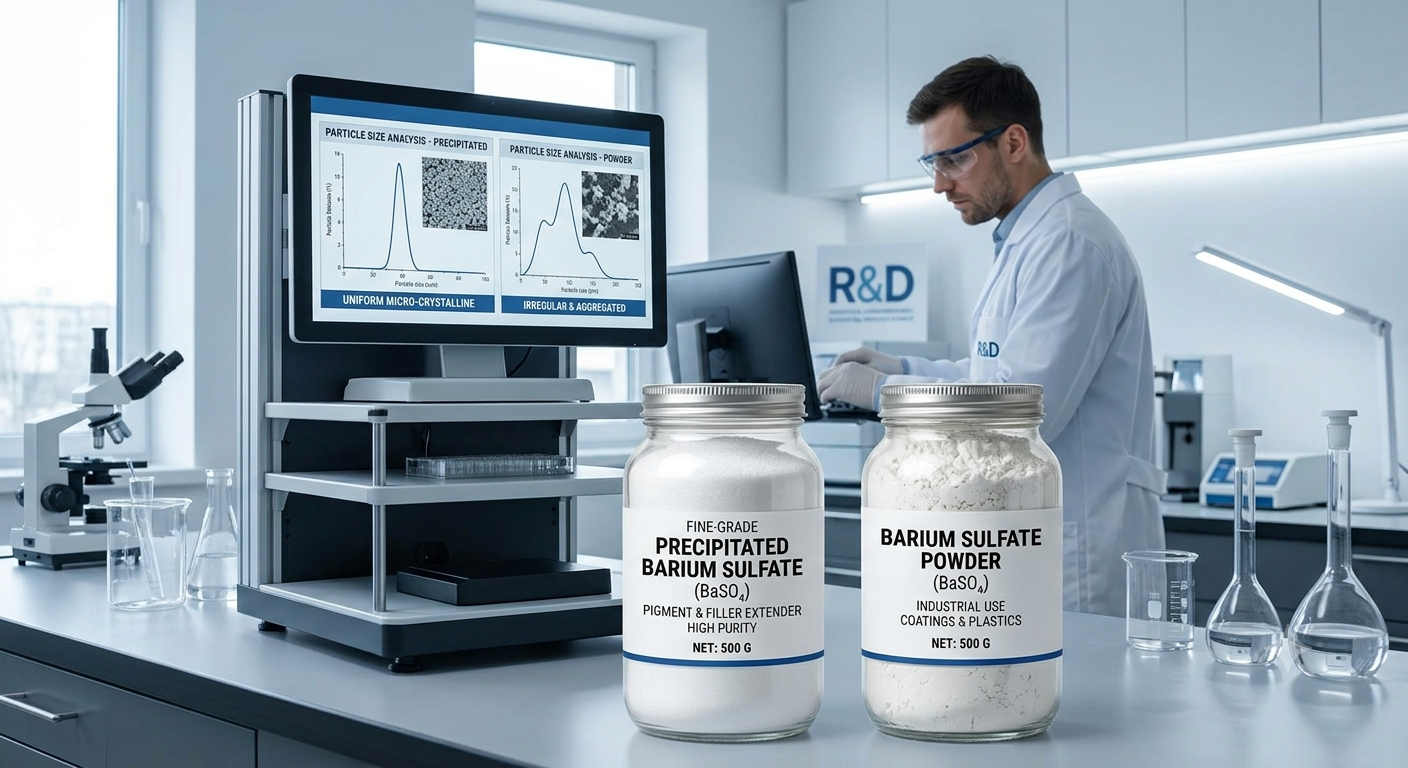
Industrial materials often determine the performance, appearance, durability, and processing efficiency of finished products. Among the mineral-based functional materials widely used across coatings, plastics, rubber, inks, and other manufacturing applications, Precipitated Barium Sulfate and Barium Sulfate Powder hold an important position.
Although both materials are based on barium sulfate, differences in production method, particle characteristics, purity, and surface properties can influence how they perform in specific formulations. Manufacturers therefore need to understand not only what these materials are, but also how to select the appropriate grade.
This guide explains their properties, applications, benefits, differences, quality factors, and future relevance in modern industrial production.
What Is Precipitated Barium Sulfate?
Precipitated Barium Sulfate is a synthetically produced form of barium sulfate manufactured through a controlled chemical precipitation process. Its production method makes it possible to achieve relatively consistent particle characteristics, purity, whiteness, and controlled physical properties.
The material is commonly valued as a functional filler or extender in industries where surface quality, chemical stability, and processing consistency are important.
Unlike naturally mined mineral products, precipitated grades can be manufactured under controlled processing conditions. This helps producers tailor material characteristics for particular industrial requirements.
What Is Barium Sulfate Powder?
Barium Sulfate Powder is a fine, dense, chemically stable inorganic material based on the compound BaSO₄. Depending on the manufacturing route, it may be supplied as natural barite-based powder or as a highly refined synthetic product.
Its useful characteristics include good chemical resistance, relatively high density, low solubility in water, and suitability as a filler in numerous industrial formulations.
Barium Sulfate Powder may be used to modify properties such as density, surface finish, dimensional stability, processing behavior, and overall formulation cost.
Key Properties of Barium Sulfate Materials
The effectiveness of Precipitated Barium Sulfate depends on the grade selected and how well its properties match the final application.
Important characteristics may include:
-
Controlled particle size
-
High chemical stability
-
Good weather resistance
-
Low moisture sensitivity
-
Strong compatibility with suitable formulations
-
Good whiteness in selected grades
-
High density compared with many common fillers
-
Stable performance under normal processing conditions
These properties make Barium Sulfate Powder suitable for both performance-oriented and cost-conscious industrial formulations.
Precipitated Barium Sulfate vs Standard Barium Sulfate Powder
The choice between these materials depends largely on manufacturing requirements.
| Factor | Precipitated Barium Sulfate | Barium Sulfate Powder |
|---|---|---|
| Production | Chemical precipitation | Natural processing or synthetic production |
| Particle Control | Generally more controlled | Depends on grade and processing |
| Purity | Often high | Varies according to source |
| Whiteness | Can be highly consistent | Grade dependent |
| Surface Performance | Suitable for demanding formulations | Suitable for general and specialized uses |
| Typical Applications | Premium coatings, plastics, inks | Paints, plastics, rubber, industrial products |
Neither option is universally better. Performance depends on formulation requirements, processing technology, quality expectations, and budget.
Applications in Paints and Coatings
One of the major application areas for Precipitated Barium Sulfate is the coatings industry.
It can function as an extender and functional filler in selected paint systems. Manufacturers may use it to support surface smoothness, coating consistency, hardness, and dimensional stability.
Potential applications include:
-
Industrial coatings
-
Automotive-related coatings
-
Powder coatings
-
Protective finishes
-
Decorative coating formulations
The correct grade should be selected according to binder system, pigment combination, particle-size requirement, and desired finish.
Applications in Plastics
Barium Sulfate Powder is also used in plastic manufacturing where controlled filler characteristics are needed.
Depending on the formulation, it can help increase density, improve dimensional stability, support surface appearance, and modify processing characteristics.
Common applications may include engineered plastic parts, masterbatches, household products, industrial components, and specialty polymer formulations.
Importance of Particle Size
Particle size can significantly influence dispersion and surface quality.
Finer Precipitated Barium Sulfate grades may be preferred when manufacturers require smoother surfaces and controlled appearance, while other grades may suit general filling or density-adjustment requirements.
Use in Rubber Manufacturing
Rubber formulations frequently require fillers that provide stable performance without undesirable chemical interactions.
Barium Sulfate Powder can be incorporated into selected rubber compounds to influence density, processing characteristics, dimensional properties, and production economics.
Manufacturers should evaluate compatibility with the polymer system, curing process, additives, and final performance requirements before selecting a grade.
Printing Inks and Pigment Systems
Controlled particle characteristics make Precipitated Barium Sulfate useful in selected ink and pigment formulations.
It may support:
-
Smooth dispersion
-
Consistent printing behavior
-
Controlled gloss
-
Surface uniformity
-
Pigment distribution
For high-quality applications, consistent raw material specifications become particularly important because variations in particle size or impurities can influence finished-product performance.
Benefits for Industrial Manufacturers
Using an appropriate Barium Sulfate Powder grade can provide several manufacturing advantages.
Formulation Stability
Its chemical stability makes barium sulfate suitable for a wide variety of industrial systems.
Surface Quality
Selected grades can support smoother, more uniform finished surfaces.
Density Modification
Because barium sulfate has comparatively high density, it can be useful where manufacturers need to adjust product weight or density.
Production Consistency
Reliable Precipitated Barium Sulfate specifications can help manufacturers maintain repeatable formulation behavior between production batches.
Cost and Performance Balance
A well-designed formulation should not simply use the most expensive material. The goal is to select the grade that provides the necessary performance without introducing unnecessary manufacturing cost.
Quality Factors to Consider Before Buying
Industrial buyers should evaluate more than just price when sourcing Barium Sulfate Powder.
Important selection factors include:
-
Particle-size distribution
-
Purity level
-
Whiteness
-
Moisture content
-
Oil absorption
-
Density
-
Chemical stability
-
Dispersion behavior
-
Batch consistency
-
Packaging and storage requirements
The required specifications depend on the final application. A coating manufacturer may prioritize whiteness and dispersion, while another industry may focus more heavily on density or particle-size consistency.
Safe Handling and Storage
Although Precipitated Barium Sulfate is used extensively in industrial environments, appropriate workplace controls should always be followed.
Powder handling can generate airborne dust. Facilities should therefore use proper ventilation, appropriate personal protective equipment, clean handling practices, and suitable storage procedures according to the supplier's safety documentation and applicable workplace requirements.
Materials should generally be stored in dry conditions and protected from contamination.
Sustainability and Manufacturing Efficiency
Modern manufacturers increasingly evaluate raw materials based on processing efficiency as well as technical performance.
Better dispersion, controlled particle size, optimized formulation design, and accurate dosing can reduce unnecessary material consumption and improve manufacturing consistency.
Selecting a suitable Barium Sulfate Powder grade can also reduce reprocessing caused by poor dispersion or inconsistent surface appearance.
Responsible sourcing, efficient packaging, production optimization, and waste reduction are becoming more important throughout industrial supply chains.
Future of Precipitated Barium Sulfate
Demand for consistent functional fillers is likely to remain closely connected to developments in coatings, polymers, electronics, transportation, construction materials, and advanced manufacturing.
Future grades of Precipitated Barium Sulfate may increasingly focus on tighter particle control, improved dispersion, enhanced surface treatment, and application-specific performance.
As manufacturers seek greater consistency from raw materials, technical cooperation between suppliers and product developers will become increasingly valuable.
Frequently Asked Questions
1. What is Precipitated Barium Sulfate?
Precipitated Barium Sulfate is a synthetic barium sulfate produced through controlled chemical precipitation for industrial applications requiring consistent properties.
2. What is Barium Sulfate Powder used for?
Barium Sulfate Powder is commonly used in paints, coatings, plastics, rubber, inks, and various industrial formulations.
3. Is precipitated barium sulfate different from natural barite?
Yes. Precipitated material is chemically manufactured, while natural barite originates from mineral deposits and is processed mechanically.
4. Why is particle size important?
Particle size affects dispersion, surface smoothness, processing behavior, and finished-product appearance.
5. Can barium sulfate be used in plastic products?
Yes. Suitable grades are used as functional fillers in various polymer and plastic formulations.
6. Is barium sulfate suitable for coatings?
Yes. It is widely used in selected coatings where stability, surface quality, and formulation performance are important.
7. What determines the quality of barium sulfate powder?
Purity, particle size, whiteness, moisture, density, dispersion, and batch consistency are important quality factors.
8. How should barium sulfate powder be stored?
It should generally be kept in sealed packaging in a clean, dry environment according to supplier recommendations.
9. How do manufacturers choose the correct grade?
Selection should be based on application requirements, material compatibility, processing conditions, desired performance, and cost.
10. Is precipitated barium sulfate suitable for high-quality formulations?
Yes. Controlled Precipitated Barium Sulfate grades are often selected when manufacturers require consistent particle characteristics and refined surface performance.
- Technology for Students
- Admissions & Applications
- Online Courses
- Career and Jobs
- Campus Life
- Drinks
- Film
- Fitness
- Food
- Oyunlar
- Gardening
- Health
- Home
- Literature
- Music
- Networking For Students
- Insights
- Party
- Religion
- Shopping
- Sports
- Theater
- Wellness
- Education News
- Business & Finance For Students
- Security, Law & Crime Education
- Insurance
- Science & Technology For Students
 Turkish
 English
 Arabic
 French
 Spanish
 Portuguese
 Deutsch
 Dutch
Dutch
 Italiano
 Russian
 Romaian
 Portuguese (Brazil)
 Greek
Greek