


DNA Synthesis Services and Custom Oligo Synthesis for Precision Research Applications
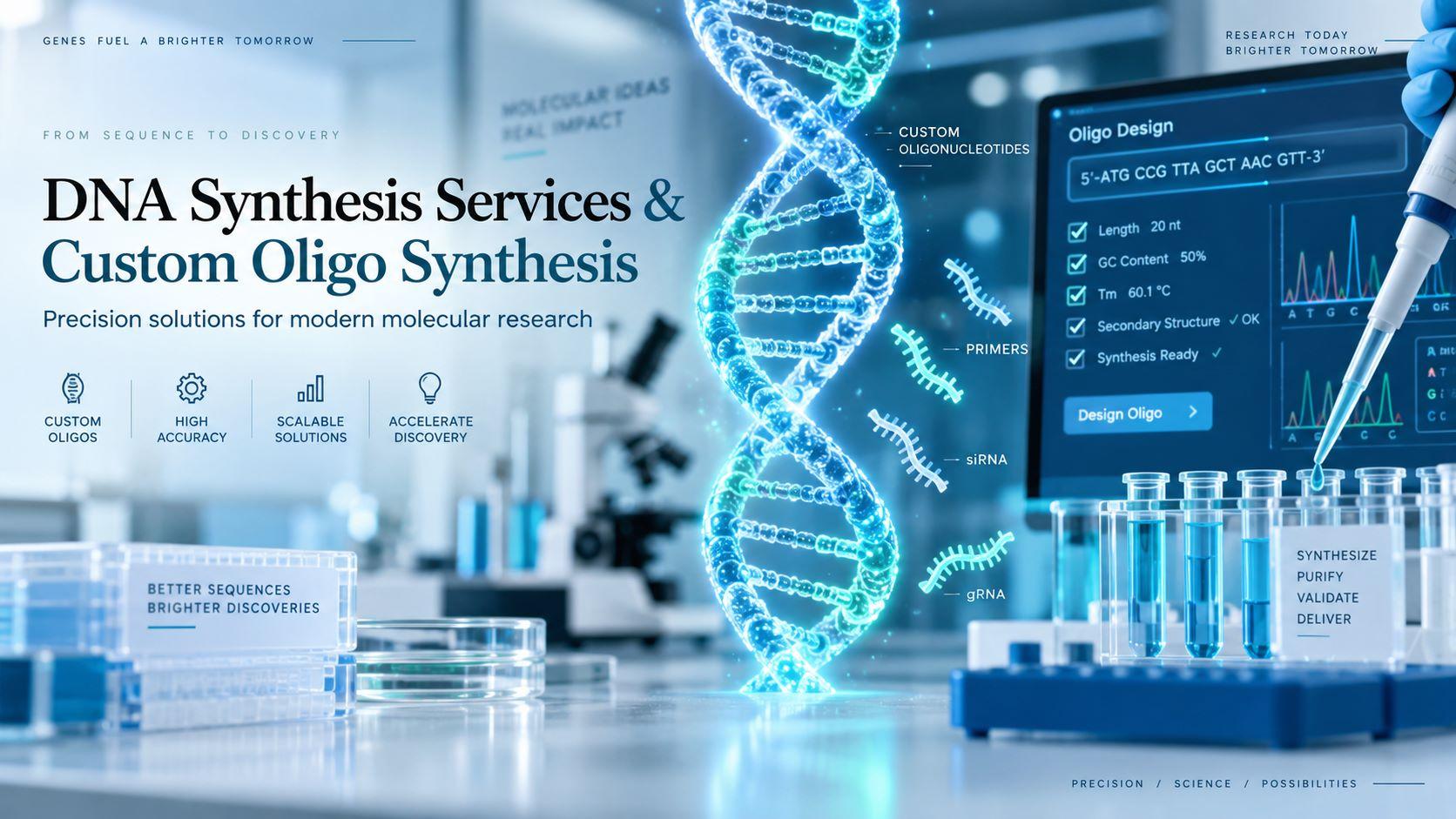
Researchers working in molecular biology, diagnostics, genomics, synthetic biology, and life science development increasingly rely on DNA synthesis services and custom oligo synthesis to obtain sequences designed for specific experimental goals.
Instead of preparing every nucleotide sequence manually, laboratories can order customized DNA fragments and oligonucleotides according to required length, purity, sequence composition, modifications, and scale. This approach can simplify experimental preparation while supporting consistency across different research workflows.
Understanding the differences between DNA synthesis services and custom oligo synthesis, their applications, quality considerations, and selection criteria can help research teams choose an appropriate solution for demanding molecular biology projects.
What Are DNA Synthesis Services?
DNA synthesis services provide artificially created DNA sequences based on a researcher’s specified nucleotide design. Rather than isolating a desired sequence from a natural biological source, DNA can be chemically or enzymatically synthesized according to a digital sequence.
These services can support research involving genes, DNA fragments, constructs, templates, and specialized sequences.
Common applications include:
-
Synthetic biology research
-
Gene construction
-
Molecular cloning
-
Assay development
-
Genetic engineering research
-
Functional genomics
-
Diagnostic research
-
Protein expression studies
The appropriate synthesis method depends on sequence length, complexity, downstream application, and required quality.
Understanding Custom Oligo Synthesis
Custom oligo synthesis focuses on producing short nucleotide sequences designed according to individual research requirements.
Oligonucleotides are widely used as primers, probes, adapters, sequencing components, and molecular biology reagents.
Researchers can often specify characteristics such as:
-
DNA or RNA sequence
-
Sequence length
-
Purification level
-
Synthesis scale
-
Fluorescent labels
-
Chemical modifications
-
Terminal modifications
-
Special functional groups
This flexibility makes custom oligo synthesis useful across many laboratory and research applications.
DNA Synthesis Services vs Custom Oligo Synthesis
Although these terms are related, they generally serve different requirements.
| Feature | DNA Synthesis Services | Custom Oligo Synthesis |
|---|---|---|
| Typical Product | Longer DNA sequences | Short oligonucleotides |
| Common Use | Gene and DNA fragment creation | Primers and probes |
| Customization | Sequence and construct design | Sequence and chemical modifications |
| Applications | Synthetic biology, cloning | PCR, sequencing, assays |
| Complexity | Often higher | Usually shorter sequences |
| Purification | Depends on application | Multiple purification options |
Both technologies can complement each other within the same research project.
Why Researchers Use Synthetic DNA Solutions
Modern molecular biology frequently requires highly specific sequences that may be difficult or inconvenient to obtain naturally.
Greater Design Flexibility
Researchers can create sequences according to experimental objectives rather than depending solely on naturally available DNA.
Improved Workflow Efficiency
Ordering pre-designed sequences may reduce several preparation steps in laboratory workflows.
Consistent Experimental Material
Professional synthesis processes can provide standardized material when multiple experiments require the same sequence.
Support for Specialized Research
Custom sequences can be designed for applications involving mutations, sequence optimization, labeling, or specialized molecular analysis.
Key Applications of DNA Synthesis Services
DNA synthesis services support a broad range of biotechnology and life science research areas.
Synthetic Biology
Synthetic DNA allows researchers to design biological components and study how engineered sequences function in controlled experimental systems.
Gene Research
Researchers may use synthesized genes for expression studies, functional analysis, cloning, and related laboratory investigations.
Molecular Diagnostics Research
Designed DNA sequences can support development and evaluation of molecular detection methods.
Genomics Research
Synthetic sequences can be used as controls, standards, reference materials, or experimental components in genomic workflows.
Research and Development
DNA synthesis can also support early-stage development where multiple sequence variants must be evaluated before selecting a final design.
Common Uses of Custom Oligo Synthesis
Custom oligo synthesis is widely used because oligonucleotides are fundamental components of many molecular biology techniques.
Important applications include:
-
PCR primers
-
Quantitative PCR probes
-
DNA sequencing
-
Gene assembly
-
Hybridization studies
-
Molecular diagnostics research
-
Mutation analysis
-
Nucleic acid detection
-
Cloning workflows
-
Genomic research
The exact oligonucleotide design should always match the intended laboratory method.
Quality Factors That Matter
Reliable synthesis is not only about producing the correct sequence. Quality control can significantly influence downstream experimental performance.
Researchers should consider several factors when evaluating DNA synthesis services or custom oligo synthesis.
Sequence Accuracy
Correct nucleotide composition is essential because sequence errors can affect amplification, binding, expression, or other experimental outcomes.
Purity
Different applications require different purification levels. Routine experiments may have different requirements from sensitive analytical workflows.
Verification
Depending on the product and application, suppliers may use analytical methods to confirm identity, purity, or sequence characteristics.
Documentation
Clear specifications and quality documentation can help researchers maintain reproducible laboratory records.
How to Choose the Right Synthesis Service
Selecting a provider should involve more than simply comparing prices.
Consider the following factors:
-
Required sequence length
-
Desired synthesis scale
-
Purification options
-
Modification capabilities
-
Quality control processes
-
Technical support
-
Packaging requirements
-
Application compatibility
-
Sequence complexity
-
Turnaround requirements
For custom oligo synthesis, modification options may be particularly important when designing probes or specialized analytical sequences.
For longer DNA projects, sequence complexity and verification methods may become more significant.
Technology Behind Modern DNA Synthesis
DNA synthesis technology continues to evolve alongside advances in genomics and biotechnology.
Traditional oligonucleotide production commonly relies on controlled chemical synthesis cycles in which nucleotides are added sequentially.
Longer synthetic DNA sequences may involve assembling shorter fragments into larger constructs.
Software also plays an increasingly important role by helping researchers evaluate sequence design, identify potential synthesis challenges, and prepare digital sequence information for manufacturing.
Automation has improved throughput while reducing repetitive manual steps.
Challenges in DNA and Oligo Synthesis
Despite major technological progress, synthesis can still become difficult when sequences contain challenging structural characteristics.
Potential issues include:
-
Extreme GC content
-
Repetitive regions
-
Secondary structure
-
Long homopolymer regions
-
Complex modifications
-
Difficult sequence combinations
Experienced providers typically evaluate sequence characteristics before production and may recommend design adjustments where appropriate.
Future of DNA Synthesis Technology
The future of DNA synthesis services is closely connected with advances in synthetic biology, automation, bioinformatics, and high-throughput research.
Researchers increasingly require faster access to customized genetic material for testing multiple designs.
Improved synthesis platforms may continue to increase throughput, sequence flexibility, and manufacturing efficiency.
Meanwhile, custom oligo synthesis is likely to remain essential for PCR, sequencing, diagnostics research, genomic analysis, and emerging molecular technologies.
Greater integration between sequence design software and synthesis platforms may also make ordering and evaluating complex sequences more streamlined.
Frequently Asked Questions
1. What are DNA synthesis services?
They are professional services that create artificial DNA sequences according to specified nucleotide designs for research and biotechnology applications.
2. What is custom oligo synthesis?
Custom oligo synthesis involves producing short DNA or RNA sequences according to a researcher’s chosen sequence, scale, purity, and modifications.
3. What are synthetic oligonucleotides used for?
They are commonly used as PCR primers, probes, sequencing components, adapters, and other molecular biology reagents.
4. Are DNA synthesis and oligo synthesis the same?
Not exactly. Oligo synthesis generally focuses on shorter sequences, while DNA synthesis can involve longer fragments or complete genes.
5. Can oligonucleotides contain modifications?
Yes. Depending on the synthesis provider, oligos may include fluorescent labels, terminal modifications, or other chemical groups.
6. Why is purification important?
Purification helps remove unwanted synthesis-related components and can improve suitability for demanding downstream applications.
7. How do researchers select the correct oligo length?
Length depends on the intended application, target sequence, binding characteristics, and experimental design.
8. Can synthesized DNA be used for cloning research?
Yes. Synthetic DNA fragments and genes are commonly used in molecular cloning and related research workflows.
9. What makes a DNA sequence difficult to synthesize?
Highly repetitive regions, unusual GC content, secondary structures, and certain sequence patterns can increase synthesis complexity.
10. Why use professional DNA synthesis services?
Professional services provide access to specialized synthesis equipment, purification methods, quality control processes, and customization options.
- Technology for Students
- Admissions & Applications
- Online Courses
- Career and Jobs
- Campus Life
- Drinks
- Film
- Fitness
- Food
- Игры
- Gardening
- Health
- Главная
- Literature
- Music
- Networking For Students
- Insights
- Party
- Religion
- Shopping
- Sports
- Theater
- Wellness
- Education News
- Business & Finance For Students
- Security, Law & Crime Education
- Insurance
- Science & Technology For Students
 Russian
 English
 Arabic
 French
 Spanish
 Portuguese
 Deutsch
 Turkish
 Dutch
Dutch
 Italiano
 Romaian
 Portuguese (Brazil)
 Greek
Greek