


2,3-Dimethyl-2,3-Diphenylbutane and 1,2-Octanediol: Properties and Uses
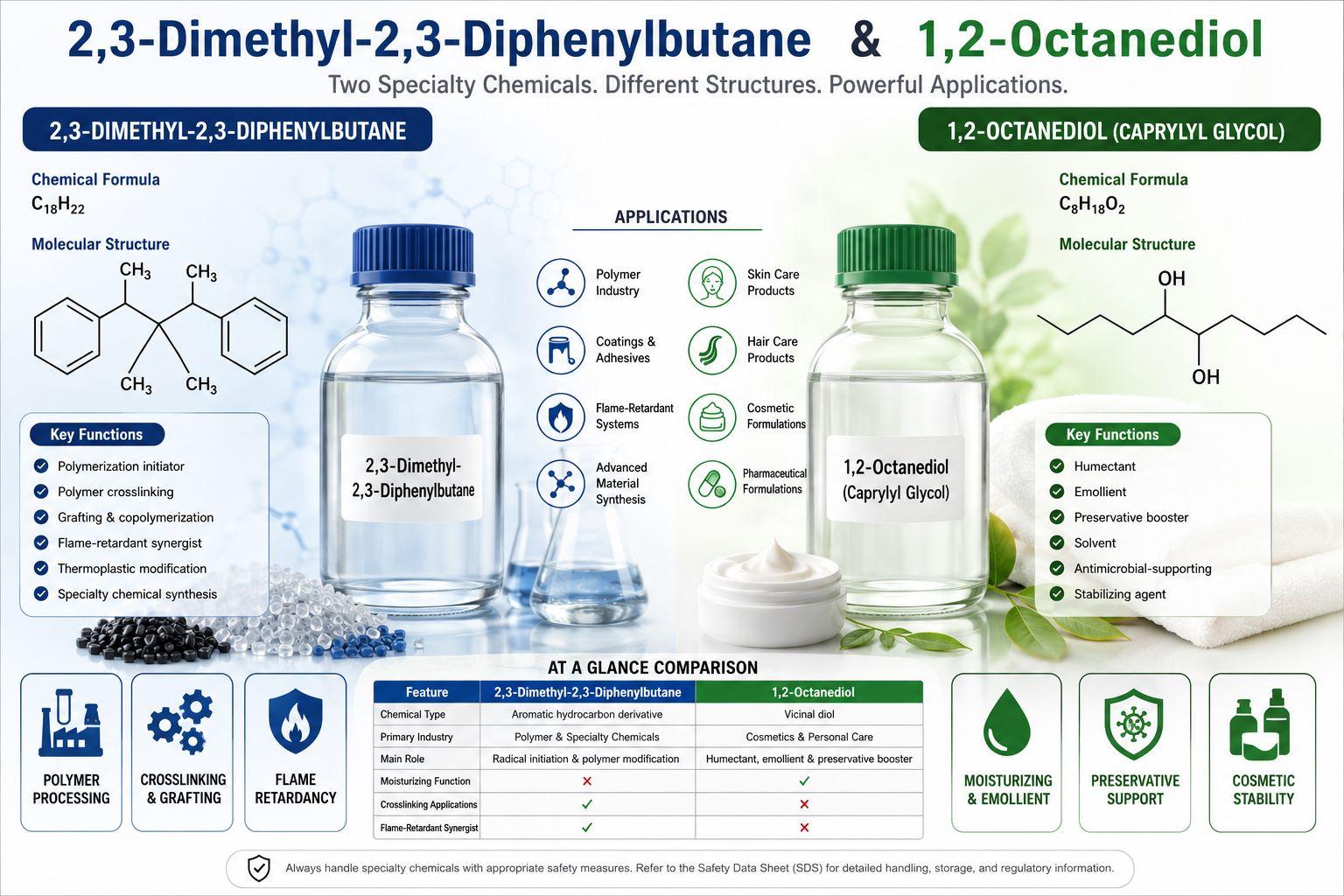
Specialty chemicals play an important role in modern materials, polymers, cosmetics, research, and industrial formulation. Two compounds with very different structures and functions are 2,3-dimethyl-2,3-diphenylbutane and 1,2-octanediol. Understanding their chemical characteristics, compatibility, applications, and handling requirements helps researchers and manufacturers select appropriate materials for specific formulations.
2,3-Dimethyl-2,3-diphenylbutane is an aromatic hydrocarbon associated mainly with polymer and specialty-material applications, while 1,2-octanediol is a glycol also known as caprylyl glycol and is widely recognized in cosmetic and formulation chemistry. Their different molecular structures give them distinct physical and functional behavior.
What Is 2,3-Dimethyl-2,3-Diphenylbutane?
2,3-dimethyl-2,3-diphenylbutane is an organic compound with the molecular formula C18H22 and a molecular weight of approximately 238.37 g/mol. Its CAS Registry Number is 1889-67-4. Commercial references describe it as a solid material, with available grades commonly supplied for laboratory, research, or industrial applications.
Its molecular structure contains two phenyl groups combined with a highly substituted hydrocarbon framework. This structure contributes to its hydrophobic character and differentiates it significantly from glycols such as 1,2-octanediol.
Important Chemical Characteristics
Commonly reported characteristics include:
-
Molecular formula: C18H22
-
Molecular weight: 238.37 g/mol
-
CAS number: 1889-67-4
-
Physical form: solid
-
Aromatic hydrocarbon structure
-
Low affinity for water
Reported commercial data describe the material as insoluble in water and available as crystalline powder, flakes, or chunks depending on grade and supplier.
Industrial Role of 2,3-Dimethyl-2,3-Diphenylbutane
The compound has attracted attention primarily within polymer chemistry and specialty materials.
Some commercial technical descriptions identify 2,3-dimethyl-2,3-diphenylbutane as a polymer additive and describe its use in systems involving polymer modification, crosslinking, grafting, or copolymerization. It has also been promoted as a synergistic additive in certain flame-retardant polymer formulations.
Polymer Modification
Polymer manufacturers continually seek additives that help control material performance during processing and end use. Depending on the polymer system, formulation, temperature, and processing conditions, specialty additives may influence:
-
Crosslinking behavior
-
Polymer modification
-
Thermal processing
-
Material compatibility
-
Final mechanical performance
The suitability of any additive must be validated experimentally for the specific polymer and application rather than assumed from its general chemical category.
Importance of Controlled Formulation
Concentration, processing temperature, polymer type, and interaction with other additives can influence results. Manufacturers should therefore use formulation testing, quality-control procedures, and supplier technical documentation before commercial production.
What Is 1,2-Octanediol?
1,2-octanediol is an eight-carbon diol with the molecular formula C8H18O2 and molecular weight of approximately 146.23 g/mol. Its CAS number is 1117-86-8. It is also widely known as caprylyl glycol or octane-1,2-diol.
Unlike 2,3-dimethyl-2,3-diphenylbutane, this molecule contains two hydroxyl groups. These functional groups strongly influence its formulation behavior and explain why the chemical belongs to the glycol family.
Applications of 1,2-Octanediol
One of the best-known areas of application for 1,2-octanediol is cosmetic and personal-care formulation. PubChem identifies caprylyl glycol within cosmetic ingredient classifications and lists functions including humectant, emollient, and hair-conditioning roles.
Cosmetic and Personal-Care Formulations
Depending on the complete formulation, 1,2-octanediol can contribute to desirable sensory and moisture-management properties.
Typical formulation categories may include:
-
Skin-care products
-
Hair-care formulations
-
Creams and lotions
-
Cosmetic emulsions
-
Personal-care systems
Its usefulness should always be assessed together with the product's other ingredients, intended use, regulatory requirements, and stability profile.
Formulation Performance
Diols are valuable because their hydroxyl functionality can influence interactions with other ingredients. In practical product development, formulators may evaluate 1,2-octanediol for characteristics such as compatibility, texture, moisture retention, stability, and overall formulation performance.
2,3-Dimethyl-2,3-Diphenylbutane vs 1,2-Octanediol
Although both are specialty organic chemicals, their chemistry and applications differ substantially.
| Feature | 2,3-Dimethyl-2,3-Diphenylbutane | 1,2-Octanediol |
|---|---|---|
| Formula | C18H22 | C8H18O2 |
| Molecular Weight | 238.37 g/mol | 146.23 g/mol |
| CAS Number | 1889-67-4 | 1117-86-8 |
| Chemical Type | Aromatic hydrocarbon | Diol/glycol |
| Key Functional Groups | Phenyl and alkyl groups | Two hydroxyl groups |
| Common Focus | Polymer/material applications | Cosmetic/formulation applications |
| Alternative Name | Dicumene | Caprylyl glycol |
The comparison shows why these substances cannot normally be considered interchangeable.
Quality, Purity, and Material Selection
Chemical quality can directly affect research reproducibility and manufacturing consistency. Buyers should review specifications rather than selecting chemicals by name alone.
Important considerations include:
-
Verified CAS number
-
Assay or purity
-
Certificate of Analysis
-
Storage instructions
-
Impurity profile
-
Packaging
-
Batch traceability
-
Safety Data Sheet
For industrial manufacturing, raw-material qualification should form part of a broader quality-management process.
Safety and Responsible Handling
Both chemicals should be handled according to supplier Safety Data Sheets and applicable workplace regulations.
Commercial safety information for 2,3-dimethyl-2,3-diphenylbutane includes warnings related to irritation or sensitization depending on the supplier classification. Appropriate protective equipment, controlled handling, and proper disposal procedures are therefore important.
For 1,2-octanediol, safety evaluation should similarly consider concentration, intended application, exposure route, and the complete formulation rather than relying only on the ingredient name.
Future Importance of Specialty Chemicals
Industries are increasingly looking for materials that combine performance with better manufacturing efficiency, consistent quality, and responsible chemical management.
Future development is likely to focus on more precise polymer-additive systems, optimized formulations, advanced analytical testing, improved traceability, and application-specific ingredient selection. Both 2,3-dimethyl-2,3-diphenylbutane and 1,2-octanediol illustrate how molecular structure determines practical industrial value.
Frequently Asked Questions
1. What is 2,3-dimethyl-2,3-diphenylbutane?
It is an aromatic organic compound with formula C18H22, commonly associated with research and polymer-related specialty applications.
2. What is the CAS number of 2,3-dimethyl-2,3-diphenylbutane?
Its CAS Registry Number is 1889-67-4.
3. What is 1,2-octanediol?
It is an eight-carbon diol containing two hydroxyl groups and is also known as caprylyl glycol.
4. What is the CAS number of 1,2-octanediol?
Its CAS number is 1117-86-8.
5. Is 1,2-octanediol used in cosmetics?
Yes. It is recognized in cosmetic ingredient information for functions including humectant and emollient uses.
6. Is 2,3-dimethyl-2,3-diphenylbutane a glycol?
No. It is a hydrocarbon and does not contain the hydroxyl groups characteristic of glycols.
7. Can these two chemicals replace each other?
Generally, no. Their molecular structures and typical functions are significantly different.
8. Why is chemical purity important?
Purity can affect formulation consistency, research reproducibility, product quality, and process performance.
9. What documents should chemical buyers request?
A Certificate of Analysis, Safety Data Sheet, product specification, and appropriate traceability documentation are important.
10. How should specialty chemicals be selected?
Selection should consider chemical identity, purity, compatibility, intended function, safety requirements, regulatory obligations, and actual application testing.
- Technology for Students
- Admissions & Applications
- Online Courses
- Career and Jobs
- Campus Life
- Drinks
- Film
- Fitness
- Food
- Jocuri
- Gardening
- Health
- Home
- Literature
- Music
- Networking For Students
- Insights
- Party
- Religion
- Shopping
- Sports
- Theater
- Wellness
- Education News
- Business & Finance For Students
- Security, Law & Crime Education
- Insurance
- Science & Technology For Students
 Romaian
 English
 Arabic
 French
 Spanish
 Portuguese
 Deutsch
 Turkish
 Dutch
Dutch
 Italiano
 Russian
 Portuguese (Brazil)
 Greek
Greek