


Vacuum Casting and Injection Molding Supplier for Modern Product Manufacturing
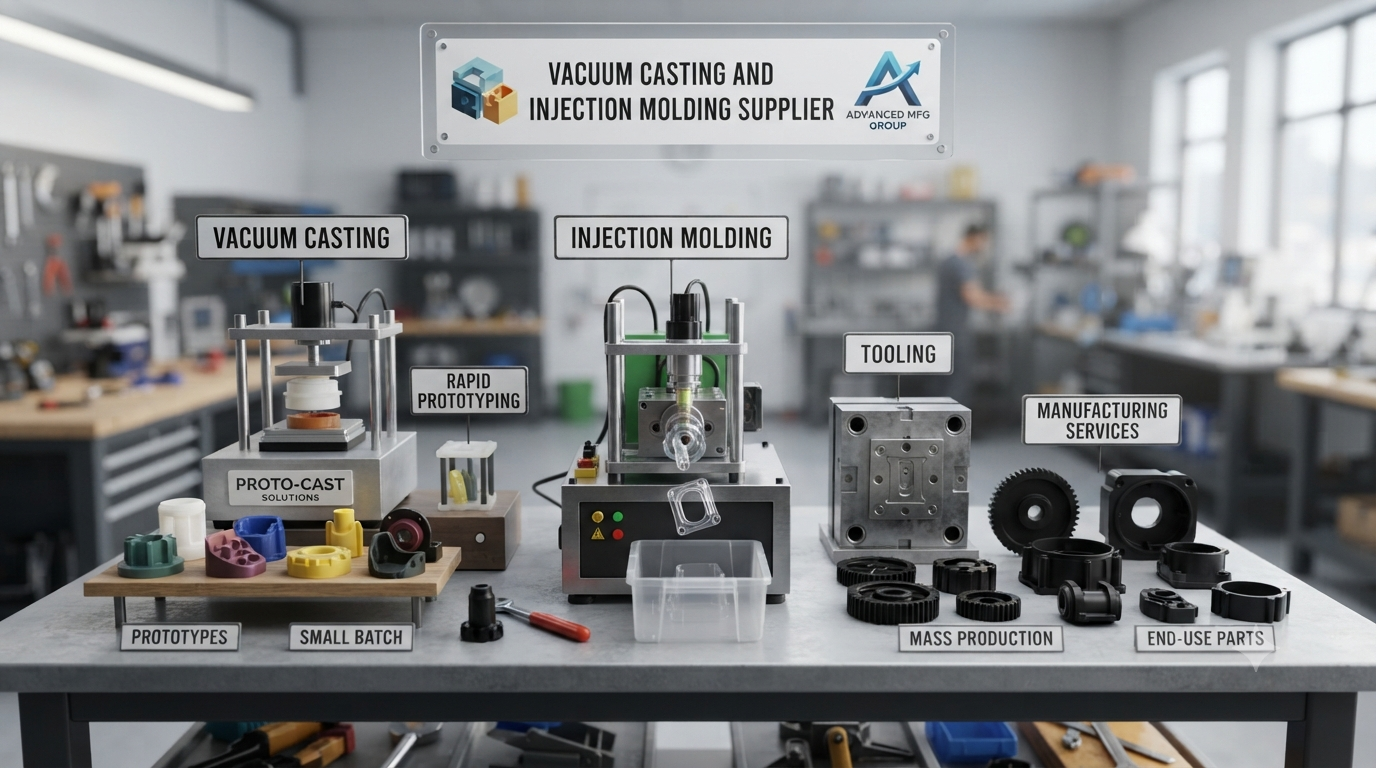
Turning a product idea into a reliable physical component requires the right manufacturing process and the right production partner. Vacuum casting and working with an experienced injection molding supplier are two popular solutions for companies developing plastic and polymer parts. Although both processes can create high-quality components, they serve different production requirements.
Vacuum casting is commonly selected for prototypes, design validation, presentation models, and low-volume parts. Injection molding is generally more suitable when production quantities increase and consistent repeatability becomes essential. Understanding the difference helps engineers, product developers, startups, and manufacturers select a process that balances cost, quality, lead time, material performance, and production volume.
What Is Vacuum Casting?
Vacuum casting is a manufacturing process used to reproduce plastic-like parts from a master model. A silicone mold is created around the master pattern, and liquid polyurethane or another casting material is poured into the mold under vacuum conditions.
The vacuum helps minimize trapped air and improves the reproduction of fine surface details.
The basic process includes:
-
Creating an accurate master model.
-
Building a silicone mold around the master.
-
Cutting the cured mold carefully.
-
Preparing the selected casting resin.
-
Casting material inside the mold under vacuum.
-
Allowing the component to cure.
-
Removing and finishing the final part.
This process is especially practical when businesses need a limited number of realistic prototypes without investing immediately in expensive production tooling.
Why Vacuum Casting Is Popular for Product Development
One of the strongest advantages of vacuum casting is flexibility. Manufacturers can produce relatively small quantities while maintaining good visual appearance and functional performance.
Suitable for Low-Volume Production
Silicone tooling can be quicker and less expensive to prepare than traditional metal injection molds. This makes the method useful for product testing, exhibitions, customer demonstrations, engineering trials, and initial market validation.
Good Surface Quality
The process can reproduce textures, fine details, and complex external features from a well-prepared master model.
Multiple Material Characteristics
Casting resins can simulate different properties, including rigid plastics, flexible rubber-like materials, transparent components, and heat-resistant applications.
Useful Before Tooling Investment
Product teams can evaluate a design physically before committing to production tooling, reducing the risk of expensive design modifications later.
What Does an Injection Molding Supplier Do?
An experienced injection molding supplier supports manufacturers in producing repeatable plastic components using injection molding technology.
In this process, plastic material is heated until it becomes flowable and then injected under pressure into a precision mold. Once cooled, the molded component is released and the cycle begins again.
A professional supplier may assist with:
-
Design for Manufacturing reviews
-
Mold design and engineering
-
Material recommendations
-
Prototype tooling
-
Production tooling
-
Plastic injection molding
-
Surface finishing
-
Assembly support
-
Dimensional inspection
-
Quality control
Choosing the right injection molding supplier is therefore about more than selecting a factory. Engineering knowledge and process control can have a major impact on final product quality.
Vacuum Casting vs Injection Molding
Both processes have important roles in product development and manufacturing.
| Factor | Vacuum Casting | Injection Molding |
|---|---|---|
| Typical Quantity | Low volume | Medium to high volume |
| Tooling | Silicone mold | Metal mold |
| Initial Investment | Generally lower | Generally higher |
| Production Speed | Suitable for small batches | Efficient for repeated production |
| Material | Casting resins | Production thermoplastics |
| Design Changes | Easier during development | More costly after tooling |
| Best Application | Prototypes and short runs | Scalable manufacturing |
The ideal choice depends on the expected quantity, material requirements, component geometry, tolerances, timeline, and budget.
When Should You Choose Vacuum Casting?
Vacuum casting can be a practical choice when product quantity is limited or when the design is still evolving.
Common applications include:
-
Functional prototype housings
-
Consumer electronics models
-
Automotive development parts
-
Medical equipment prototypes
-
Display models
-
Custom components
-
Pre-production samples
-
Product testing units
It can also bridge the gap between a single prototype and full-scale manufacturing.
When Should You Choose Injection Molding?
Injection molding becomes attractive when manufacturers need larger quantities with repeatable dimensions and production-grade thermoplastics.
A reliable injection molding supplier can help determine whether a design is ready for tooling by reviewing wall thickness, ribs, bosses, draft angles, undercuts, gate positions, shrinkage, and ejection requirements.
Injection molding may be preferred when:
-
Production quantities are increasing.
-
Consistent repeatability is essential.
-
Specific thermoplastics are required.
-
Unit cost becomes increasingly important.
-
Long-term production is planned.
How to Select the Right Manufacturing Supplier
Supplier selection can significantly influence quality, delivery reliability, and overall project success.
Consider the following factors:
Engineering Experience
A capable supplier should identify potential manufacturing problems before tooling or production begins.
Material Knowledge
Different polymers behave differently during casting and molding. The supplier should understand mechanical strength, flexibility, temperature resistance, appearance, shrinkage, and application requirements.
Quality Management
Ask how dimensions, appearance, material consistency, and manufacturing processes are inspected and controlled.
Communication
A dependable injection molding supplier should communicate clearly about tooling, design modifications, production schedules, and technical limitations.
Design Considerations for Better Parts
Good manufacturing begins with good design.
For vacuum casting, designers should consider master pattern quality, parting lines, thin features, internal geometries, and finishing requirements.
For injection molding, important considerations include:
-
Uniform wall thickness
-
Suitable draft angles
-
Controlled undercuts
-
Proper rib dimensions
-
Practical tolerances
-
Gate placement
-
Ejection strategy
-
Material shrinkage
Design for Manufacturing Matters
Design for Manufacturing, commonly known as DFM, helps identify features that may increase production difficulty, cost, or quality risk.
Avoid Unnecessary Complexity
A simpler, well-engineered design can often provide better manufacturing consistency than a highly complicated component with features that do not improve functionality.
Technology and Quality in Modern Manufacturing
Digital manufacturing technologies are improving both processes. CAD software, CNC machining, 3D printing, mold-flow analysis, automated inspection, and digital measurement systems help manufacturers develop and verify components more efficiently.
A professional injection molding supplier may use advanced manufacturing and inspection equipment to control critical dimensions throughout production.
Likewise, improved master-model manufacturing has increased the quality achievable through vacuum casting, making it valuable for realistic prototypes and low-volume components.
Sustainability and Production Efficiency
Sustainable manufacturing increasingly focuses on reducing unnecessary material, energy consumption, rejected components, and excessive tooling.
Low-volume processes allow teams to validate designs before committing to large-scale production. This can prevent significant material waste caused by poorly optimized designs.
For production projects, efficient mold design, optimized cycle times, recyclable thermoplastic selection where appropriate, and responsible scrap management can contribute to better resource efficiency.
Frequently Asked Questions
1. What is vacuum casting used for?
Vacuum casting is commonly used for realistic prototypes, low-volume components, product testing, presentation models, and pre-production samples.
2. Is vacuum casting suitable for production?
It is suitable for limited quantities, but larger recurring volumes may be more economical with injection molding.
3. What materials are used in vacuum casting?
Polyurethane-based casting resins with different rigid, flexible, transparent, and heat-resistant characteristics are commonly available.
4. What does an injection molding supplier provide?
An injection molding supplier may provide mold engineering, tooling, molding, material selection, finishing, inspection, and assembly support.
5. Which process is better for prototypes?
For small quantities and evolving designs, vacuum casting is often a practical option.
6. Which process is better for high-volume manufacturing?
Injection molding is generally better suited to repeated medium- and high-volume plastic production.
7. Why is injection molding tooling more expensive?
Production molds usually require precision machining, durable metal materials, engineering, cooling systems, and detailed manufacturing work.
8. Can vacuum-cast parts look like final products?
Yes. Properly produced cast parts can provide realistic colors, textures, finishes, and product-like appearance.
9. How do I choose an injection molding supplier?
Evaluate engineering capability, tooling experience, material knowledge, quality processes, communication, manufacturing capacity, and production support.
10. Can vacuum casting and injection molding be used in the same project?
Yes. Vacuum casting can support prototype and pre-production stages before an injection molding supplier develops tooling for larger-scale manufacturing.
- Technology for Students
- Admissions & Applications
- Online Courses
- Career and Jobs
- Campus Life
- Drinks
- Film
- Fitness
- Food
- الألعاب
- Gardening
- Health
- الرئيسية
- Literature
- Music
- Networking For Students
- Insights
- Party
- Religion
- Shopping
- Sports
- Theater
- Wellness
- Education News
- Business & Finance For Students
- Security, Law & Crime Education
- Insurance
- Science & Technology For Students
 Arabic
 English
 French
 Spanish
 Portuguese
 Deutsch
 Turkish
 Dutch
Dutch
 Italiano
 Russian
 Romaian
 Portuguese (Brazil)
 Greek
Greek