


RFID Cards for Access Control and RFID Keyfobs: A Complete Security Guide
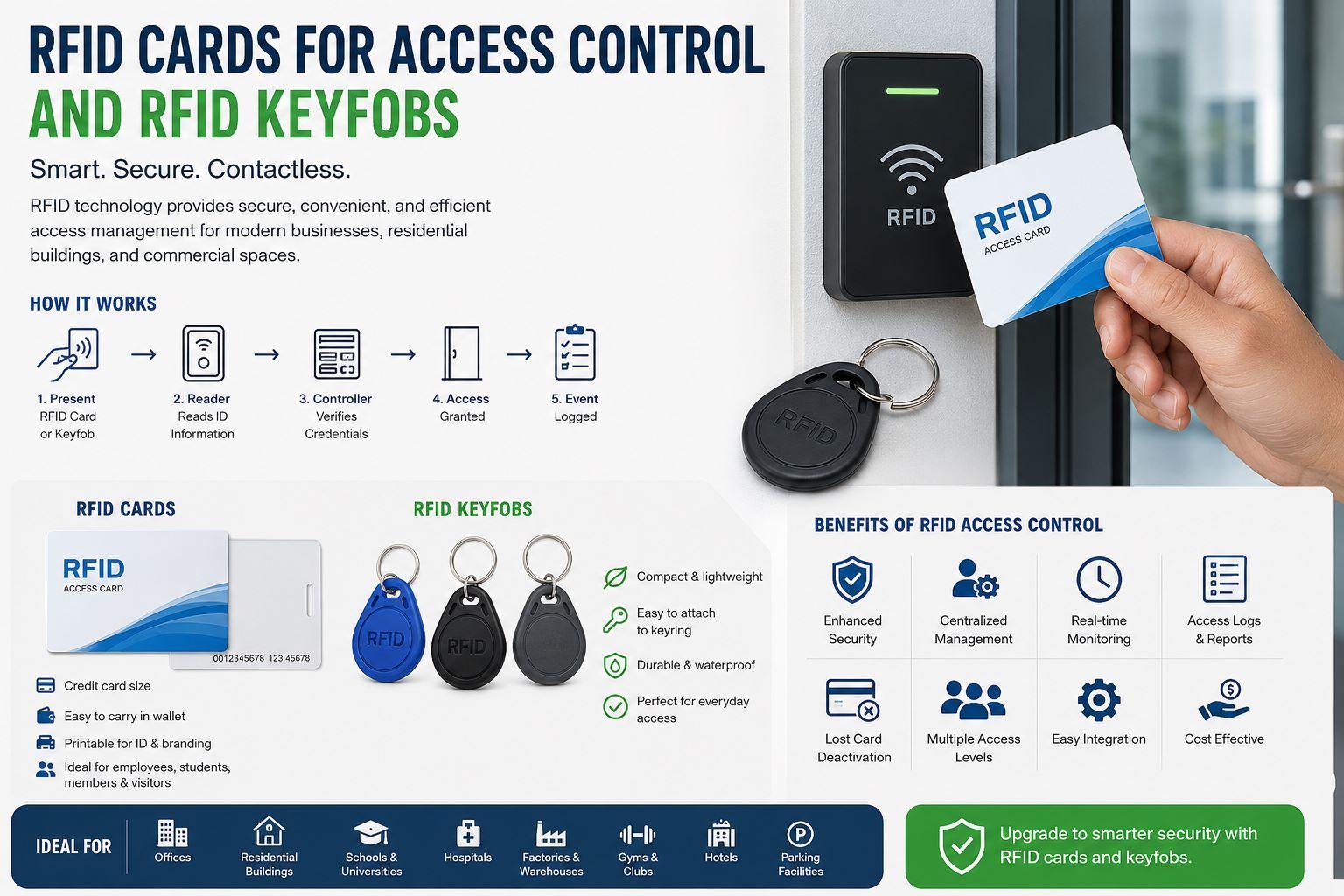
Modern organizations need security systems that are convenient, scalable, and easy to manage. Traditional keys can be lost, copied, or difficult to control when employees, residents, students, or contractors change frequently. This is why RFID cards for access control have become a practical choice for offices, commercial buildings, educational institutions, healthcare facilities, hotels, warehouses, and residential properties.
Alongside cards, RFID keyfobs provide a compact alternative for users who prefer a credential that can stay attached to their keys. Both technologies allow authorized individuals to unlock doors or access restricted areas without using conventional mechanical keys.
Understanding how RFID credentials work, their benefits, limitations, security considerations, and differences can help organizations build a more reliable access control environment.
What Are RFID Cards for Access Control?
RFID cards for access control are electronic credentials that communicate with compatible RFID readers using radio frequency identification technology. Each card contains an embedded chip and antenna that can transmit credential information when brought within the reader's operating range.
When a card is presented, the access control reader sends the credential data to the connected system. The system verifies whether that credential has permission to enter the requested area.
The typical process includes:
-
A user presents an RFID card near a reader.
-
The reader detects the credential.
-
Credential information is checked by the access control system.
-
User permissions are verified.
-
The electronic lock opens when access is approved.
-
The access event may be recorded for future monitoring.
This eliminates much of the manual key management associated with conventional locks.
What Are RFID Keyfobs?
RFID keyfobs perform a similar function but use a small, portable form factor designed to attach to a keyring.
Inside the keyfob is an RFID chip containing identification information. When placed near a compatible reader, the credential can be recognized and processed by the access control system.
Keyfobs are commonly used for:
-
Apartment and residential entry
-
Office access
-
Parking areas
-
Gym memberships
-
Hotels and hospitality facilities
-
Restricted rooms
-
Employee access systems
-
Storage and warehouse facilities
Their compact design makes them particularly convenient for people who already carry keys throughout the day.
How RFID Access Control Improves Security
One major advantage of electronic access control is centralized credential management.
If somebody loses a traditional key, changing the lock may sometimes be necessary. With RFID cards for access control, administrators can generally deactivate the missing credential and issue another one without replacing the physical door lock.
Access permissions can also be customized according to job responsibilities, departments, locations, or operating requirements.
For example, an organization might allow:
-
All employees into the main office
-
IT staff into server areas
-
Management into administrative rooms
-
Warehouse personnel into inventory areas
-
Contractors into designated zones only
This creates a more structured approach to physical security.
RFID Cards vs RFID Keyfobs
Both credential types can work effectively, but their suitability depends on how the access system will be used.
| Feature | RFID Cards | RFID Keyfobs |
|---|---|---|
| Form | Card-shaped | Small keyring device |
| Portability | Wallet or badge holder | Attached to keys |
| Branding | Large printable surface | Limited branding area |
| Employee ID use | Excellent | Limited |
| Convenience | High | Very high |
| Access control use | Excellent | Excellent |
| Visibility | Easy to display | Compact and discreet |
Businesses requiring employee photographs, names, departments, or company branding may prefer cards. Organizations focused primarily on convenient building entry may find keyfobs more practical.
Major Benefits of RFID Access Credentials
The growing adoption of RFID cards for access control is closely connected to improved operational efficiency.
Important advantages include:
-
Quick contactless authentication
-
Easier credential administration
-
Fast cancellation of lost credentials
-
Flexible access permissions
-
Reduced reliance on mechanical keys
-
Better tracking of entry events
-
Integration with modern security platforms
-
Convenient employee and visitor management
-
Scalable access for multiple doors or facilities
Electronic access systems can therefore support both security and daily operational management.
Choosing the Right RFID Technology
Not every RFID credential works with every reader. Organizations should confirm system compatibility before purchasing cards or keyfobs.
Important considerations include frequency, credential technology, reader compatibility, encryption capabilities, memory configuration, operating environment, durability, and the security architecture of the entire access control platform.
Organizations should also consider future expansion. A solution suitable for one entrance today may eventually need to support multiple buildings, hundreds of users, visitor management, or integration with other security technologies.
Selecting a scalable platform can reduce unnecessary replacement costs later.
Security Considerations for RFID Systems
RFID technology can improve access management, but security depends heavily on proper system implementation.
Older or poorly configured credential technologies may offer weaker protection than modern secure platforms. Organizations should therefore avoid evaluating a system solely on credential price.
A stronger security strategy may include:
-
Modern credential technology
-
Secure communication
-
Controlled credential enrollment
-
Immediate deactivation of missing credentials
-
Regular access permission reviews
-
Strong administrative authentication
-
Entry activity monitoring
-
Multi-factor authentication for sensitive areas
For highly restricted environments, RFID credentials may also be combined with PIN codes, mobile credentials, biometrics, or additional authentication methods.
RFID Access Control Applications
The versatility of RFID keyfobs and RFID cards makes them suitable for many industries.
Corporate offices can manage employee entry and department-level permissions. Schools can restrict staff-only locations. Hotels can manage guest room access. Healthcare organizations can protect sensitive areas, while warehouses can restrict inventory and equipment rooms.
Residential communities can also use RFID credentials for building entrances, parking facilities, gyms, clubhouses, and other shared amenities.
Because permissions are managed electronically, administrators gain greater control over who can enter specific areas.
Future of RFID Access Control
Physical security is increasingly becoming connected with digital identity management.
Modern access platforms may combine RFID cards for access control, mobile credentials, cloud-based administration, smart readers, centralized monitoring, and advanced authentication technologies.
However, physical RFID credentials are likely to remain useful because they are simple, familiar, cost-effective, and easy to issue.
The future will therefore probably involve flexible systems where organizations can use RFID cards, keyfobs, smartphones, and other credentials together according to different security requirements.
How to Select RFID Cards and Keyfobs
Before selecting credentials, organizations should evaluate their operational and security needs.
Consider these questions:
-
Which access control system is currently installed?
-
What RFID technologies does the reader support?
-
How many users require credentials?
-
Will employee information be printed on cards?
-
Are credentials required indoors or outdoors?
-
How quickly must lost credentials be disabled?
-
Are detailed access records required?
-
Will additional doors be added later?
-
Are high-security areas involved?
-
Will mobile or biometric access eventually be required?
Answering these questions makes it easier to select an appropriate credential solution.
Frequently Asked Questions About RFID Cards and RFID Keyfobs
1. What are RFID cards for access control?
They are electronic credentials containing RFID technology that allow authorized users to interact with compatible access control readers.
2. How do RFID keyfobs work?
An RFID keyfob communicates credential information to a nearby compatible reader, which verifies whether the user has permission to enter.
3. Are RFID cards contactless?
Yes. RFID credentials typically communicate wirelessly with compatible readers without physical contact.
4. Are RFID keyfobs better than cards?
Neither is universally better. Keyfobs offer compact portability, while cards provide more space for employee identification and branding.
5. Can lost RFID cards be deactivated?
In properly configured access control systems, administrators can generally disable a lost credential so it can no longer provide authorized access.
6. Can one RFID card open several doors?
Yes, if the access control system assigns permission for those doors to the credential.
7. Can RFID cards be customized?
Many RFID cards can support printed logos, employee photographs, names, identification numbers, and company branding.
8. Where are RFID keyfobs commonly used?
They are frequently used in offices, apartments, gyms, parking facilities, hotels, commercial properties, and restricted-access environments.
9. Are all RFID credentials compatible?
No. RFID technologies, frequencies, credential formats, and security protocols vary. Compatibility should always be verified.
10. Are RFID access systems secure?
Security depends on credential technology, reader configuration, communication protocols, administrative controls, and overall system architecture.
- Technology for Students
- Admissions & Applications
- Online Courses
- Career and Jobs
- Campus Life
- Drinks
- Film
- Fitness
- Food
- Игры
- Gardening
- Health
- Главная
- Literature
- Music
- Networking For Students
- Insights
- Party
- Religion
- Shopping
- Sports
- Theater
- Wellness
- Education News
- Business & Finance For Students
- Security, Law & Crime Education
- Insurance
- Science & Technology For Students
 Russian
 English
 Arabic
 French
 Spanish
 Portuguese
 Deutsch
 Turkish
 Dutch
Dutch
 Italiano
 Romaian
 Portuguese (Brazil)
 Greek
Greek