


Die Casting Manufacturer and Die Casting Factories: A Complete Manufacturing Guide
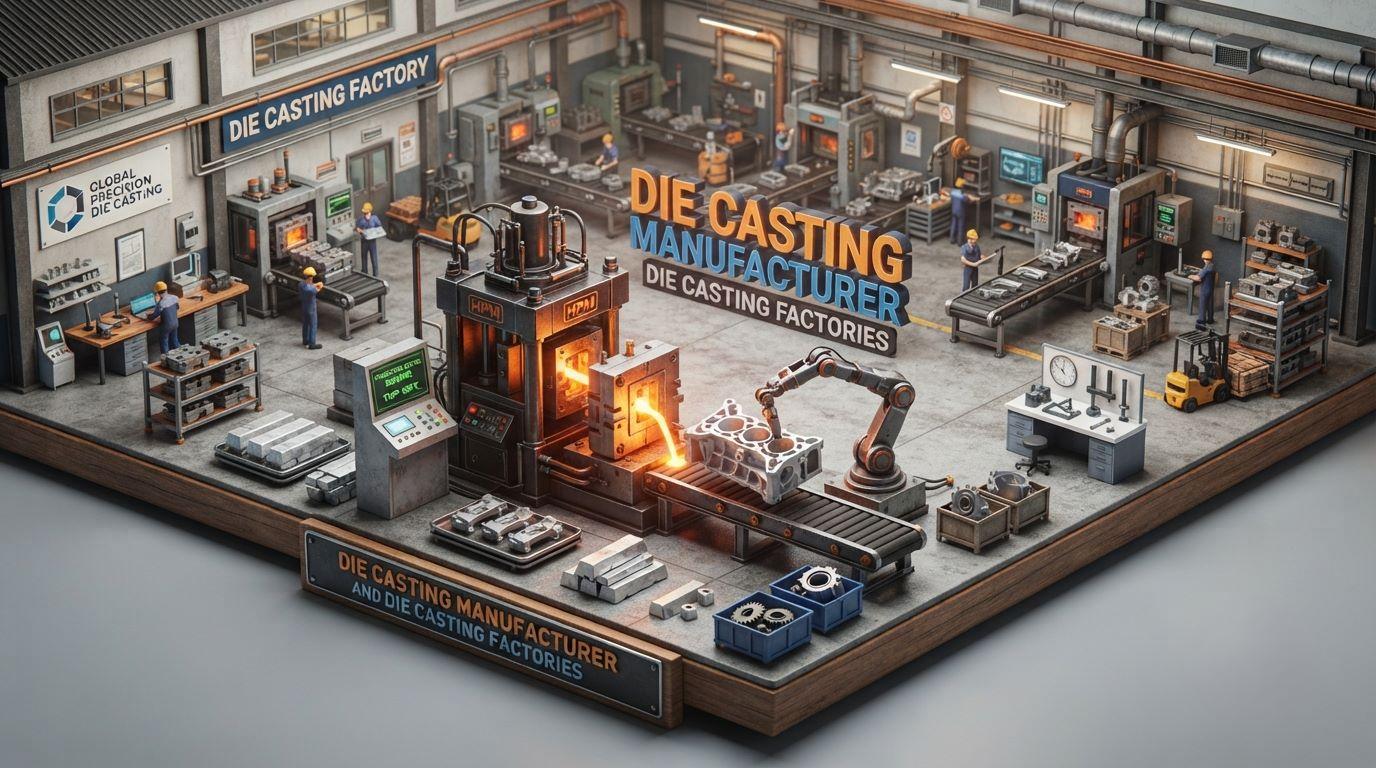
Choosing the right die casting manufacturer and die casting factories is an important decision for businesses that require strong, accurate, and repeatable metal components. Die casting has become a widely used manufacturing process because it can produce complex shapes with excellent dimensional consistency, smooth surfaces, and efficient production cycles.
From automotive components and electrical housings to lighting parts, industrial equipment, and consumer products, die-cast components support numerous industries. However, manufacturing quality depends greatly on equipment, engineering expertise, tooling capability, material control, and inspection standards.
Understanding how a professional die casting manufacturer operates can help buyers evaluate suppliers, reduce production risks, control costs, and develop reliable long-term manufacturing partnerships.
What Is a Die Casting Manufacturer?
A die casting manufacturer specializes in producing metal components by injecting molten metal into precisely engineered steel molds under controlled pressure. After the metal cools and solidifies, the component is removed, trimmed, inspected, and prepared for additional finishing when required.
Common die casting materials include:
-
Aluminum alloys
-
Zinc alloys
-
Magnesium alloys
-
Copper-based alloys
Aluminum die casting is especially common for components requiring a combination of lightweight construction, strength, corrosion resistance, thermal performance, and design flexibility.
Professional manufacturers may provide complete services covering mold design, casting, CNC machining, polishing, surface treatment, assembly, inspection, and packaging.
How Die Casting Factories Work
Modern die casting factories combine automated machinery, engineered tooling, process monitoring, skilled technicians, and quality-control systems.
The manufacturing process typically follows several important stages.
1. Product and Engineering Review
Before production starts, engineers evaluate drawings, dimensions, tolerances, wall thickness, draft angles, material requirements, and expected production volume.
A detailed engineering review helps identify manufacturability problems before expensive tooling begins.
2. Die and Mold Manufacturing
The mold determines the shape and dimensional accuracy of the finished casting. Tooling engineers create durable dies designed to withstand repeated pressure and temperature cycles.
Proper gate positioning, cooling channels, vents, runners, and ejector systems contribute significantly to casting consistency.
3. Molten Metal Injection
Metal is melted at controlled temperatures and transferred into the casting machine. The molten alloy is injected into the die cavity, where pressure helps fill detailed sections of the mold.
Process Stability Matters
Stable temperature, pressure, injection speed, cooling time, and alloy composition help minimize defects while maintaining repeatable production quality.
4. Trimming and Secondary Processing
After solidification, the casting is ejected from the mold. Excess material may then be removed.
Depending on the application, additional processes can include CNC machining, drilling, tapping, grinding, polishing, shot blasting, powder coating, plating, painting, or assembly.
Die Casting Manufacturer vs Die Casting Factories
Although these terms are often used interchangeably, buyers should understand their practical differences.
| Factor | Die Casting Manufacturer | Die Casting Factories |
|---|---|---|
| Main role | Complete manufacturing solution | Production facility |
| Engineering support | Often available | Depends on factory |
| Tool development | Usually integrated | May be outsourced |
| Production capacity | Small to large volumes | Typically volume focused |
| Secondary machining | Frequently available | Varies |
| Quality management | Supplier dependent | Factory dependent |
| Customization | Usually strong | Depends on capabilities |
The best supplier combines strong factory capacity with responsive engineering, quality management, communication, and project support.
Benefits of Working With Experienced Die Casting Factories
Selecting established die casting factories can create several manufacturing advantages.
-
High repeatability across production batches
-
Efficient manufacturing for medium and large quantities
-
Ability to create complex component geometry
-
Good dimensional consistency
-
Reduced secondary machining for well-designed parts
-
Smooth surfaces suitable for finishing
-
Integration of multiple features into one casting
-
Potential reduction in assembly requirements
-
Scalable manufacturing capacity
These advantages make die casting suitable for companies seeking efficient production without sacrificing component performance.
Industries Using Die Casting Components
A capable die casting manufacturer can serve many industries because the process supports both structural and functional metal parts.
Automotive Manufacturing
Automotive applications can include brackets, housings, transmission-related components, electronic enclosures, structural parts, and thermal-management components.
Lighting Industry
Die casting is frequently used for LED light housings, heat sinks, outdoor lighting enclosures, mounting components, and decorative lighting structures.
Electronics and Electrical Equipment
Electronic products require durable housings that protect internal components while supporting heat dissipation and structural stability.
Industrial Machinery
Machinery manufacturers use die-cast components for covers, housings, motor parts, mounting structures, handles, and equipment assemblies.
Consumer Products
Appliances, furniture hardware, tools, communication equipment, and various consumer products may contain precision die-cast components.
How to Choose a Reliable Die Casting Manufacturer
Supplier evaluation should extend beyond price comparisons.
Consider these factors:
-
Review manufacturing equipment and production capacity.
-
Evaluate engineering and tooling experience.
-
Confirm available casting materials.
-
Examine CNC machining capabilities.
-
Understand inspection procedures.
-
Review surface-finishing options.
-
Discuss expected production quantities.
-
Evaluate communication and project management.
-
Request samples when appropriate.
-
Confirm packaging and delivery capabilities.
A supplier capable of supporting the entire production cycle can simplify sourcing and improve accountability.
Quality Control in Die Casting Factories
Quality management is essential because small process variations can affect dimensions, appearance, mechanical properties, or assembly performance.
Professional die casting factories may inspect incoming materials, casting parameters, dimensional tolerances, surface condition, machining accuracy, and final assemblies.
Inspection equipment can include coordinate measuring machines, gauges, hardness-testing equipment, spectrometers, leak-testing systems, and visual inspection stations.
Traceable quality procedures also help manufacturers identify production issues and implement corrective actions efficiently.
Sustainable Development in Die Casting
Sustainability is increasingly influencing metal manufacturing. Manufacturers are improving furnace efficiency, recycling suitable metal scrap, optimizing production cycles, reducing unnecessary machining, and improving equipment efficiency.
Design optimization can also reduce component weight while maintaining required performance.
When recycling, manufacturing efficiency, tooling life, and material utilization are considered together, die casting can support more resource-conscious industrial production.
Future of Die Casting Manufacturing
The future of die casting manufacturer and die casting factories operations will increasingly involve automation, robotics, digital monitoring, intelligent inspection, simulation software, and connected production equipment.
Real-time process information can help factories identify abnormal conditions earlier and improve production consistency.
Demand for lightweight components, electric vehicles, renewable-energy equipment, smart electronics, advanced lighting products, and efficient industrial systems may continue creating opportunities for precision die casting.
Frequently Asked Questions
What does a die casting manufacturer do?
A manufacturer produces metal components by injecting molten alloys into engineered dies and may also provide machining, finishing, assembly, and inspection services.
What materials are commonly used for die casting?
Aluminum, zinc, magnesium, and selected copper-based alloys are commonly used depending on product requirements.
Why are aluminum alloys popular?
Aluminum offers a useful combination of low weight, strength, corrosion resistance, thermal performance, and design flexibility.
Are die casting factories suitable for custom components?
Yes. Custom molds can be developed according to drawings, specifications, and application requirements.
Is die casting suitable for large production volumes?
Yes. Once tooling is developed, die casting can efficiently produce repeatable components at significant volumes.
Can die-cast parts receive additional machining?
Yes. CNC milling, drilling, tapping, turning, and other secondary operations can achieve features or tolerances not produced directly during casting.
What surface finishes are available?
Options can include powder coating, polishing, painting, plating, anodizing where suitable, shot blasting, and other application-specific treatments.
How can casting defects be reduced?
Proper mold design, alloy control, temperature management, injection parameters, venting, and inspection procedures help reduce defects.
What should buyers provide when requesting a quotation?
Provide technical drawings, material requirements, estimated quantities, tolerances, finishing requirements, and relevant quality expectations.
How should businesses compare die casting suppliers?
Compare technical capability, tooling experience, quality control, equipment, communication, secondary services, capacity, lead requirements, and total manufacturing value rather than price alone.
- Technology for Students
- Admissions & Applications
- Online Courses
- Career and Jobs
- Campus Life
- Drinks
- Film
- Fitness
- Food
- Giochi
- Gardening
- Health
- Home
- Literature
- Music
- Networking For Students
- Insights
- Party
- Religion
- Shopping
- Sports
- Theater
- Wellness
- Education News
- Business & Finance For Students
- Security, Law & Crime Education
- Insurance
- Science & Technology For Students
 Italiano
 English
 Arabic
 French
 Spanish
 Portuguese
 Deutsch
 Turkish
 Dutch
Dutch
 Russian
 Romaian
 Portuguese (Brazil)
 Greek
Greek