


Low Volume Silicone Molding and Silicone Rubber Compression Molding Guide
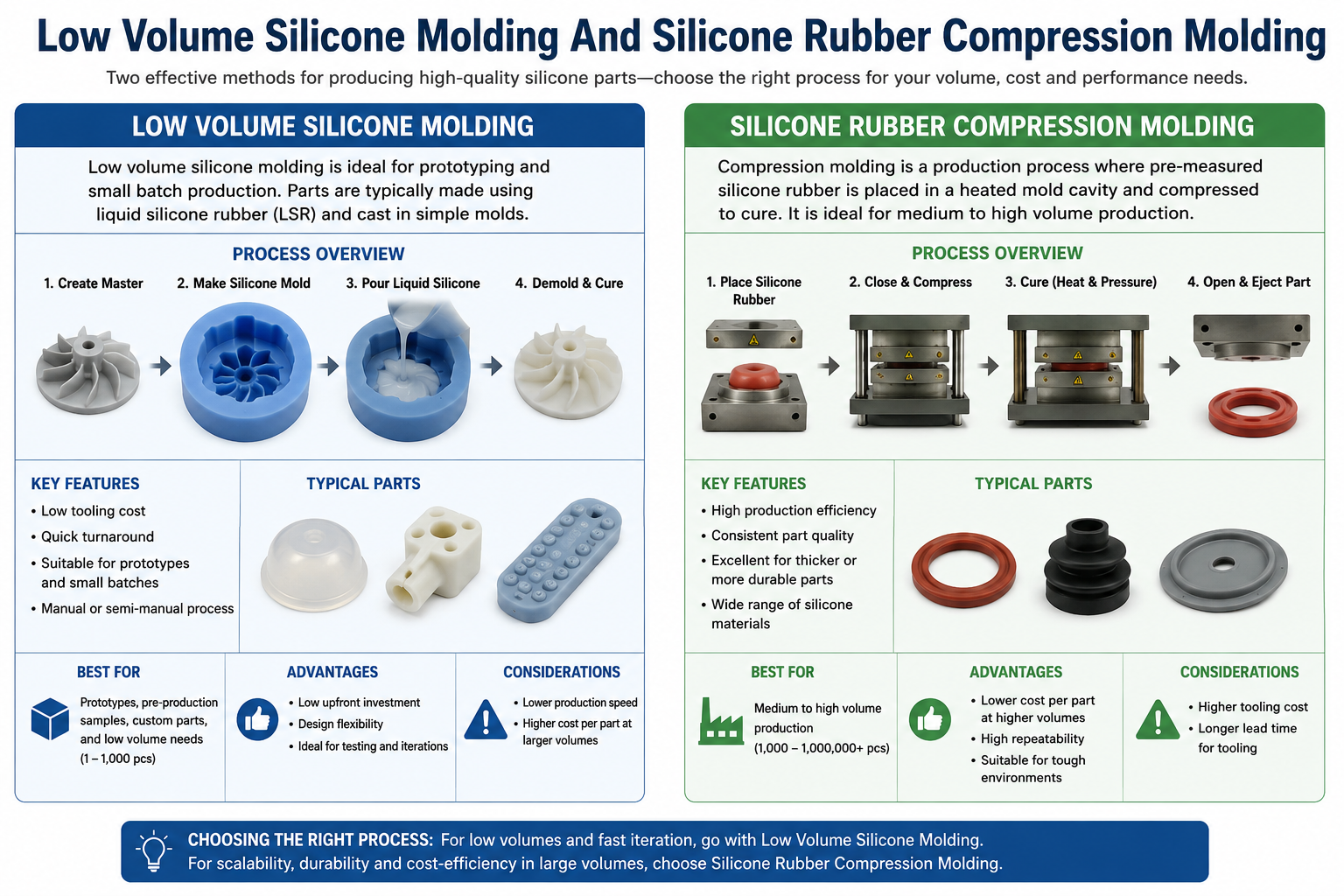
They need dependable components, manageable tooling costs, and opportunities to improve parts before scaling. Low volume silicone molding helps manufacturers meet those needs, while silicone rubber compression molding offers a practical method for creating durable elastomer components. Understanding how production quantity and molding technique interact can prevent expensive mistakes.
What Is Low Volume Silicone Molding?
Low volume silicone molding describes making relatively small batches of silicone components instead of committing immediately to mass production. It is a production strategy, not one specific molding process. Manufacturers may use compression molding, transfer molding, or liquid silicone rubber injection molding depending on design, material, and order quantity.
Smaller runs suit pilot launches, replacement components, specialty equipment, and products with uncertain demand. They also allow teams to validate fit, sealing performance, and customer feedback before purchasing higher-capacity tooling.
How Silicone Rubber Compression Molding Works
In silicone rubber compression molding, an operator places a measured amount of uncured silicone compound into a heated mold cavity. The mold closes under pressure, forcing the material to fill the desired shape. Heat and time cure the silicone, after which the finished part is removed, trimmed, and inspected.
The Basic Production Sequence
-
Review the component drawing and select a suitable silicone grade.
-
Prepare tooling and measure the required material charge.
-
Place the compound inside the mold and close the press.
-
Apply controlled heat and pressure for the specified cure cycle.
-
Demold, remove excess flash, and check critical dimensions.
Why Process Control Matters
Inconsistent charge weight, mold temperature, or curing time can cause short fills, surface defects, or dimensional variation. Clear processing instructions and routine inspections therefore matter as much as the mold itself.
Where These Approaches Overlap
Low volume silicone molding and silicone rubber compression molding are not competing categories. One defines production scale; the other defines manufacturing technique. A manufacturer can use compression molding for a small custom batch or for larger recurring orders.
Compression molding is especially useful when a part has straightforward geometry, the material is available as a high-consistency silicone compound, and production speed is less critical than tooling economics. However, extremely intricate features and high-output automation may favor another process.
Comparison of Manufacturing Options
| Consideration | Low-volume production strategy | Compression molding process |
|---|---|---|
| Main focus | Flexible batch quantities | Forming silicone under heat and pressure |
| Tooling | Depends on selected process | Often relatively simple mold construction |
| Best fit | Trials, niche products, gradual launches | Gaskets, pads, seals, and similar parts |
| Main limitation | Higher unit cost at small quantities | Flash trimming and longer cycles may be required |
| Scalability | Can transition to higher volumes | Supports various quantities with suitable tooling |
The correct choice depends on lifetime demand, geometry, tolerances, inspection requirements, and acceptable cost per component rather than a single quoted tooling price.
Benefits for Product Developers
For startups and established manufacturers, low volume silicone molding can reduce the financial exposure of an unproven design. Teams can order limited quantities, identify assembly problems, and revise specifications without carrying excessive inventory.
Meanwhile, silicone rubber compression molding can be economical for relatively uncomplicated components. Silicone's elasticity, temperature resistance, and ability to form functional seals make it valuable across many industries, provided the selected compound matches real operating conditions.
Typical applications include:
-
Protective covers and vibration-damping pads.
-
Custom gaskets for industrial enclosures.
-
Flexible buttons and equipment interfaces.
-
Sealing components for specialized machinery.
No silicone grade is universally suitable. Chemical contact, compression set, hardness, regulatory needs, and operating temperature should be assessed individually.
Design and Quality Considerations
Before placing an order, share a dimensioned drawing, expected usage conditions, target quantity, and any critical tolerances. Specify Shore A hardness where appropriate, along with color, surface finish, and required testing.
Avoid unnecessary undercuts and complicated parting lines when planning silicone rubber compression molding. Discuss draft, flash allowance, and inspection methods with the supplier early. Sample approval should cover both physical appearance and functional performance. Discuss realistic delivery schedules early, because sampling, material sourcing, and finishing can affect launch dates significantly.
A low initial tooling quote is not automatically the lowest total cost. Waste, cycle time, secondary trimming, and rejected parts can influence long-term economics.
Frequently Asked Questions
1. Is low volume silicone molding suitable for prototypes?
Yes. It supports functional evaluation and limited market testing, although tooling may still be necessary.
2. Does compression molding require a metal mold?
Usually, production molds are metal because they must withstand repeated heating and pressure.
3. Which silicone type is commonly compression molded?
High-consistency silicone rubber is commonly used, subject to product and process requirements.
4. Can small batches include custom colors?
Often yes, but color matching and minimum material purchases can affect cost.
5. Is compression molding appropriate for complex parts?
Some complex shapes are possible, but intricate details may be better suited to alternative processes.
6. What affects the final part price?
Material, geometry, tooling, quantity, cycle time, trimming, and quality checks all contribute.
7. Can silicone components tolerate high temperatures?
Many can, but exact limits depend on the chosen formulation and exposure conditions.
8. Are compression-molded parts waterproof?
A properly designed seal may prevent water ingress; performance depends on installation and testing.
9. How do manufacturers check part quality?
They may inspect dimensions, appearance, hardness, and application-specific performance.
10. When should production move to injection molding?
Consider it when larger quantities, intricate details, or automation justify the tooling investment.
- Technology for Students
- Admissions & Applications
- Online Courses
- Career and Jobs
- Campus Life
- Drinks
- Film
- Fitness
- Food
- Games
- Gardening
- Health
- Home
- Literature
- Music
- Networking For Students
- Insights
- Party
- Religion
- Shopping
- Sports
- Theater
- Wellness
- Education News
- Business & Finance For Students
- Security, Law & Crime Education
- Insurance
- Science & Technology For Students
 English
 Arabic
 French
 Spanish
 Portuguese
 Deutsch
 Turkish
 Dutch
 Italiano
 Russian
 Romaian
 Portuguese (Brazil)
 Greek