


Why Polished Stainless Steel Tubing and 304 Stainless Steel Tubing Are Taking Over Modern Fabrication
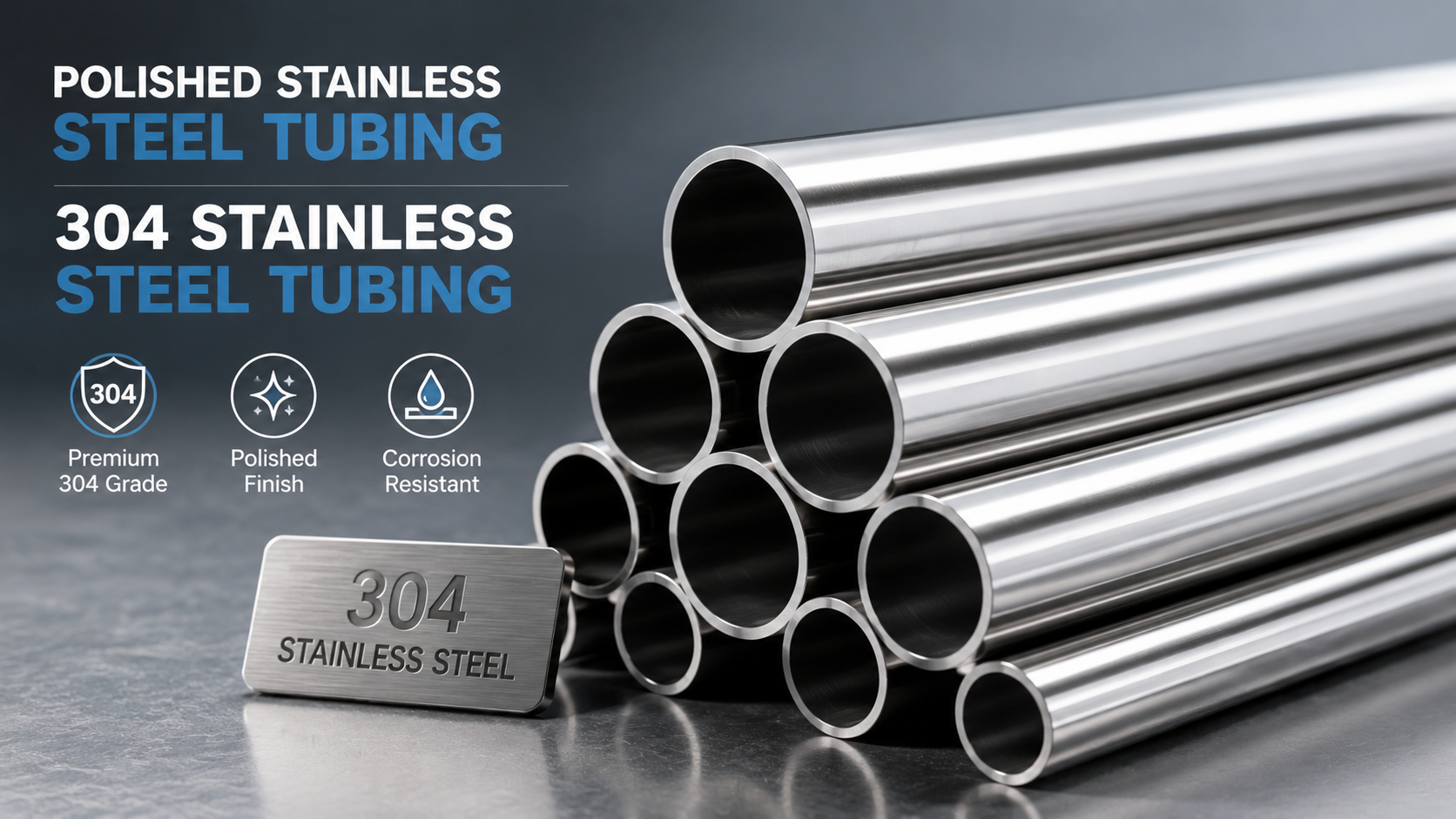
Walk through a modern commercial kitchen, a luxury building, an industrial plant, or a high-end retail space and there is a good chance stainless steel tubing is working quietly in the background.
It may be supporting a railing, carrying fluids, strengthening a machine frame, forming a decorative structure, or helping maintain a clean production environment.
That is exactly why Polished Stainless Steel Tubing and 304 Stainless Steel Tubing continue to attract attention across manufacturing, architecture, food processing, engineering, and fabrication.
They are strong. They look premium. They are easy to maintain. And when specified correctly, they can deliver years of dependable performance.
But there is one important detail many buyers miss: polished stainless steel tubing and 304 stainless steel tubing are not the same thing.
The Difference Most Buyers Overlook
Polished Stainless Steel Tubing describes the surface finish of the tube.
304 Stainless Steel Tubing describes the stainless steel grade used to manufacture it.
That means a tube can be made from grade 304 stainless steel and then polished to create a smooth, satin, brushed, or mirror-like appearance.
This distinction matters because one specification affects appearance and surface quality, while the other affects material performance.
For many applications, the ideal solution is actually polished 304 stainless steel tubing.
Why Polished Stainless Steel Tubing Looks So Premium
There is a reason polished stainless steel appears in luxury interiors, modern railings, premium equipment, designer furniture, and food-processing systems.
The smooth finish creates a clean, professional appearance that ordinary unfinished tubing cannot always match.
Polishing also removes or reduces visible surface marks left during production.
Common applications include:
-
Architectural railings
-
Balustrades
-
Designer furniture
-
Commercial kitchens
-
Food-processing machines
-
Pharmaceutical equipment
-
Retail fixtures
-
Automotive components
-
Decorative frames
-
Interior structures
A polished surface can range from subtle satin to highly reflective mirror finish depending on the required look.
304 Stainless Steel Tubing Is Popular for a Reason
Few stainless steel grades are as widely recognized as 304 Stainless Steel Tubing.
Its popularity comes from balance.
It offers useful corrosion resistance, good strength, excellent fabrication flexibility, and strong availability across different sizes and wall thicknesses.
That makes it suitable for both everyday engineering and more demanding commercial projects.
Where 304 Tubing Performs Well
You will commonly find grade 304 tubing in:
-
Food and beverage equipment
-
Industrial fabrication
-
Machinery frames
-
Structural supports
-
Kitchen systems
-
Architectural projects
-
Automotive assemblies
-
Process equipment
-
Furniture manufacturing
-
General engineering
It also performs well in many indoor and outdoor environments where exposure conditions are moderate.
Polished vs 304 Stainless Steel Tubing
Here is the simplest way to understand the difference.
| Feature | Polished Stainless Steel Tubing | 304 Stainless Steel Tubing |
|---|---|---|
| What it describes | Surface finish | Stainless steel grade |
| Main advantage | Smooth, attractive appearance | Corrosion resistance and versatility |
| Typical use | Decorative and hygienic applications | Industrial and structural applications |
| Finish options | Satin, brushed, mirror polished | Depends on manufacturing specification |
| Fabrication | Depends on base alloy | Generally easy to form and weld |
| Maintenance | Often easy to clean | Depends on finish and environment |
The key takeaway is simple: these products are not direct competitors.
A single tube can be both polished and made from grade 304 stainless steel.
Why Industries Keep Choosing Polished Stainless Tubing
Modern manufacturing is moving toward materials that combine performance and appearance.
That is where Polished Stainless Steel Tubing stands out.
Clean Appearance
A polished surface instantly makes fabricated equipment look more refined.
This matters in customer-facing environments such as hotels, malls, restaurants, airports, offices, showrooms, and premium residential spaces.
Easier Cleaning
Smooth stainless steel surfaces are generally easier to wipe down and maintain than rougher finishes.
That makes them attractive for industries where cleanliness is important.
Strong Visual Consistency
For projects with exposed metalwork, surface consistency matters.
Uneven scratches or rough patches can make even well-built structures look unfinished.
Polished tubing helps create a more uniform final result.
Long-Term Value
When the right grade is matched to the right environment, stainless steel tubing can provide excellent durability with relatively low maintenance requirements.
Why 304 Stainless Steel Tubing Remains a Top Choice
The biggest strength of 304 Stainless Steel Tubing is versatility.
It works across multiple sectors without requiring highly specialized handling in many standard applications.
Good Corrosion Resistance
Grade 304 performs well against many common environmental conditions.
Excellent Fabrication Flexibility
It can be cut, welded, bent, formed, and fabricated into many different structures.
Strong Availability
Because grade 304 is widely used, it is available in many sizes, thicknesses, shapes, and finishes.
Professional Appearance
Even without mirror polishing, stainless steel offers a clean metallic appearance that fits modern industrial and architectural design.
What Should You Check Before Buying?
The wrong tubing specification can cause unnecessary cost, fabrication issues, or disappointing performance.
Before purchasing, check the following.
-
Material grade
Confirm whether grade 304 is suitable for the intended environment. -
Outside diameter
Choose dimensions based on structural or design requirements. -
Wall thickness
Thicker walls may provide additional strength but also increase weight and cost. -
Surface finish
Select brushed, satin, polished, or mirror finish depending on appearance and cleaning needs. -
Tolerance
Precision fabrication may require tighter dimensional control. -
Weld quality
For welded tubing, consistency and finish around the seam are important. -
Application environment
Consider moisture, chemicals, salt exposure, temperature, and cleaning methods.
Where These Tubes Create the Biggest Impact
Architecture
Polished stainless tubing is often used for handrails, decorative partitions, entrance structures, and premium interiors.
Food Processing
Smooth stainless surfaces support easy cleaning and professional hygiene standards.
Manufacturing
Grade 304 tubing is commonly used for machine frames, protective structures, supports, and processing equipment.
Automotive
Stainless tubing may be used in selected exhaust, structural, and decorative applications.
Furniture
Designers use polished stainless tubing to create modern tables, chairs, frames, and display systems.
The Mistake That Can Cost Buyers More
One of the biggest purchasing mistakes is choosing tubing only by appearance.
A shiny tube may look impressive, but the underlying stainless steel grade still needs to suit the application.
The opposite is also true.
A high-quality 304 tube may perform perfectly but still need additional polishing if it will be highly visible.
That is why experienced buyers specify both material grade and surface finish.
Frequently Asked Questions
1. What is Polished Stainless Steel Tubing?
It is stainless steel tubing that has undergone surface finishing to create a smoother and more attractive appearance.
2. What is 304 Stainless Steel Tubing?
It is tubing manufactured using grade 304 stainless steel, a widely used austenitic stainless steel known for corrosion resistance and fabrication flexibility.
3. Can 304 stainless steel tubing be polished?
Yes. Grade 304 can be polished to satin, brushed, or mirror-like finishes depending on requirements.
4. Which tubing is better for decorative use?
Polished stainless tubing is often preferred where appearance is important.
5. Is 304 stainless steel suitable for food equipment?
Yes, it is widely used in many food-processing and commercial kitchen applications.
6. Does polished tubing resist corrosion better?
Surface condition can influence maintenance and contamination buildup, but corrosion resistance also depends heavily on the stainless steel grade and environment.
7. Can 304 stainless tubing be welded?
Yes. Grade 304 generally offers good weldability when proper welding practices are followed.
8. Is polished stainless steel expensive?
Cost depends on grade, dimensions, wall thickness, quantity, and polishing level.
9. Is 304 tubing available in different shapes?
Yes. It is commonly supplied in round, square, rectangular, and custom profiles.
10. Should I choose polished 304 stainless steel tubing?
It can be an excellent option when a project requires both good material performance and a premium surface finish.
- Technology for Students
- Admissions & Applications
- Online Courses
- Career and Jobs
- Campus Life
- Drinks
- Film
- Fitness
- Food
- Games
- Gardening
- Health
- Home
- Literature
- Music
- Networking For Students
- Insights
- Party
- Religion
- Shopping
- Sports
- Theater
- Wellness
- Education News
- Business & Finance For Students
- Security, Law & Crime Education
- Insurance
- Science & Technology For Students
 English
 Arabic
 French
 Spanish
 Portuguese
 Deutsch
 Turkish
 Dutch
Dutch
 Italiano
 Russian
 Romaian
 Portuguese (Brazil)
 Greek
Greek