


Custom Silicone Rubber Parts and Silicone Rubber Molded Parts: Design, Benefits, Uses & Buying Guide
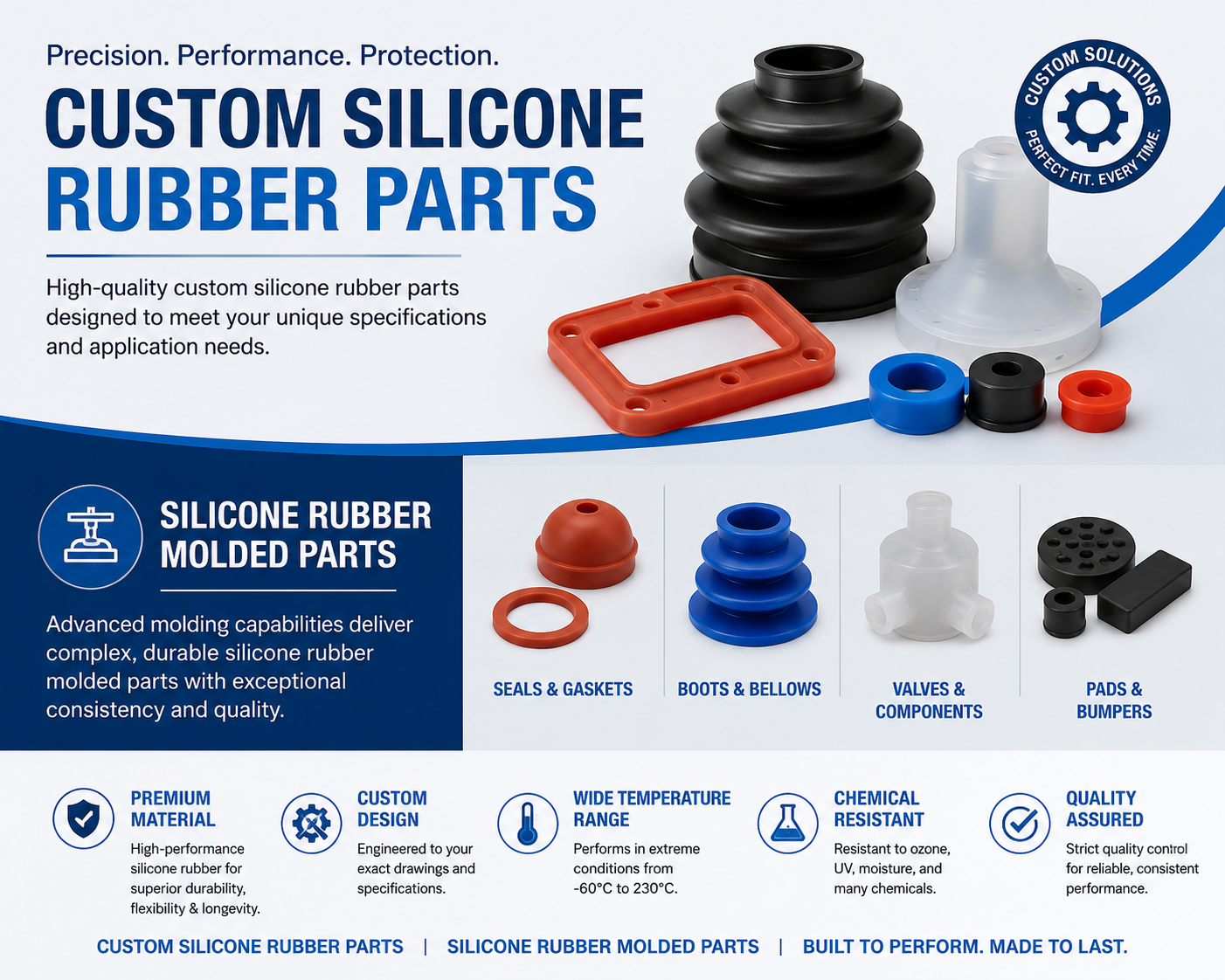
Manufacturers often need components that can withstand heat, pressure, moisture, movement, and demanding environments. Custom silicone rubber parts can be engineered around exact dimensions and performance requirements. Silicone rubber molded parts also allow complex shapes, consistent profiles, and application-specific features that standard components may not provide. The right material, molding method, hardness, and tolerance can improve reliability and service life.
What Are Custom Silicone Rubber Parts?
Custom silicone rubber parts are engineered components produced from a drawing, sample, CAD model, or dimensional specification. Instead of adapting a standard item, manufacturers can create a part that closely matches the intended assembly.
Common examples include:
-
Gaskets and seals
-
O-rings and sealing rings
-
Diaphragms
-
Protective boots
-
Bellows and sleeves
-
Keypads and buttons
-
Bumpers and pads
-
Electrical insulation parts
-
Custom plugs and caps
Customization may include shape, size, hardness, color, finish, temperature resistance, and compression characteristics.
What Are Silicone Rubber Molded Parts?
Silicone rubber molded parts are components formed inside specially designed molds. Silicone material is placed or injected into a mold cavity and processed under controlled conditions until the final component takes its required shape.
Molding is useful for repeatable dimensions, integrated details, complex geometries, or larger production volumes. Common processes include compression, transfer, and liquid silicone rubber injection molding.
Key Benefits of Custom Silicone Rubber Components
Properly engineered custom silicone rubber parts can offer several advantages:
-
Resistance to high and low temperatures.
-
Good flexibility through repeated operating cycles.
-
Reliable sealing against air, dust, water, and fluids.
-
Electrical insulation for suitable applications.
-
Resistance to ozone, UV exposure, and weathering.
-
Availability in different hardness levels.
-
Ability to form detailed and complex designs.
-
Consistent performance in demanding environments.
Material grade should always match actual operating conditions and compliance needs.
Custom Silicone Rubber Parts vs Standard Rubber Parts
| Feature | Custom Silicone Parts | Standard Rubber Parts |
|---|---|---|
| Dimensions | Application-specific | Fixed standard sizes |
| Design freedom | High | Limited |
| Material selection | Can be tailored | Predetermined |
| Fit | Optimized for assembly | May require compromise |
| Complex geometry | Often possible | Usually limited |
| Color options | Can be customized | Fewer options |
| Initial sourcing | Tooling may be needed | Usually faster |
Standard parts can be economical for common applications, while silicone rubber molded parts are often more suitable when fit, sealing, geometry, appearance, or performance must meet precise requirements.
Important Design Factors Before Manufacturing
A successful silicone component starts with clear technical requirements. Evaluate:
-
Operating temperature range
-
Contact with oils, chemicals, water, or gases
-
Required hardness
-
Compression and recovery needs
-
Part dimensions and tolerances
-
Static or dynamic movement
-
Surface texture
-
Production quantity
-
Testing or regulatory requirements
Clear drawings and application information can reduce design revisions and improve manufacturing consistency.
Common Molding Methods for Silicone Parts
Compression Molding
Compression molding uses measured silicone material placed inside a heated mold. It can be practical for many simple or moderately complex components.
Transfer Molding
Transfer molding moves silicone material into a closed mold cavity. It may suit parts requiring controlled material flow or detailed geometry.
Liquid Silicone Rubber Injection Molding
Liquid silicone rubber injection molding uses controlled equipment to inject material into the mold. It is often considered for high-volume production, intricate parts, repeatability, and automation.
Choosing the Right Method
The best process depends on part geometry, production quantity, tooling investment, tolerance requirements, material specification, and quality expectations.
Industries Using Silicone Rubber Molded Parts
Silicone rubber molded parts are used across many sectors, including:
-
Automotive and transportation
-
Electronics and electrical equipment
-
Medical and laboratory equipment
-
Food-processing equipment
-
Industrial machinery
-
Consumer products
-
Lighting systems
-
Appliances
-
Renewable energy
-
Fluid-handling systems
Each industry may require different levels of cleanliness, temperature stability, sealing, electrical performance, or compliance.
How to Choose a Silicone Rubber Parts Manufacturer
Choosing a supplier involves more than price. Review engineering support, tooling, material knowledge, dimensional control, inspection, capacity, and communication.
Before requesting a quotation, provide:
-
2D drawings or 3D models.
-
Expected order quantity.
-
Required silicone grade.
-
Hardness requirements.
-
Operating conditions.
-
Tolerance expectations.
-
Color and finish requirements.
-
Testing or certification needs.
Detailed information helps the manufacturer assess feasibility and recommend a suitable production approach.
Frequently Asked Questions
1. What are custom silicone rubber parts used for?
They are used for sealing, cushioning, insulation, protection, fluid control, vibration management, and other application-specific functions.
2. Can silicone parts be made in custom shapes?
Yes. Molding enables many sizes, profiles, and geometries, depending on tooling and manufacturability.
3. Are silicone rubber molded parts heat resistant?
Many silicone compounds offer strong temperature resistance, although the suitable range depends on the selected formulation.
4. Can silicone hardness be customized?
Yes. Different hardness levels can be selected according to flexibility, sealing pressure, durability, and design needs.
5. Are custom colors available?
Often, yes. Color options depend on material formulation, production quantity, and application requirements.
6. What information is needed for a quotation?
Drawings, dimensions, quantity, material, hardness, tolerances, color, and application details are usually helpful.
7. Is silicone suitable for outdoor use?
Silicone generally offers good resistance to weathering, ozone, and UV exposure, making it useful for many outdoor applications.
8. Which molding process is best?
The best method depends on design complexity, volume, material, tolerances, tooling, and production economics.
9. Can molded silicone parts have tight tolerances?
They can achieve controlled dimensions, but realistic tolerances depend on part size, geometry, material behavior, and tooling.
10. Can prototypes be produced before mass production?
Often, yes. Sample validation can help confirm fit, dimensions, and function before larger production runs.
- Technology for Students
- Admissions & Applications
- Online Courses
- Career and Jobs
- Campus Life
- Drinks
- Film
- Fitness
- Food
- Jocuri
- Gardening
- Health
- Home
- Literature
- Music
- Networking For Students
- Insights
- Party
- Religion
- Shopping
- Sports
- Theater
- Wellness
- Education News
- Business & Finance For Students
- Security, Law & Crime Education
- Insurance
- Science & Technology For Students
 Romaian
 English
 Arabic
 French
 Spanish
 Portuguese
 Deutsch
 Turkish
 Dutch
Dutch
 Italiano
 Russian
 Portuguese (Brazil)
 Greek
Greek